
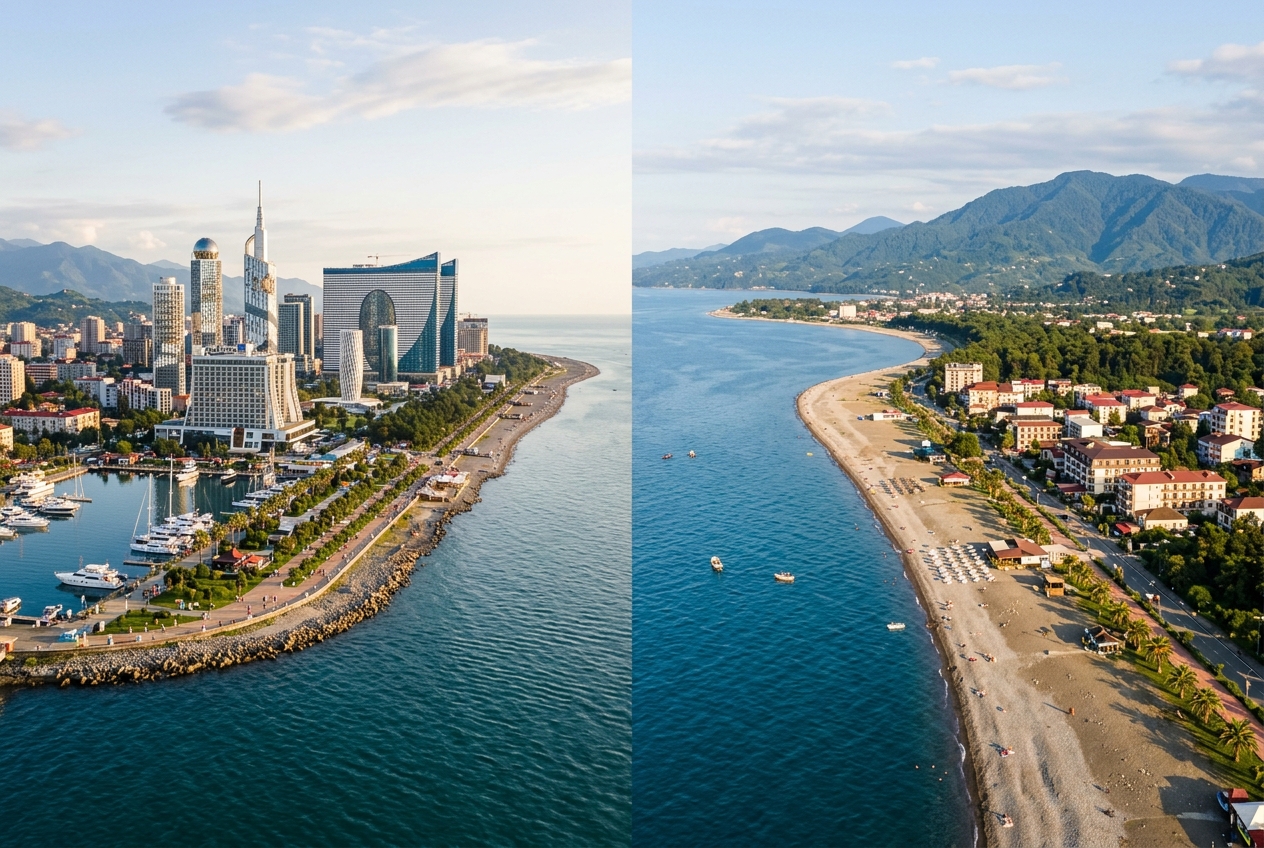
Georgia’s Black Sea coastline has become one of Europe’s most talked-about summer destinations, and for good reason. The country welcomed 7.8 million international visitors in 2025, a 6% jump from the previous year, and a huge chunk of those travelers ended up on the Adjara coast. If you’re trying to decide between Batumi and Kobuleti for your stay on the Black Sea, you’re asking the right question. These two towns sit just 20 kilometers apart, but they offer wildly different experiences. One is a neon-lit boomtown with skyscrapers and casinos; the other is a pine-scented stretch of dark sand where your biggest decision is whether to nap in a hammock or walk to the beach. I’ve spent time in both, and the honest answer is that neither is universally “better.” The right pick depends entirely on what kind of trip you’re after. Here’s everything you need to make that call.
Overview of Georgia’s Black Sea Gems
The Adjara region occupies Georgia’s southwestern corner, where subtropical humidity meets the Caucasus foothills. The coastline runs roughly 50 kilometers, and most visitors cluster around two hubs: Batumi, the regional capital, and Kobuleti, a quieter resort town to the north. Both have deep roots as vacation spots dating back to the Soviet era, but their trajectories since Georgian independence have been dramatically different. Understanding what each place actually feels like on the ground is the first step toward picking the right base.
Batumi: The Modern Metropolis
Batumi has transformed almost beyond recognition over the past 15 years. What was once a sleepy port city is now a skyline of glass towers, Ferris wheels, and architectural experiments that range from stunning to bizarre. The city welcomed over 1.6 million international visitors in 2023 alone, and those numbers keep climbing. Batumi International Airport recorded 521,325 trips in 2025, a 30.5% increase over the previous period, which tells you everything about the momentum here.
The city’s appeal is multifaceted. You get a proper European-style boulevard running along the coast, a dense cluster of restaurants serving everything from traditional Adjarian khachapuri to Japanese fusion, and a nightlife scene anchored by casinos that draw visitors from Turkey, Iran, and the Gulf states. The post-2003 generation here speaks solid English, and you’ll find that younger bartenders, hotel staff, and Bolt drivers can communicate easily. Older residents often default to Russian or Georgian, so having Google Translate’s offline Georgian pack is still useful for deeper conversations.
Batumi feels genuinely cosmopolitan in a way few cities in the Caucasus do. It’s not trying to be Dubai or Tbilisi; it has its own energy, a mix of Soviet-era charm in the old town and aggressive modernism along the waterfront. The downside? It can feel crowded and commercial during peak season, especially in July and August, when the boulevard becomes a wall of people.
Kobuleti: The Traditional Seaside Retreat
Kobuleti is a different animal entirely. This long, narrow town stretches along the coast for about 10 kilometers, and its rhythm is slower, quieter, and more traditionally Georgian. There are no skyscrapers here. Instead, you’ll find family-run guesthouses tucked behind garden walls, small cafes where the owner’s grandmother is rolling khinkali in the back, and a beach that feels genuinely spacious even in high season.
The town has been gaining serious attention from investors. Apartment sales in Kobuleti increased by almost 60% year-on-year in 2023, signaling that people are betting on this place’s future. But for now, it retains the feel of a town where the concept of “stumari ghvtisaa” (the guest is a gift from God) still governs daily interactions. Your guesthouse host will likely insist on feeding you homemade churchkhela and pouring you chacha whether you asked for it or not.
Kobuleti appeals to families, couples seeking quiet, and anyone who finds Batumi’s pace exhausting. The trade-off is fewer dining options, limited nightlife, and a town that mostly shuts down after 10 PM outside of a few seasonal bars.
Comparing Beach Quality and Atmosphere
Beach quality is often the deciding factor for coastal travelers, and these two towns deliver very different experiences at the water’s edge.
Pebbles and Promenades in Batumi
Batumi’s beach is pebbled, not sandy. These aren’t small pebbles either: think stones the size of eggs, which means you’ll want water shoes unless you enjoy a foot massage that borders on punishment. The beach runs along the boulevard for several kilometers, and it’s well-maintained with regular cleaning, lifeguard stations, and rental loungers.
The atmosphere is lively. Vendors walk the beach selling corn, beer, and sunglasses. Music drifts from nearby bars. Jet ski operators shout offers at passersby. If you want a social beach experience where people-watching is half the entertainment, Batumi delivers. The water itself is reasonably clean, though it can get murky near the port area; head south toward Gonio for the clearest swimming.
The boulevard behind the beach is arguably Batumi’s greatest asset: a 7-kilometer stretch of palm trees, cycling paths, sculptures, and cafes. Evening walks here, with the sun setting over the Black Sea and the city lights flickering on, are genuinely memorable.
Magnetic Sands and Pine Forests in Kobuleti
Kobuleti’s beach is the polar opposite. The sand here is dark, almost black, with a high iron content that locals have long claimed has therapeutic properties. Whether or not “magnetic sand” actually cures joint pain is debatable, but walking on warm, fine sand instead of punishing pebbles is undeniably more comfortable.
The beach is wide and long, backed in many stretches by pine forests that fill the air with resin. Even in August, you can find sections where you’re practically alone, something impossible in Batumi. The water tends to be a bit warmer here, and the gentle slope of the seabed makes it safer for children.
There’s less infrastructure: fewer loungers for rent, fewer vendors, and no boulevard. You bring your own towel, find a spot, and that’s it. For some travelers, this simplicity is exactly the point.
| Feature | Batumi | Kobuleti |
|---|---|---|
| Beach type | Large pebbles | Dark magnetic sand |
| Crowd level (July-Aug) | Very crowded | Moderate |
| Water shoes needed? | Yes | No |
| Beachfront infrastructure | Extensive (loungers, bars, lifeguards) | Basic |
| Best for | Social atmosphere, people-watching | Relaxation, families with kids |
Entertainment, Nightlife, and Dining
Casinos and High-End Gastronomy
Batumi is Georgia’s undisputed entertainment capital on the coast. The casino scene is a major draw: establishments like the Hilton Casino and Eclipse attract high rollers from neighboring countries where gambling is restricted. You don’t have to gamble to enjoy the energy; the casino-adjacent bars and restaurants create a lively scene that runs until dawn.
The dining options in Batumi have expanded dramatically. Beyond traditional Georgian fare, you’ll find Italian trattorias, Turkish kebab houses, sushi spots, and craft cocktail bars. Restaurants like Khinkalmania serve excellent Georgian staples at reasonable prices, while spots along Parnavaz Mepe Street cater to more international palates. A proper dinner for two with wine runs between 60 and 120 GEL (roughly $22 to $45), which remains astonishing value by European standards.
The city also hosts cultural events throughout summer: open-air concerts on the boulevard, the Batumi Music Fest, and occasional art installations. For younger travelers, the club scene centers around a handful of venues near the port, though it’s modest compared to Tbilisi’s techno underground.
Family-Friendly Parks and Local Eateries
Kobuleti’s entertainment is gentler. The town has a central park with rides and attractions aimed squarely at families: bumper cars, trampolines, and cotton candy stands. The Kobuleti Protected Areas nearby offer nature trails through wetlands that are home to rare bird species, perfect for a morning walk.
Dining in Kobuleti is almost entirely traditional Georgian. Small family-run restaurants serve Adjarian khachapuri (the boat-shaped bread filled with cheese, butter, and egg), grilled meats, and fresh Black Sea fish. Meals are cheaper than Batumi: a family of four can eat well for 50 to 70 GEL. The flip side is limited variety. If you crave sushi or a proper espresso after three days, you’ll need to marshrutka over to Batumi.
Evening entertainment usually means a walk along the beach promenade, a beer at a seasonal bar, or a family card game on the guesthouse terrace. Kobuleti doesn’t pretend to be something it’s not, and that honesty is part of its charm.
Accommodation Options and Budget Planning
Luxury Skyscrapers vs Guesthouses
Batumi’s accommodation ranges from five-star international brands (Hilton, Radisson Blu, Wyndham) to budget hostels and Airbnb apartments in newly built towers. The real estate boom here has been extraordinary: by the end of 2025, foreigners bought 52% of apartments in Batumi, many of which cycle onto short-term rental platforms during summer. This means you’ll find modern, well-equipped apartments with sea views for surprisingly reasonable nightly rates, especially if you book early.
A mid-range hotel in Batumi during July runs $50 to $90 per night. Luxury options push past $150. Budget travelers can find decent hostels for $10 to $15.
Kobuleti’s accommodation is dominated by family-run guesthouses and small hotels. These range from basic rooms with shared bathrooms (as low as $15 per night) to renovated boutique-style guesthouses with private balconies and home-cooked breakfast included for $30 to $50. The experience is more personal: your host might drive you to the market, teach you to make lobiani, or invite you to a family supra (feast) if you stay long enough.
Seasonal Pricing and Value for Money
Pricing in both towns follows a sharp seasonal curve. Peak season (mid-June through August) sees rates double or triple compared to May or September. If your schedule allows, visiting in early June or September gives you warm water, fewer crowds, and significantly lower prices.
Real estate analyst Leo Chikava from Colliers Georgia has noted that real estate prices in Georgia are expected to stabilize in 2025 due to increased supply, which could mean more rental inventory and competitive pricing for tourists in both cities going forward.
Kobuleti consistently offers better value. A week’s stay in a good guesthouse with breakfast included might cost what three nights in a Batumi hotel would. For budget-conscious travelers or families, this difference adds up fast.
| Budget Category | Batumi (per night) | Kobuleti (per night) |
|---|---|---|
| Budget | $10-25 | $10-20 |
| Mid-range | $50-90 | $25-50 |
| Luxury | $150+ | $60-80 |
| Daily food (2 people) | $20-40 | $12-25 |
Accessibility and Day Trip Potential
Both towns are connected by frequent marshrutkas (minibuses) that run every 15 to 20 minutes and cost about 2 GEL ($0.75). The ride takes 30 to 40 minutes, meaning you can easily stay in one town and visit the other for a day. Batumi is the transport hub: its airport handles direct flights from several Middle Eastern and European cities, and the train station connects to Tbilisi (a roughly 5-hour journey on the overnight service).
Kobuleti has a train station too, with direct connections to Tbilisi, though fewer daily departures. Getting around locally, Bolt works well in Batumi but coverage in Kobuleti is spottier; Yandex Go can fill the gaps.
Botanical Gardens and Mountain Escapes
The Batumi Botanical Garden, perched on a hillside about 9 kilometers north of the city center, is one of the best day trips on the coast. Founded in 1912, it spans 111 hectares and contains plant collections from nine geographic zones. The views of the coastline from the upper terraces are worth the visit alone.
From either town, you can reach the Adjarian highlands within two to three hours. The village of Khulo, accessible by a spectacular mountain road, offers a completely different Georgia: stone towers, alpine meadows, and a cable car that crosses a gorge at stomach-dropping height. Gonio Fortress, a Roman-era fortification 15 minutes south of Batumi, is another easy half-day trip.
Kobuleti has its own natural attractions. The Kintrishi Protected Areas, a river gorge with hiking trails through virgin forest, starts just 15 kilometers inland. It’s far less visited than anything near Batumi and offers genuine wilderness.
The Verdict: Choosing Your Ideal Coastal Base
The question of where to stay on the Black Sea between Batumi and Kobuleti really comes down to what you value most on vacation. Choose Batumi if you want restaurants, nightlife, cultural events, and the buzz of a city that’s growing fast and knows it. Choose Kobuleti if you want quiet beaches, authentic Georgian hospitality, lower prices, and the sound of pine trees instead of construction cranes.
My honest recommendation? If you have a week, split your time. Spend three or four nights in Kobuleti to decompress, swim in the magnetic sand, and eat homemade food until you can’t move. Then shift to Batumi for the final stretch: hit the boulevard, try the restaurants, and soak in the city’s peculiar energy. You’ll get the full spectrum of what Georgia’s coast offers, and you’ll understand why this stretch of Black Sea shoreline is pulling in millions of visitors every year.
Whichever you choose, book your accommodation early for July and August. Both towns fill up fast, and the best guesthouses in Kobuleti and the best-value apartments in Batumi disappear months in advance. Georgia’s coast rewards those who plan ahead.