
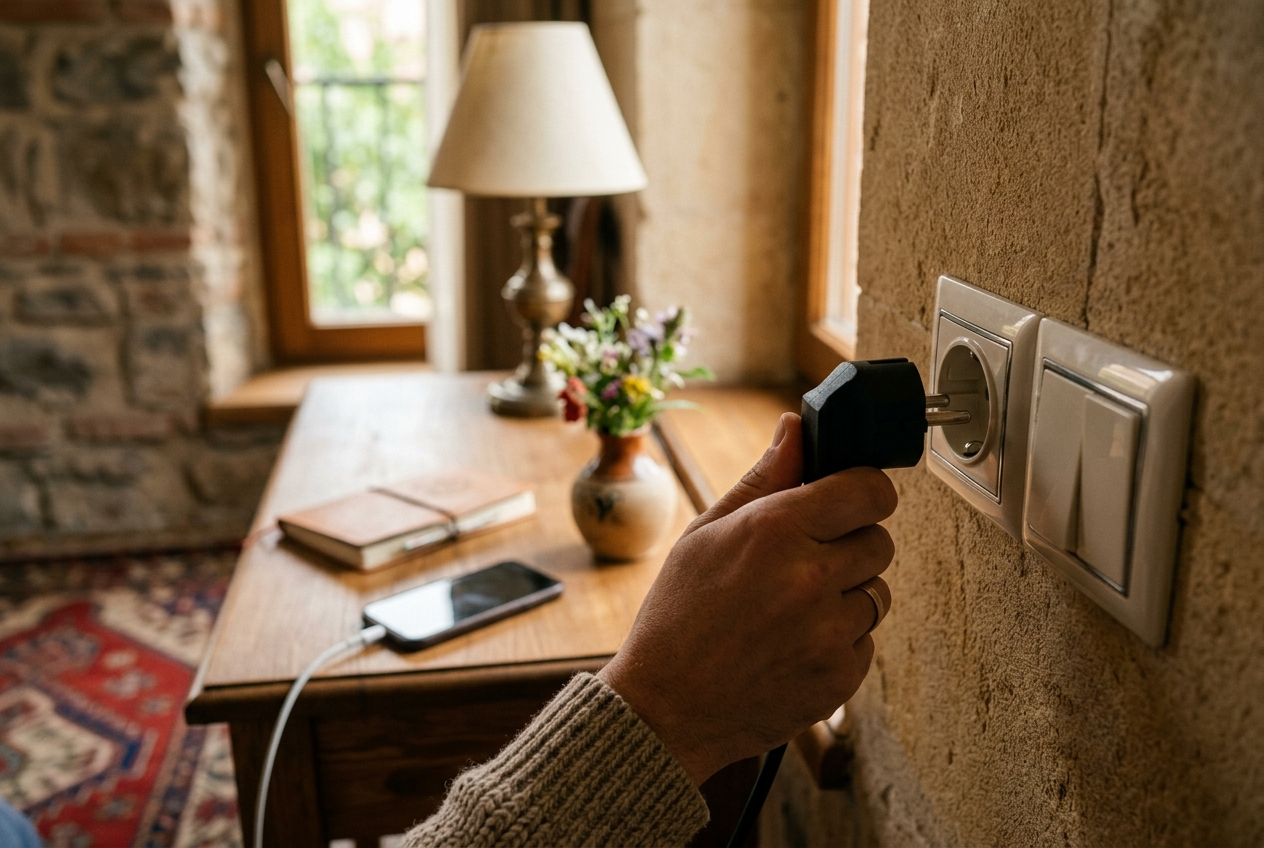
Planning a trip to the country of Georgia and wondering what plugs and power outlets you’ll encounter there? You’re not alone. This is one of those details that catches travelers off guard, usually at the worst possible moment: standing in a Tbilisi guesthouse at midnight with a dead phone and no way to charge it. Georgia, known locally as Sakartvelo, sits at the crossroads of Europe and Asia, and its electrical infrastructure reflects its European leanings. The plug types, voltage, and frequency all differ significantly from what travelers in North America, the UK, Japan, and several other regions are accustomed to. Getting this right before you leave home saves you the hassle of hunting for adapters in an unfamiliar city. I’ve seen plenty of travelers scramble through electronics shops near Rustaveli Avenue because they assumed their plugs would just work. A few minutes of preparation makes all the difference. Here’s everything you need to know about Georgia’s electrical standards, what adapters to bring, and how to keep your devices safe and charged throughout your trip.
Standard Plug Types in Georgia
Georgia’s electrical system follows the conventions common across much of continental Europe. If you’ve traveled to Germany, France, Spain, or most of Eastern Europe, you’ll find the outlets familiar. If you’re coming from the US, UK, Australia, or parts of Asia, you’ll need an adapter. There’s no way around it.
The country officially uses Type C and Type F plugs as its standards. Both feature round pins, but they differ in important ways, especially around grounding. Understanding the distinction matters because it affects which of your devices you can safely plug in and whether you need just an adapter or a full converter.
Type C: The Standard European Plug
Type C is the classic two-round-pin European plug you’ve probably seen before. It’s sometimes called the “Europlug,” and it fits into a wide range of European-style outlets. The pins are 4.0 mm in diameter and spaced 19 mm apart. There’s no grounding pin or clip, which is precisely why Type C is gradually being phased out for new installations.
You’ll still encounter Type C outlets in older buildings, guesthouses, and rural homes across Georgia. Many budget accommodations in places like Mestia or Sighnaghi haven’t been rewired recently, so Type C sockets remain common. They work fine for low-power devices: phone chargers, camera battery chargers, electric shavers, and similar small electronics.
The critical limitation is the lack of grounding. Type C sockets are generally not permitted for new installations because they don’t provide an earth connection. This means they’re not ideal for high-power appliances like hair dryers or laptops with three-prong plugs. For charging your phone or tablet, though, they work perfectly well.
Type F: Grounded Schuko Outlets
Type F is the more modern and widely installed outlet type in Georgia. Also known as the “Schuko” plug (short for Schutzkontakt, the German word for “protective contact”), it’s the standard across much of Europe. Type F plugs have two round pins and two earth clips on the side, providing the grounding that Type C lacks.
In newer hotels, apartments, and renovated buildings throughout Tbilisi, Batumi, and Kutaisi, you’ll almost exclusively find Type F outlets. These sockets accept both Type C and Type F plugs, so if you have a European adapter with two round pins, it’ll fit into either outlet type.
The grounding feature of Type F matters for safety, especially with higher-wattage devices. If you’re plugging in a laptop, a portable heater, or any appliance with a metal casing, the earth connection helps prevent electric shock. For most travelers, the practical takeaway is simple: buy an adapter that works with Type F sockets, and you’ll be covered for both outlet types in Georgia.
| Feature | Type C | Type F |
|---|---|---|
| Pin shape | Two round pins | Two round pins + side earth clips |
| Grounded | No | Yes |
| Common in | Older buildings, rural areas | New construction, hotels, cities |
| Best for | Low-power devices (chargers, shavers) | All devices, including high-wattage |
| Still installed new? | No | Yes |
Voltage and Frequency Specifications
Getting the right plug shape is only half the equation. Voltage and frequency determine whether your devices will actually function correctly, or whether you’ll fry them. Georgia’s electrical standards are consistent with the European norm, but they differ sharply from what’s used in North America and parts of Asia.
The 220V Standard Explained
The standard voltage in Georgia is 220V, which is typical for European countries. For comparison, the United States and Canada run on 120V, while Japan uses 100V. This voltage difference is the one that can actually damage your electronics if you’re not careful.
Here’s the good news: most modern electronics are built to handle a range of voltages. Flip over your phone charger, laptop power brick, or camera charger and look at the fine print. You’ll usually see something like “Input: 100-240V, 50/60Hz.” That label means the device can handle Georgia’s 220V supply without any issues. You just need the right plug adapter to physically fit into the outlet.
The bad news comes with single-voltage devices. Older American hair dryers, curling irons, and some small kitchen appliances are often rated at 120V only. Plug a 120V-only hair dryer into a 220V Georgian outlet, and you’ll get a brief, dramatic display of sparks and smoke before the device dies. I’ve personally witnessed this happen at a guesthouse in Kazbegi, and the smell of burnt plastic lingered for hours.
Managing Frequency Differences (50Hz)
Georgia operates at 50Hz, the standard frequency across Europe. The US and Canada use 60Hz. For most travelers, this difference is irrelevant. Your phone charger, laptop, and camera don’t care about the difference between 50Hz and 60Hz.
Where frequency matters is with devices that rely on precise timing from the electrical cycle. Old analog clocks that plug into the wall will run slower on 50Hz than they would on 60Hz. Certain turntables and older audio equipment can also behave differently. But unless you’re traveling with vinyl records and a turntable (and honestly, some travelers to Tbilisi’s music scene might be), this won’t affect you.
The practical rule is straightforward: if your device says “50/60Hz” on the label, you’re fine. If it says “60Hz only,” leave it at home or bring a frequency converter, which is expensive and heavy. Almost no modern consumer electronics are frequency-sensitive, so this is a non-issue for 99% of travelers.
Determining if You Need a Power Converter
This is where confusion usually sets in. An adapter changes the physical shape of your plug so it fits into a Georgian outlet. A converter (or transformer) actually changes the voltage from 220V to 120V (or vice versa). Most people need an adapter. Far fewer need a converter.
Checking for Dual-Voltage Devices
Before you spend money on a voltage converter, check every device you plan to bring. The label is usually on the power brick, the bottom of the device, or near the plug prongs. You’re looking for the input voltage range.
Many US appliances are dual voltage and will be marked “100-240V,” meaning they do not require a voltage converter. This includes virtually all modern smartphones, tablets, laptops, e-readers, and most camera chargers. The power brick handles the voltage conversion internally. All you need is a plug adapter.
Here’s a quick checklist for what’s almost always dual-voltage:
- iPhone, Android, and other smartphone chargers
- Laptop power supplies (Dell, Apple, Lenovo, HP, etc.)
- USB charging hubs and power banks (they charge via USB anyway)
- Electric toothbrushes (most Oral-B and Sonicare models)
- DSLR and mirrorless camera battery chargers
- Kindle and tablet chargers
If every device you’re bringing falls into the dual-voltage category, you can skip the converter entirely and just pack an adapter.
Risks of Using High-Wattage Appliances
Single-voltage devices rated at 120V are the ones that cause problems. Hair dryers, flat irons, curling irons, and some electric razors from North American brands are common culprits. These devices draw significant wattage and are often built for 120V only.
Plugging a 120V, 1800-watt hair dryer into a 220V outlet doesn’t just break the dryer. It can trip the circuit breaker in your hotel room, potentially damage the outlet, and in rare cases cause a small fire. The risk isn’t theoretical: it happens regularly in hotels worldwide.
Your options are to buy a travel-sized dual-voltage hair dryer before your trip (they’re inexpensive and widely available), ask your hotel if they provide one (most mid-range and upscale hotels in Tbilisi do), or purchase a heavy-duty voltage converter rated for high wattage. That last option is the least practical because converters for 1500+ watt appliances are bulky, heavy, and expensive. A $25 dual-voltage travel hair dryer is a much better investment.
Travel Adapter Recommendations for Georgia
Knowing what outlets Georgia uses is the foundation. Choosing the right adapter is the practical step that ensures you actually stay connected during your trip.
Universal vs. Region-Specific Adapters
You have two main options: a universal travel adapter that works in multiple countries, or a region-specific adapter designed for European Type C/F outlets.
Universal adapters are the Swiss Army knife approach. Brands like Ceptics, EPICKA, and TESSAN make compact all-in-one adapters with sliding prongs that adjust for outlets in Europe, the UK, Australia, and Asia. These typically cost between $15 and $30 and include USB-A and USB-C ports for charging multiple devices simultaneously. The downside is that they’re bulkier than a simple European adapter, and the sliding mechanisms can feel flimsy after heavy use.
Region-specific adapters are smaller, cheaper, and more reliable for a single destination. A simple US-to-Europe adapter costs $5-10, fits in your pocket, and does exactly one thing well. If Georgia is your only destination, this is the smarter choice. If you’re combining Georgia with trips to the UK or Asia, go universal.
One thing to watch: some cheap universal adapters don’t properly accommodate the grounding clips on Type F outlets. The plug might fit loosely and fall out, which is annoying and potentially dangerous with high-draw devices. Stick with reputable brands and read reviews before buying.
Where to Buy Adapters in Tbilisi and Beyond
Forgot your adapter? Don’t panic. Tbilisi has plenty of options. The Tbilisi Mall and East Point shopping centers both have electronics stores that stock adapters. Small electronics shops along Rustaveli Avenue and near the Dry Bridge Market also carry them, though selection varies.
In my experience, the most reliable spots are the dedicated electronics retailers in shopping malls. Prices are reasonable, usually 10-20 GEL (roughly $4-8 USD) for a basic adapter. You can also try the small shops near Tbilisi’s main train station, which cater to travelers.
Outside the capital, your options shrink considerably. Batumi has a few electronics stores near the boulevard, and Kutaisi has some options near the central market. But in smaller towns like Mestia, Stepantsminda, or Telavi, finding an adapter can be genuinely difficult. Rural guesthouses sometimes have a spare adapter they’ll lend you, but counting on that is risky. Buy your adapter before you leave Tbilisi, or better yet, before you leave home.
For travelers arriving from the United States, it’s worth remembering that American plugs are Type A and B, which are completely incompatible with Georgian outlets. There’s no partial fit or workaround. You absolutely need an adapter.
Practical Tips for Staying Charged While Traveling
Beyond adapters and voltage, a few practical habits will keep your devices running throughout your Georgia trip.
Carry a portable power bank rated at 10,000-20,000 mAh. Georgia’s public transportation, particularly marshrutkas (minibuses) on longer routes, rarely has USB charging ports. A power bank lets you use Google Maps, translate Georgian script with Google Translate’s camera feature, and still have battery left for photos at Gergeti Trinity Church. Charge the power bank overnight at your hotel, and you’re set for a full day of exploration.
Bring at least two adapters if you’re traveling with a partner or have multiple devices. Hotel rooms in Georgia, especially in older buildings and guesthouses, often have limited outlet availability. Having two adapters means you can charge your phone and laptop simultaneously without playing musical chairs with the single outlet behind the nightstand.
A short extension cord or power strip from home can be surprisingly useful. Plug your adapter into the Georgian outlet, then plug your home-country power strip into the adapter. Suddenly you have multiple familiar outlets available. This trick works well in guesthouses where the only outlet is inconveniently located across the room from the bed.
Download offline maps and language packs before you arrive. If your phone dies in a remote area like Tusheti or upper Svaneti, you won’t find a charging station. Having offline resources means a low battery is an inconvenience rather than a crisis. Apps like Maps.me work entirely offline and are popular among travelers in Georgia’s mountain regions.
If you’re staying in Airbnbs or guesthouses, message your host ahead of time and ask about outlet types and availability. Some older Tbilisi apartments have been partially rewired, meaning you might find a mix of Type C and Type F outlets in different rooms. Knowing this in advance helps you pack appropriately.
Georgia’s power grid is generally stable in cities, but rural areas can experience occasional outages, particularly during winter storms in mountainous regions. A small flashlight or headlamp is worth packing alongside your electrical gear. It won’t help charge your phone, but it’ll keep you from stumbling around a pitch-dark guesthouse in Ushguli.
The bottom line on power and plugs in Georgia is refreshingly simple. Pack a Type C/F adapter (or a universal one), verify your devices are dual-voltage, skip the heavy converter, and bring a power bank. With those four steps handled before departure, you won’t waste a single minute of your trip worrying about electricity. Spend that time instead on what Georgia does best: extraordinary food, ancient wine traditions, and some of the most dramatic mountain scenery in all of Europe.