
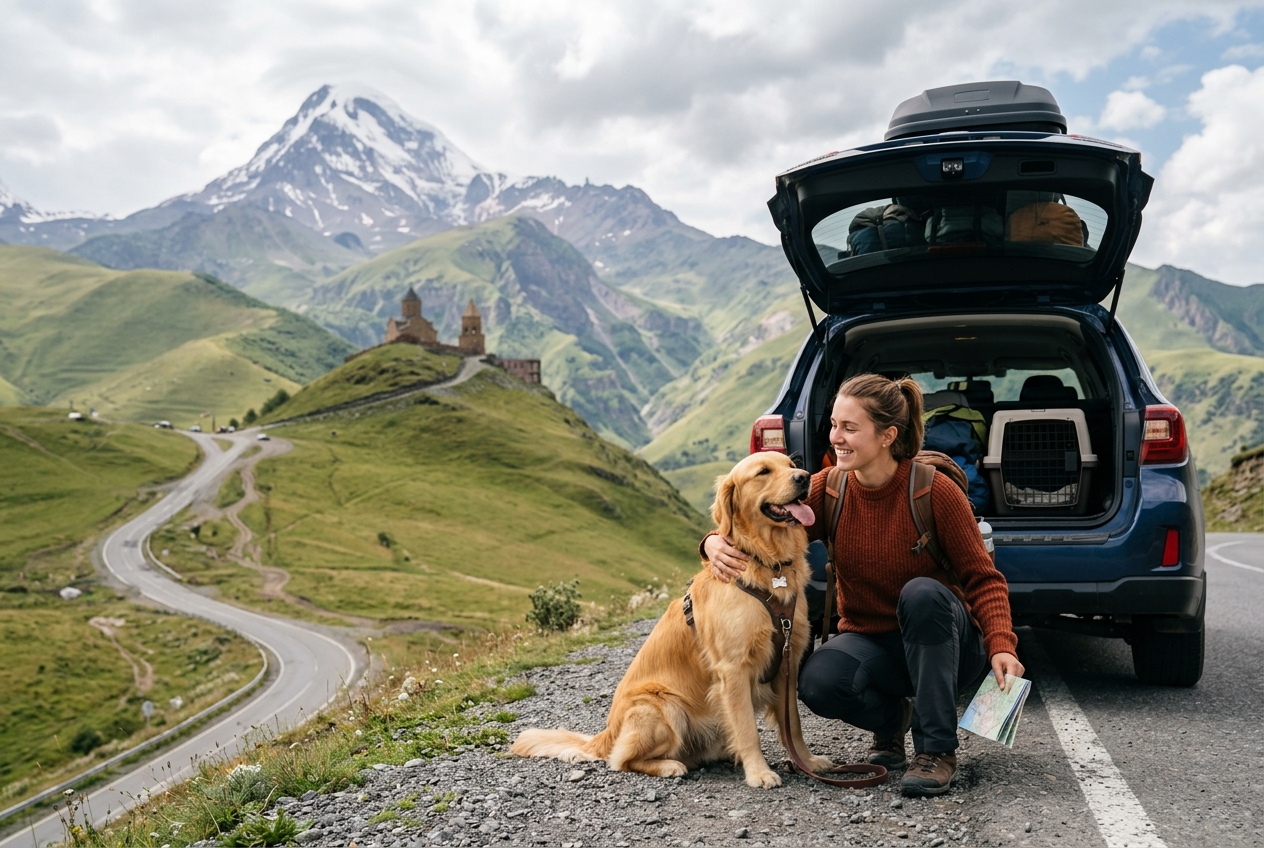
Georgia, the small Caucasus nation wedged between Europe and Asia, has become one of the most popular destinations for digital nomads, long-term travelers, and expats over the past few years. Tbilisi’s charm, Batumi’s Black Sea coastline, and the country’s famously generous hospitality culture – rooted in the old Georgian saying “stumari ghvtisaa” (a guest is a gift from God) – make it incredibly appealing. But if you’re planning to bring your four-legged companion along, the logistics require some homework. Figuring out how to travel with a dog or cat to Georgia isn’t overly complicated compared to places like Australia or Japan, but there are specific vaccination, documentation, and transport steps you can’t afford to skip. I’ve seen travelers get turned away or delayed at borders because they assumed the process was simple enough to wing. This guide covers everything: entry requirements, border procedures, transport options, pet-friendly life on the ground, and what to expect when you eventually leave. Whether you’re relocating permanently or passing through on a longer journey, the details here should save you real headaches.
Essential Entry Requirements for Pets in Georgia
The Republic of Georgia is relatively welcoming to pet owners, but “relatively” still means paperwork. The country caps non-commercial pet movement at no more than 5 pets per traveler, so if you’re traveling with a small menagerie, you’ll need to look into commercial import procedures instead. For most people bringing one or two animals, though, the process is straightforward once you know the specific requirements.
Microchipping and Identification Standards
Every pet entering Georgia needs a microchip, and it must be an ISO 11784/11785 compliant 15-digit chip. This is the same standard used across the EU, so if your pet was chipped in Europe, North America, or most of Asia, you’re likely already covered. The chip must be implanted before any vaccinations are administered, because the microchip number is what links your pet to their medical records. If your pet was vaccinated before being chipped, some countries (and Georgia can be inconsistent here) may not recognize those vaccinations as valid.
As one veterinary resource puts it, it’s always best to have your dog microchipped in case they go missing at any point along your trip. This is especially true in Georgia, where stray dogs are common and your pet could wander off in an unfamiliar environment. Bring your own microchip scanner or confirm that the chip is readable before departure – I’ve heard of cases where chips migrated under the skin and couldn’t be detected at the border.
Mandatory Vaccinations and Health Certificates
Vaccination requirements differ depending on whether you’re bringing a dog or a cat. Dogs must be vaccinated against distemper, hepatitis, leptospirosis, parvovirus, and parainfluenza before entering the country. Cats need proof of vaccination against feline viral rhinotracheitis, panleukopenia, and feline leukemia. Both dogs and cats must have a current rabies vaccination, administered at least 21 days before arrival but no more than 12 months prior.
You’ll also need a veterinary health certificate issued within 10 days of travel. In the US, this is the USDA-endorsed APHIS Form 7001. In EU countries, it’s the EU pet passport or an Annex IV certificate. The health certificate confirms that your pet is clinically healthy and free of infectious diseases. Don’t leave this to the last minute: USDA endorsement alone can take 2-5 business days if done by mail.
| Requirement | Dogs | Cats |
|---|---|---|
| Microchip | ISO 11784/11785 | ISO 11784/11785 |
| Rabies vaccine | 21 days – 12 months before travel | 21 days – 12 months before travel |
| Core vaccines | Distemper, hepatitis, leptospirosis, parvovirus, parainfluenza | Rhinotracheitis, panleukopenia, feline leukemia |
| Health certificate | Within 10 days of travel | Within 10 days of travel |
| Max pets per person | 5 (non-commercial) | 5 (non-commercial) |
Rabies Titer Test Requirements for Specific Countries
If you’re arriving from a country not listed as rabies-free or rabies-controlled, Georgian authorities may request a rabies antibody titer test. This blood test, conducted at an approved laboratory, must show a result of at least 0.5 IU/ml. The test needs to be done at least 30 days after vaccination and at least 3 months before arrival, so plan accordingly.
Travelers from the US, EU, UK, and most developed nations typically don’t face this requirement, but if you’re coming from parts of Southeast Asia, Africa, or certain Middle Eastern countries, the titer test is non-negotiable. The test itself costs around $50-$150 depending on the lab. Kansas State University’s Rabies Laboratory and the ANSES lab in France are two of the most commonly used facilities worldwide. Keep the original lab results with your travel documents – photocopies may not be accepted.
Navigating Customs and Border Control
Required Documentation for Airport Arrival
Tbilisi International Airport (TBS) is where most international travelers arrive, though Kutaisi (KUT) and Batumi (BUS) also handle international flights. At customs, you’ll present your pet’s microchip documentation, vaccination records, and health certificate. Georgian border officials will scan the microchip to verify it matches your paperwork. In my experience, the process at Tbilisi is relatively quick – usually 15-30 minutes if your documents are in order.
One thing that catches people off guard: Georgia doesn’t have a formal pet quarantine for most arrivals, which is a huge relief compared to countries that hold animals for weeks. However, if your paperwork is incomplete or your pet appears ill, officials have the authority to quarantine your animal or deny entry entirely. Have all documents organized in a single folder. Print physical copies of everything, even if you have digital backups. Airport Wi-Fi in Tbilisi is decent but not something you want to rely on during a border inspection.
Land Border Crossings with Pets
Many travelers enter Georgia overland from Turkey (Sarpi or Vale crossings), Armenia (Sadakhlo or Bavra), or Azerbaijan (Red Bridge). Land crossings tend to be less formal than airports, but the documentation requirements are identical. The Sarpi crossing from Turkey is particularly popular with road-trippers and van-lifers, and border guards there are accustomed to seeing pets.
Expect the process to take a bit longer at land borders, especially during summer when tourist traffic peaks. I’ve spoken with travelers who breezed through in 10 minutes and others who waited over an hour while officials consulted with veterinary inspectors by phone. If you’re driving, make sure your pet has water and ventilation during any wait. Temperatures at the Turkish and Armenian borders can exceed 35°C in July and August.
Choosing the Best Transport Method
Airline Policies and In-Cabin vs. Cargo Travel
Airline pet policies vary wildly, and this is where your planning really needs to be specific. Turkish Airlines, one of the most common carriers to Tbilisi, allows small pets (under 8 kg including carrier) in the cabin on most routes. Larger animals travel in the pressurized cargo hold. Wizz Air, which operates budget flights to Kutaisi, does not allow pets at all except for service animals – a detail that has ruined more than a few travel plans.
Georgian Airways and FlyDubai both permit in-cabin pets on certain routes, but policies change seasonally. Always call the airline directly rather than relying on website information, which can be outdated. Cargo travel typically costs between $200 and $500 depending on the route and animal size. Book your pet’s spot at least two weeks in advance, as most airlines limit the number of animals per flight to one or two in the cabin and a handful in cargo.
For in-cabin travel, your carrier must fit under the seat in front of you (typically max dimensions of 45 x 35 x 25 cm). Soft-sided carriers are easier to squeeze into tight spaces. Sedate your pet only on veterinary advice – most airlines actually prohibit sedated animals because it increases health risks at altitude.
Pet-Friendly Transit via Train and Public Transport
Once you’re in Georgia, getting around with a pet is surprisingly manageable. Georgian Railways allows small pets on trains if they’re in a carrier, and larger dogs can travel in designated areas on some routes. The overnight train from Tbilisi to Batumi (about 5 hours) is a popular option, and I’ve seen travelers with dogs in both first-class compartments and general seating without issues.
Tbilisi’s metro officially prohibits animals except service dogs, but enforcement is inconsistent. Marshrutkas (minibuses) are a gamble: the driver decides, and a large dog will almost certainly be refused. Your best bet for urban transport is Bolt or Yandex Go, both of which operate in Tbilisi and Batumi. Select the “pet-friendly” option if available, or message the driver before they arrive. Most Georgian taxi drivers are pragmatic about it, especially for small dogs and cats in carriers.
Finding Pet-Friendly Accommodation and Services
Top Pet-Friendly Cities: Tbilisi and Batumi
Tbilisi is hands-down the best city in Georgia for pet owners. The Vake and Saburtalo neighborhoods have wide sidewalks, green spaces, and a concentration of pet-friendly cafés and restaurants. Vake Park is essentially an unofficial dog park, with locals bringing their dogs off-leash in the early mornings and evenings. Many Airbnb hosts in Tbilisi accept pets, though you should always confirm in advance and expect a small cleaning fee.
Batumi, the coastal city, is more seasonal but equally accommodating during the summer months. The Batumi Boulevard promenade is a great spot for evening walks with your dog, and several beachfront restaurants welcome well-behaved pets on their terraces. Outside these two cities, pet-friendliness drops off significantly. Rural guesthouses may welcome your animal, but don’t assume – Georgian hospitality is generous toward humans, but attitudes toward indoor pets vary in traditional households.
Veterinary Clinics and Emergency Care in Georgia
Tbilisi has several well-equipped veterinary clinics, including Vet House and the Georgian Veterinary Clinic, both of which have English-speaking staff and modern diagnostic equipment. A standard vet consultation costs between 30-60 GEL (roughly $10-$22), which is remarkably affordable compared to Western prices. Emergency care is available, though after-hours services are limited outside Tbilisi.
Stock up on any prescription medications your pet needs before arriving, as specific brands may not be available locally. Basic supplies like quality pet food (Royal Canin, Hills, Purina) are sold at Goodwill and Carrefour supermarkets in Tbilisi and Batumi. Specialty pet stores exist but are concentrated in the capital. If you’re heading to rural areas like Svaneti or Tusheti, bring everything your pet will need – veterinary services in mountain villages are essentially nonexistent.
Local Pet Culture and Safety Considerations
Managing Interactions with Georgia’s Street Dogs
Georgia has a large population of free-roaming dogs, particularly in Tbilisi, where the city runs a trap-neuter-vaccinate-return (TNVR) program. Most street dogs are tagged with yellow ear clips indicating they’ve been vaccinated and sterilized. They’re generally docile and well-fed by locals, but they’re still semi-wild animals with territorial instincts.
Keep your pet leashed in areas with high concentrations of street dogs, especially near markets, parks, and construction sites where strays tend to gather. Dog-on-dog aggression is the primary risk, particularly if your pet is unneutered. Nighttime encounters can be more unpredictable, as street dogs form packs after dark and may react defensively. Carry a walking stick or umbrella if you’re walking in less-trafficked areas at night – not to use aggressively, but as a visual deterrent.
Leash Laws and Public Space Etiquette
Georgia doesn’t have strict, nationally enforced leash laws, but Tbilisi municipality requires dogs to be leashed in public spaces. Enforcement is minimal, and you’ll see plenty of locals walking dogs off-leash. That said, keeping your dog leashed is both courteous and safe, especially given the street dog population and busy traffic patterns. Georgian drivers are not particularly attentive to animals near roads.
Picking up after your dog is expected in central Tbilisi and Batumi but rarely practiced elsewhere. Carry your own bags – waste stations are almost nonexistent. In restaurants and cafés, outdoor seating areas are generally fine for pets, but ask before entering indoor spaces. Georgians are culturally warm toward animals, and you’ll likely receive more smiles than complaints, but respect for shared spaces goes a long way.
Preparing for Your Departure from Georgia
Leaving Georgia with your pet requires just as much preparation as arriving, and this is where people often get caught off guard. Your destination country’s import requirements are what matter now, and they may be significantly stricter than Georgia’s. If you’re heading to an EU country, for example, you’ll need an EU-format health certificate issued by an authorized Georgian veterinarian, plus a valid rabies titer test result if Georgia isn’t on the EU’s list of approved third countries.
Visit a vet in Tbilisi at least two weeks before departure to get an updated health certificate and confirm all vaccinations are current. If you need a titer test and don’t already have one, the 3-month waiting period means you need to plan this months in advance. The National Food Agency of Georgia (NFA) can endorse veterinary documents for export, but their office hours and processing times are unpredictable – don’t leave this for your last day.
Bringing a pet to Georgia is genuinely doable with the right preparation. The country’s entry requirements are moderate, veterinary care is affordable, and the culture is generally welcoming toward animals. The biggest mistakes I see travelers make are underestimating documentation timelines and failing to research their onward destination’s rules while still in Georgia. Start your paperwork early, keep physical copies of everything, and build in buffer days for bureaucratic delays. Your pet will thank you for the extra effort – and honestly, few places reward that effort quite like Georgia does.