
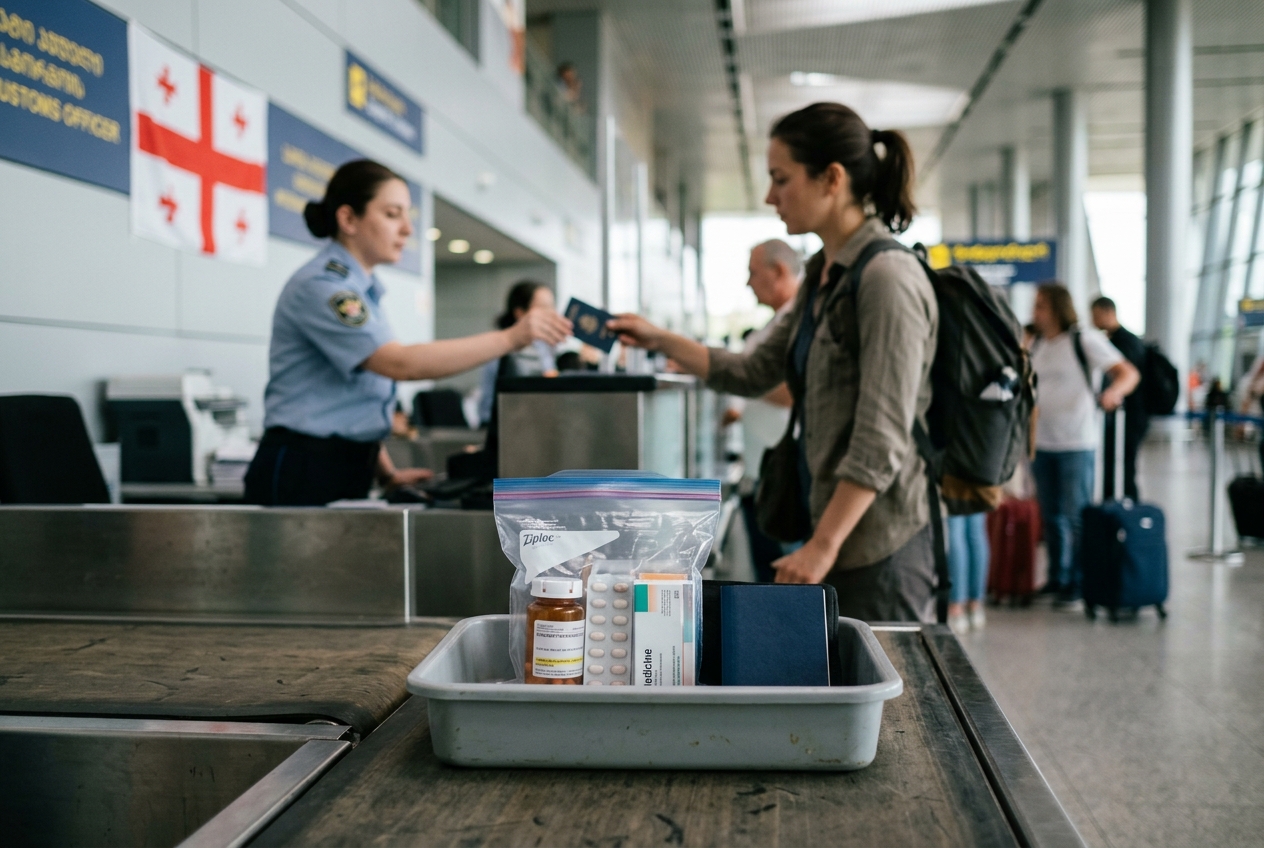
Traveling to Georgia with prescription medications can feel like stepping into a bureaucratic maze, especially if you rely on daily drugs for chronic conditions. The country – known locally as Sakartvelo – has specific customs rules about what you can and can’t bring across its borders, and the consequences for getting it wrong range from confiscation to criminal charges. I’ve seen travelers arrive at Tbilisi International Airport completely unprepared, clutching unlabeled pill bottles and zero documentation, only to face stressful encounters with customs officers. The good news is that Georgia’s medication import rules are straightforward once you understand them. The not-so-good news is that the rules differ significantly depending on whether your medication contains controlled substances, how much you’re carrying, and whether you have the right paperwork. This guide breaks down everything you need to know about bringing medications into Georgia, from quantity limits and required documents to what happens if customs flags your bag. One more thing worth flagging early: as of January 1, 2026, all visitors entering Georgia must have valid health or accident insurance for the duration of their stay, which adds another layer of preparation to your pre-trip checklist.
General Rules for Importing Personal Medications to Georgia
Georgia allows travelers to bring personal medications into the country, but there are clear boundaries. The general principle is simple: if it’s a common over-the-counter drug or a standard prescription medication that doesn’t contain narcotic or psychotropic ingredients, you’re unlikely to face any issues, provided you carry a reasonable amount and keep it in its original packaging. The system is designed to separate personal medical needs from commercial importation or drug trafficking, so the rules focus on quantity, packaging, and documentation.

For most travelers carrying blood pressure pills, allergy medications, or antibiotics, crossing the Georgian border is uneventful. Customs officers are primarily looking for red flags: large quantities, loose pills without labels, or substances that fall under Georgia’s controlled drug lists. If your medication doesn’t raise any of those flags, you’ll pass through without a second glance.
Standard Quantity Limits for Over-the-Counter Drugs
There’s no hard cap on common OTC medications like ibuprofen, acetaminophen, or antihistamines, but “reasonable personal use” is the guiding principle. In practice, this means carrying what you’d realistically need for your trip, not a suitcase full of cold medicine.
Where things get specific is the 10-package threshold. If you’re carrying more than 10 packages of any single medication, you’ll need a valid prescription, a doctor’s note confirming your diagnosis and treatment plan, and dosage details. This rule applies even to non-controlled drugs. So if you’re on a long trip and packed 12 boxes of a particular vitamin supplement or OTC pain reliever, bring documentation to back it up.
A practical tip: count your packages before you travel. “Package” in this context means the individual box or bottle as sold, not each blister strip inside. If you’re close to the limit, it’s worth getting a brief doctor’s letter just in case.
Packaging and Labeling Requirements
Keep every medication in its original retail packaging with the pharmacy label intact. This is the single most important practical step you can take. Customs officers need to be able to identify what a substance is, and a labeled box with the active ingredient printed on it does that job instantly.
If you use a weekly pill organizer, that’s fine for daily convenience, but also pack the original boxes in your luggage. Loose pills in a Ziploc bag are a recipe for delays. The officer has no way to verify what those tablets contain without lab testing, and you don’t want to be the person holding up the customs line while they figure it out.
For medications prescribed in languages other than Georgian, English, or Russian, consider getting a translated label or carrying a pharmacist’s printout listing the generic (international nonproprietary) name of each drug. Georgian customs officers often read English and Russian, but not necessarily French, Japanese, or Arabic pharmaceutical labels.
Strict Regulations for Narcotic and Psychotropic Substances
This is where Georgia’s customs rules get serious. The country takes a hard line on narcotics and psychotropic substances, and the margin for error is essentially zero. Georgia’s drug laws are notably strict compared to many Western European countries, and what might be a routine prescription in the U.S. or Germany could be classified as a controlled or even prohibited substance in Georgia.
If your medication contains any narcotic or psychotropic active ingredient, you need to research its legal status in Georgia before you board your flight. Not after. Before.
The List of Prohibited and Restricted Active Ingredients
Georgia maintains a formal list of narcotic and psychotropic substances regulated under national law, which aligns broadly with UN conventions but includes some country-specific classifications. Common medications that fall under controlled categories include:
- Opioid painkillers (codeine, tramadol, morphine, oxycodone)
- Benzodiazepines (diazepam, alprazolam, clonazepam)
- Stimulants used for ADHD (methylphenidate, amphetamine salts)
- Certain sleep medications (zolpidem)
- Some anti-anxiety medications
The critical distinction is between restricted and prohibited. Restricted substances can be brought in with proper documentation. Prohibited substances cannot be imported under any circumstances, regardless of your prescription. Methadone, for instance, falls into a complicated category. If your medication contains an active ingredient that’s outright banned in Georgia, you’ll need to consult your doctor about alternatives before traveling.
The safest approach is to check with the Georgian embassy or consulate in your country before departure. The Georgian Consulate in New York provides specific guidance on bringing medications into the country and can clarify the status of your particular drug.
Maximum Supply Limits for Controlled Medications
For controlled substances that are permitted, there’s a hard limit: you can bring up to a 31-day supply of medications containing psychotropic or narcotic substances for personal use, provided the substance isn’t prohibited under Georgian law and you have the correct documentation.
This 31-day cap is non-negotiable. If you’re planning a longer stay in Georgia, you’ll need to arrange for a local physician to issue a Georgian prescription, or coordinate with your home doctor to have additional supply shipped through proper channels, which is complicated and not guaranteed to work.
| Medication Type | Quantity Limit | Documentation Required |
|---|---|---|
| OTC drugs (non-controlled) | Reasonable personal use (up to 10 packages without documentation) | None if under 10 packages |
| Non-controlled prescription drugs | Over 10 packages triggers documentation requirement | Prescription + doctor’s note if over 10 packages |
| Controlled substances (permitted) | Maximum 31-day supply | Prescription, doctor’s certificate, notarized translation |
| Prohibited substances | Not allowed | No documentation will permit entry |
Mandatory Documentation for Travelers
Having the right paperwork is the difference between a smooth border crossing and a very bad day. Georgia’s documentation requirements are specific, and customs officers do check, particularly for controlled substances. I’ve heard from travelers who assumed a simple prescription printout from their home pharmacy would suffice. It won’t, at least not for controlled medications.
Prescription Requirements and Notarized Translations
For controlled medications, you need three things at minimum: a valid prescription from your licensed physician, a doctor’s certificate confirming your diagnosis and the medical necessity of the medication, and dosage details specifying how much you take and how often.
Here’s the part many travelers miss: if any of these documents are in a language other than Georgian or English, they must be translated and notarized. A notarized translation means a certified translator has rendered the document into Georgian (or English), and a notary has verified the translation’s authenticity. This isn’t something you can do at the airport. Plan for it weeks before your trip.
Russian-language documents are generally understood by Georgian customs officials, especially those from the older, Soviet-educated generation, but don’t rely on this. Official policy requires Georgian or English, and the officer processing your entry may not accept Russian documentation.
For travelers from EU countries, an INCB (International Narcotics Control Board) travel certificate or a Schengen medical certificate can serve as supporting documentation, though Georgia isn’t bound to accept them. Bring them anyway as supplementary evidence of legitimacy.
The Role of the Health Certificate (Form No. IV-100/a)
Georgia has a specific medical form – the Health Certificate, Form No. IV-100/a – that serves as official authorization for importing controlled medications. This form is issued by Georgian health authorities and confirms that the traveler has legitimate medical need for the controlled substance they’re carrying.
Getting this form as a foreign tourist is tricky. It’s primarily designed for Georgian citizens or residents traveling abroad and returning with medications. For incoming tourists, the combination of a valid prescription, doctor’s certificate, and notarized translation typically fulfills the requirement. However, if you’re on a particularly sensitive medication or carrying amounts near the 31-day limit, contacting the Georgian Ministry of Health before your trip to inquire about obtaining this form can provide an extra layer of protection.
The practical reality is that most tourists with standard documentation (prescription, doctor’s letter, original packaging) pass through customs without being asked for Form IV-100/a specifically. But knowing it exists, and understanding its purpose, puts you in a stronger position if questions arise.
Navigating Georgian Customs at the Border
The physical process of clearing customs in Georgia is relatively modern and efficient, especially at Tbilisi’s Shota Rustaveli International Airport. The system uses a dual-channel approach familiar to anyone who’s traveled internationally, but the specifics of what triggers a declaration matter.
Red Channel vs. Green Channel Declarations
Georgia’s customs operates on the standard Red Channel/Green Channel system. The Green Channel is for travelers with nothing to declare: no goods over duty-free limits, no large amounts of cash, and no restricted items. The Red Channel is for everyone else.
You must use the Red Channel if you’re carrying restricted medications, items exceeding duty-free limits, or large amounts of cash. For cash specifically, the threshold is 30,000 GEL, approximately $11,000 USD, above which you must declare.
If you’re carrying controlled medications with proper documentation, go through the Red Channel. Yes, it takes longer. Yes, it might feel intimidating. But voluntarily declaring your medications signals good faith and dramatically reduces the risk of problems. Walking through the Green Channel with controlled substances, even properly documented ones, and then being stopped for a random check looks far worse than proactively declaring.
At land border crossings like Sadakhlo (from Armenia) or Kazbegi/Larsi (from Russia), the process is similar but can be less structured. Have your documents easily accessible, not buried in your checked luggage.
Consequences of Non-Compliance and Illegal Importation
Georgia does not treat medication violations lightly. The consequences depend on the substance and the circumstances, but they escalate quickly.
For carrying controlled medications without proper documentation, you can expect confiscation of the medication at minimum. This alone can be a medical emergency if you depend on the drug daily. Beyond confiscation, you may face fines, detention for questioning, or in serious cases, criminal charges under Georgia’s strict narcotics laws.
Importing prohibited substances carries criminal penalties regardless of whether you have a prescription from your home country. Georgian law doesn’t recognize foreign prescriptions for banned substances. Penalties can include imprisonment, and Georgia’s legal system doesn’t always move quickly for foreigners caught in drug-related cases.
Even an honest mistake can spiral. If a customs officer suspects your medication is mislabeled or that you’re carrying more than declared, they can detain you while the substance is tested. This process can take hours or days. Having a local contact, your hotel’s information, and your embassy’s emergency number readily available is smart preparation.
Buying Medicine Locally: Pharmacies in Georgia
Georgia has a surprisingly well-stocked pharmacy network, especially in Tbilisi, Batumi, and Kutaisi. Pharmacies (called “aptiaki” in Georgian) are abundant, often open late or 24 hours, and many common medications are available without a prescription that would be required in Western countries.
Antibiotics, for example, are frequently sold over the counter in Georgian pharmacies, though this practice is gradually being regulated. Common pain relievers, cold medications, digestive aids, and allergy drugs are readily available and often cheaper than in Western Europe or North America.
The pharmacists in urban areas, particularly the younger generation educated post-2003, often speak functional English. In rural areas, Russian is more useful than English for communicating with pharmacy staff. Having the generic (chemical) name of your medication written down is invaluable. Brand names differ between countries, but “omeprazole” is “omeprazole” everywhere.
One important caveat: controlled medications require a Georgian prescription, which means visiting a local doctor. Private clinics in Tbilisi like MediClub Georgia or the American Medical Center can issue prescriptions and are accustomed to working with foreign patients. A consultation typically costs between 50 and 150 GEL ($18 to $55 USD). Google Translate’s offline Georgian language pack is worth downloading before your trip for moments when English-speaking staff aren’t available.
Final Checklist for Traveling to Georgia with Medication
Before you zip up your suitcase, run through these items:
- Verify your medication’s legal status in Georgia by contacting the Georgian embassy or consulate in your country
- Keep all medications in original, labeled packaging with the pharmacy sticker visible
- Count your packages: if you have more than 10 of any single medication, get a prescription and doctor’s note
- For controlled substances, prepare a prescription, doctor’s certificate with diagnosis and dosage, and notarized translations into Georgian or English
- Never exceed the 31-day supply limit for narcotic or psychotropic medications
- Plan to use the Red Channel at customs if carrying any controlled substances
- Carry copies of all medical documents in both your carry-on and checked luggage
- Save your embassy’s emergency contact number in your phone
- Download offline language packs for Georgian and Russian on Google Translate
- Confirm your health insurance coverage meets Georgia’s requirements, mandatory from January 2026
The rules around bringing your own medications to Georgia aren’t designed to make your life difficult. They exist to control substance trafficking while still accommodating legitimate medical needs. The travelers who run into trouble are almost always the ones who didn’t prepare. Spend an hour before your trip organizing your documents and verifying your medications’ status, and you’ll cross the Georgian border without a hitch. Georgia is an extraordinary country to visit, and a little preparation ensures your health needs don’t become the story of your trip.