
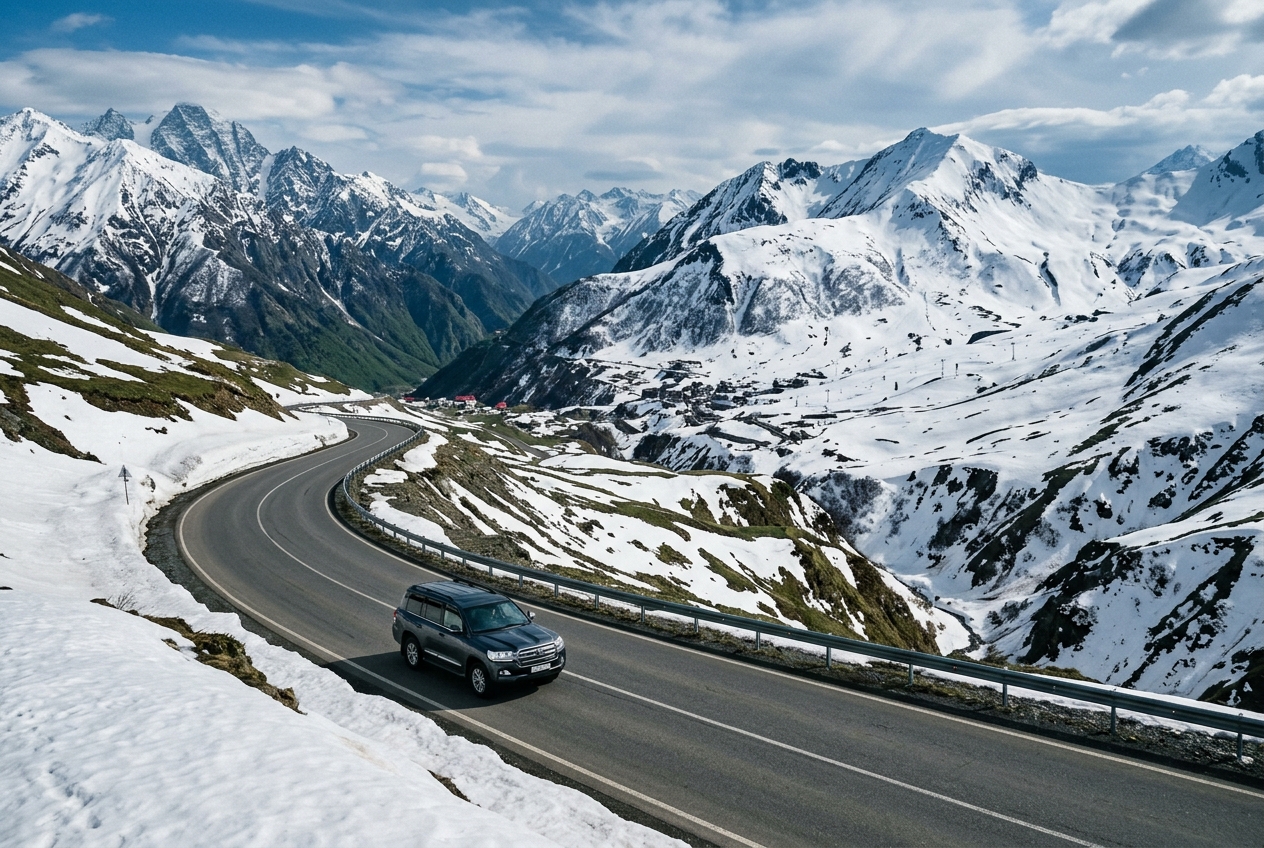
The stretch of highway connecting Georgia’s capital to its premier ski resort is one of those drives that justifies the trip all on its own. Carved through river gorges, past medieval fortresses, and up into alpine terrain that feels almost Scandinavian, the road from Tbilisi to Gudauri follows one of the oldest trade routes in the Caucasus. But this isn’t some manicured European motorway. The conditions shift with the seasons, the altitude changes dramatically, and local driving habits can catch newcomers off guard. Whether you’re heading up for a week of skiing or just passing through toward Kazbegi, understanding the road conditions and practical tips for this drive will save you stress, time, and possibly a fender. I’ve made this trip in every season, and each time the mountain teaches you something new.
The Georgian Military Highway: Route Overview and Distance
The road you’ll follow from Tbilisi to Gudauri is the Georgian Military Highway, or Sakartvelos Samkhedro Gza, one of the most historically significant routes in the Caucasus. Built in the early 19th century by the Russian Empire to connect Tbilisi with Vladikavkaz across the Greater Caucasus mountains, this highway has carried armies, traders, poets, and now busloads of skiers for over two centuries. Pushkin and Lermontov both wrote about it. Today, it’s a paved two-lane road that serves as the primary artery between Tbilisi and Georgia’s northern border.
The distance is approximately 120 kilometers, or 75 miles, and the direct drive takes roughly an hour and 37 minutes under normal traffic conditions. That said, “normal” is doing a lot of heavy lifting in that sentence. In summer, you might breeze through in under two hours. In winter, with road closures and snow, the same trip can stretch to three or four hours, or not happen at all on a given day.
The route heads north from Tbilisi along the M3 highway, climbing gradually through the Mtskheta-Mtianeti region. You’ll pass through the town of Mtskheta (Georgia’s ancient capital), then follow the Aragvi River valley as the terrain steepens. The road quality is generally good on the lower sections, with fresh asphalt and clear markings. Once you pass the Zhinvali Reservoir and begin the real ascent toward Gudauri, the road narrows, the curves tighten, and the elevation jumps from around 500 meters to over 2,100 meters at the resort.
| Route Detail | Information |
|---|---|
| Total Distance | ~120 km (75 miles) |
| Estimated Drive Time | 1 hour 37 minutes (normal conditions) |
| Starting Elevation | ~500 m (Tbilisi) |
| Ending Elevation | ~2,196 m (Gudauri) |
| Road Name | Georgian Military Highway (M3) |
| Key Passes | Jvari Pass (Cross Pass), 2,379 m |
One thing to know: this is not a highway in the Western sense. There are no rest stops with chain restaurants. Livestock cross the road. Villages appear and disappear. The scenery is extraordinary, but it demands your attention behind the wheel.
Seasonal Road Conditions and Safety
The character of this drive changes so drastically between seasons that it’s almost two different roads. Summer brings long daylight hours, dry pavement, and the kind of green mountain views that make you pull over every ten minutes for photos. Winter brings ice, avalanche risk, and road closures that can strand you for hours. The shoulder seasons, particularly late October through November and March through April, are the most unpredictable.
Summer driving (June through September) is straightforward. The road is fully open, visibility is excellent, and the biggest hazards are slow-moving trucks and the occasional cow standing in the middle of the lane. Temperatures at altitude can still drop sharply after sunset, so if you’re driving back to Tbilisi late, be prepared for cool conditions and reduced visibility on unlit mountain sections.
Winter is a different animal entirely. As one Georgian transfer service puts it, “winter travel to Gudauri requires careful planning due to mountain road conditions, snowfall, and changing weather.” That’s not marketing fluff; it’s accurate. The stretch between Kobi and Gudauri, which crosses the Jvari Pass at 2,379 meters, is the most vulnerable section. Avalanche risk is real, and the road patrol service regularly closes this segment during and after heavy snowfall.
Winter Driving and Snow Chain Requirements
If you’re driving to Gudauri between December and March, snow chains aren’t optional. Georgian law requires them on the mountain sections when conditions warrant, and police checkpoints before the ascent will turn you back if you don’t have them. You can buy chains at shops in Tbilisi or from roadside vendors near Ananuri, but buying in advance is smarter because the quality and fit will be better.
The Kobi-Gudauri pass section is where most problems occur. When it closes due to avalanche risk, it typically re-opens between 11:00 AM and 1:00 PM after safety clearing operations are complete. This means if you leave Tbilisi early in the morning during a heavy snow period, you may end up waiting in a queue of cars near Kobi for several hours. I’ve sat in that line before, engine running for heat, watching avalanche control teams work the slopes above. It’s not dangerous if you follow instructions, but it tests your patience.
Studded tires are legal in Georgia during winter months and are a worthwhile investment if you plan to make the trip multiple times. Four-wheel drive helps significantly on the upper sections, where packed snow and ice can persist even after plowing.
Navigating Fog and High-Altitude Visibility
Fog is the other seasonal hazard that catches people off guard. It’s most common in autumn and spring, but winter fog combined with blowing snow can reduce visibility to near zero on the Jvari Pass. The road has no guardrails in some sections, and the drop-offs are real.
If you hit dense fog, slow down dramatically and use your fog lights (not high beams, which reflect back and make things worse). Follow the taillights of the vehicle ahead at a safe distance. In extreme cases, pull over at a wide shoulder and wait. Georgian drivers tend to push through fog faster than is wise, so don’t feel pressured to match their pace. The mountain isn’t going anywhere.
Essential Stops and Landmarks Along the Way
Half the reason to drive this route instead of taking a transfer is the scenery and the stops. The Georgian Military Highway is dense with history and natural beauty, and rushing through it means missing some of Georgia’s most photogenic spots.
Ananuri Fortress and Zhinvali Reservoir
About 70 kilometers north of Tbilisi, the Ananuri Fortress Complex sits on a bluff overlooking the turquoise Zhinvali Reservoir. This 16th-17th century fortification was the seat of the Aragvi dukes, and its two churches and defensive towers are remarkably well-preserved. The site is free to enter and takes about 30-45 minutes to explore.
The reservoir below is stunning in any season, its color shifting from deep blue to emerald green depending on the light and time of year. There’s a small parking area and a few vendors selling churchkhela (the walnut-and-grape-juice candy that looks like a candle) and fresh fruit. This is the most popular stop on the route, so expect company, especially on weekends.
The Black and White Aragvi River Confluence
A lesser-known but genuinely fascinating stop is the confluence of the Black Aragvi and White Aragvi rivers, visible from the road near the village of Pasanauri. The two rivers carry different mineral content, giving them visibly different colors, and where they meet, you can see a clear line between the two streams before they merge. It’s one of those natural phenomena that photographs beautifully but is even more striking in person.
Pasanauri itself is known for khinkali, Georgia’s famous soup dumplings, and several roadside restaurants here serve excellent versions. If you’re driving up around lunchtime, stopping here for a plate of khinkali and a beer (for the passenger, not the driver) is practically mandatory. The village sits at roughly the halfway point of the drive, making it a natural break.
Practical Logistics for Your Road Trip
Getting the logistics right makes the difference between an enjoyable mountain drive and a stressful one. The choices you make about vehicle, fuel, and communication before you leave Tbilisi will shape the whole experience.
Choosing the Right Vehicle: 4WD vs. Sedan
In summer, a standard sedan handles the Tbilisi to Gudauri route perfectly well. The road is paved throughout, and while there are steep sections and tight curves, nothing requires high clearance or all-wheel drive. A compact rental car from one of Tbilisi’s agencies will do the job.
Winter changes the equation. A 4WD or AWD vehicle with proper winter tires is strongly recommended from November through April. The upper sections of the road can be icy even after plowing, and the extra traction matters on steep grades. If you don’t want to rent a car at all, a private transfer costs approximately 180 GEL for up to four passengers, which is reasonable when split among a group. Budget travelers can take a marshrutka van from Tbilisi’s Didube station for approximately 10 GEL per person, though the schedule is less flexible and the ride is less comfortable.
If you do rent a car, check whether the rental agreement covers mountain driving and snow chain use. Some agencies restrict travel on mountain roads during winter or charge extra for chains and winter equipment.
Fuel Stations and Connectivity Gaps
Fill your tank in Tbilisi before heading north. There are fuel stations along the first half of the route, including near Mtskheta and Ananuri, but options thin out significantly after the reservoir. The last reliable station before Gudauri is near Pasanauri. Running low on fuel while climbing a mountain pass in winter is not a situation you want to experience.
Mobile connectivity is decent along most of the route if you’re on Magti or Geocell, Georgia’s main carriers. However, there are dead zones in the deeper valleys and near the pass itself. Download offline maps through Google Maps or Maps.me before you leave. The Waze app is popular among Georgian drivers and gives useful real-time traffic data, including road closure alerts for the Jvari Pass section. Keep your phone charged; a car charger is essential gear for this drive.
Traffic Regulations and Local Driving Etiquette
Georgian driving culture is, to put it diplomatically, spirited. Speed limits exist (60 km/h in towns, 80 km/h on open road, 110 km/h on highways), and speed cameras are increasingly common on the military highway. Fines are issued electronically, and rental car companies will charge your card if a fine is linked to your vehicle.
The real challenge is the overtaking behavior. Georgian drivers frequently pass on blind curves and on hills, sometimes into oncoming traffic. This is not an exaggeration. If you see a car coming at you in your lane, don’t panic: move right, slow down, and let them complete their pass. Flashing headlights is common and can mean “I’m coming through” or “there’s a police checkpoint ahead,” depending on context.
Trucks are a constant presence on the military highway, as it’s the main freight route to Russia. They move slowly on the uphill sections and can create long queues. Be patient. Attempting aggressive overtakes on mountain roads with limited visibility is how accidents happen. Wait for clear straightaways with good sightlines before passing.
Police presence has increased along this route in recent years, and Georgian traffic police are generally professional and non-corrupt, a significant improvement from a decade ago. If you’re stopped, stay calm, be polite, and have your license and registration ready. International driving permits are recommended but not always asked for.
One cultural note: honking in Georgia is communication, not aggression. A short honk on a blind curve is standard practice to alert oncoming traffic. Don’t take it personally, and consider adopting the habit yourself on the tighter mountain bends.
Final Preparation Checklist for the Mountain Drive
Before you turn the key in Tbilisi, run through this list. It covers the essentials that separate a smooth trip from a frustrating one.
- Snow chains (winter only, but check conditions even in late autumn)
- Full fuel tank, filled in Tbilisi or no later than Pasanauri
- Offline maps downloaded on your phone
- Car charger for your phone
- Cash in Georgian Lari for roadside stops, khinkali, and churchkhela vendors
- Warm layers and a blanket in the car (winter road closures can mean hours of waiting)
- Bolt or Yandex Go apps installed as backup for return trips or local rides in Gudauri
- Windshield washer fluid topped up (road salt spray in winter is constant)
- Emergency contacts saved: Georgia’s roadside assistance number is 112
The drive from Tbilisi to Gudauri is one of those rare trips where the journey genuinely rivals the destination. The Georgian Military Highway delivers history, natural beauty, and just enough adventure to keep things interesting. Respect the mountain, prepare for the conditions, and give yourself extra time. You’ll arrive at Gudauri not just ready to ski, but with a memory of the road that stays with you long after the snow melts. If this is your first time making the trip, start with a summer drive to learn the road before attempting it in winter conditions. The mountain rewards preparation and punishes overconfidence in equal measure.