
Table of Contents
- What is Qvevri Winemaking?
- How Qvevri Winemaking Works
- Benefits and Use Cases
- Best Practices
- Related Concepts
Somewhere in the rolling hills of eastern Georgia, a winemaker is doing exactly what her ancestors did 8,000 years ago: burying a clay vessel in the earth, filling it with crushed grapes, and walking away. No stainless steel tanks, no temperature-controlled fermentation rooms, no commercial yeast packets. Just clay, fruit, and time. This is qvevri winemaking, the oldest continuous winemaking tradition on the planet, and it produces wines that taste like nothing you’ve ever tried from a bottle shop shelf. The method was inscribed on UNESCO’s Intangible Cultural Heritage list in 2013, and since then, interest from winemakers and wine lovers worldwide has surged. But most explanations of the process either romanticize it into mysticism or oversimplify it into a novelty. The reality is more interesting than either extreme: it’s a precise, deeply practical method that happens to produce extraordinary results. Whether you’re a wine professional, a home fermenter, or just someone who wants to understand what all the fuss is about, this guide covers the full picture: what qvevri are, how the process works, why the wines taste different, and how modern producers are keeping the tradition alive.
What is Qvevri Winemaking?
Definition
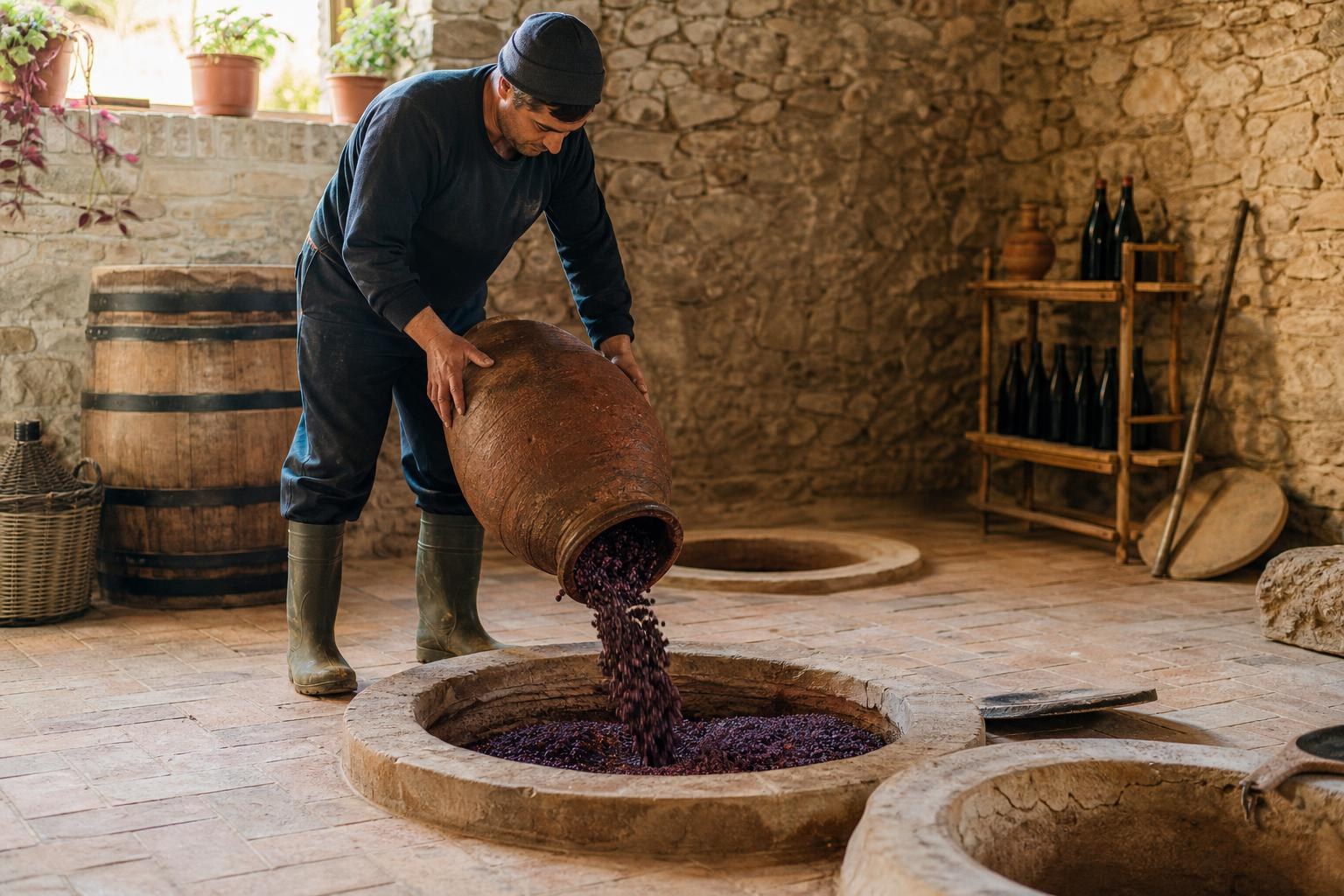
Qvevri winemaking is a method of producing wine using large, egg-shaped clay vessels called qvevri (sometimes transliterated as “kvevri”), which are buried underground up to their necks. The grapes, including skins, seeds, and sometimes stems, ferment and age inside these vessels with minimal human intervention. The technique originated in the South Caucasus region of Georgia, specifically in the Kakheti wine region, and archaeological evidence dates it back to approximately 6000 BCE.
What separates this from other ancient winemaking methods is continuity. This isn’t a reconstructed historical curiosity. Families in villages like Sighnaghi and Tsinandali have been making wine in qvevri without interruption for generations. The Georgian word “ghvino” is actually believed by many linguists to be the etymological root of the English word “wine” itself.
A single qvevri can hold anywhere from 20 to 3,500 liters, though most household vessels range between 800 and 1,500 liters. They’re made from local clay, shaped by hand without a potter’s wheel, and fired in kilns at temperatures around 1,100°C. Once cooled, the interior is coated with beeswax to reduce porosity while still allowing micro-oxygenation through the clay walls.
Key Concepts
Several ideas are central to understanding why this method produces such distinctive wine.
- Whole-cluster fermentation: Unlike most modern winemaking, qvevri producers often include grape skins, seeds, and stems during fermentation. This is what creates the famous amber or orange wines Georgia is known for, even from white grape varieties like Rkatsiteli and Mtsvane.
- Underground temperature regulation: Burying the vessel underground provides natural temperature stability, typically holding between 14-16°C year-round. This eliminates the need for mechanical cooling.
- Wild yeast fermentation: Traditional qvevri producers rely entirely on indigenous yeasts present on grape skins and in the cellar environment. No commercial yeast is added.
- Extended skin contact: White wines may spend anywhere from three to six months on their skins inside the qvevri, a practice that would be unthinkable in conventional white winemaking but produces wines with extraordinary texture, tannin structure, and complexity.
- Minimal intervention: The philosophy is one of observation rather than control. The winemaker’s role is to prepare the vessel, select healthy fruit, and then let nature do the work.
The Georgian term for a traditional wine cellar is “marani,” and in many rural households, the marani is considered the most sacred room in the home. I’ve visited several where the family patriarch wouldn’t allow shoes to be worn inside.
How Qvevri Winemaking Works
Core Mechanism
The process begins in autumn, typically September or October, depending on the grape variety and the vintage. Grapes are harvested by hand and brought to the marani. For white wines made in the Kakhetian method, the fruit is crushed (traditionally by foot, though small wooden presses are common now) and transferred into the qvevri with all solid material: skins, seeds, juice, and often stems. This mixture is called “chacha” in Georgian, though that word also refers to the grape brandy distilled later from the leftover pomace.
Once the qvevri is filled, fermentation begins spontaneously within 24 to 48 hours as wild yeasts activate. The carbon dioxide produced during fermentation pushes the solid material (the “cap”) to the top of the vessel. Traditionally, the winemaker pushes this cap down several times a day using a long wooden tool called a “khevistari” to keep the skins in contact with the juice and prevent bacterial spoilage on the surface.
After active fermentation subsides, usually within two to three weeks, the qvevri is sealed. Historically, this meant a wooden or stone lid topped with a mound of clay. The wine then sits undisturbed for five to six months. During this resting period, the solids gradually settle to the bottom of the egg-shaped vessel. The tapered bottom is a critical design feature: it collects the lees in a compact mass, reducing the surface area of contact between spent yeast and wine, which prevents off-flavors.
The underground environment does something no stainless steel tank can replicate. The earth maintains a constant cool temperature, and the porous clay walls allow a tiny amount of oxygen exchange. This micro-oxygenation softens tannins and develops flavor complexity without the oxidative risks of barrel aging.
Components
The physical elements of the process are deceptively simple, but each one matters.
| Component | Material | Function | Typical Size/Spec |
|---|---|---|---|
| Qvevri | Local clay, beeswax-lined | Fermentation and aging vessel | 800-1,500 liters (household) |
| Marani | Stone or brick cellar | Houses buried qvevri | Below ground level |
| Khevistari | Wood (often cherry or walnut) | Cap management tool | 2-3 meters long |
| Lid | Wood, stone, or clay | Seals vessel during aging | Custom-fitted to each qvevri |
| Beeswax | Natural beeswax | Interior lining to reduce porosity | Applied annually |
One detail that surprises most visitors: cleaning a qvevri is serious work. After the wine is drawn off in spring, the vessel is scrubbed with a brush made from dried cherry bark (called a “kortskhi”), then rinsed repeatedly with water. Some producers burn sulfur candles inside to sterilize. The beeswax lining is reapplied as needed. A well-maintained qvevri can last for decades, and some in use today are over a century old.
Only a handful of master qvevri makers remain in Georgia. Zaza Kbilashvili in Vardisubani is one of the most respected, and his vessels sell for roughly 3-5 GEL per liter of capacity (about $1.10-$1.85 USD per liter in 2026). A 1,000-liter qvevri therefore costs around $1,100-$1,850: remarkably affordable compared to a French oak barrel of similar capacity.
Benefits and Use Cases
Key Benefits
The wines produced in qvevri have characteristics you simply cannot replicate with modern equipment, and that’s the whole point.
Amber wines made from white grapes like Rkatsiteli using extended skin contact develop a golden-orange hue, firm tannins, and flavors ranging from dried apricot and walnut to tea leaves and honey. These are white wines that can stand up to hearty food: grilled meats, aged cheeses, even spicy dishes that would flatten a conventional Chardonnay.
From a health perspective, the extended skin contact means higher concentrations of polyphenols and antioxidants compared to conventionally made white wines. A 2023 study from the National Wine Agency of Georgia found that Kakhetian-method amber wines contained roughly 3-4 times the polyphenol content of their conventionally fermented counterparts.
The environmental footprint is genuinely minimal. There’s no electricity required for temperature control, no stainless steel manufacturing, no new oak barrels every few vintages. The clay is local, the beeswax is local, the yeasts are wild. A family producing 2,000-3,000 liters annually in their marani has a carbon footprint that would make any industrial winery envious.
For winemakers, the method also offers a kind of creative freedom. Without the ability to micromanage temperature curves or add commercial enzymes, you’re forced to focus on what actually matters: growing healthy grapes and keeping your vessels clean. The wine either works or it doesn’t, and that honesty shows in the glass.
Common Applications
The traditional Kakhetian method, with full skin contact for white wines, remains the most common application in Georgia’s Kakheti region. But variations exist.
The Imeretian method, practiced in western Georgia, uses shorter skin contact (typically a few weeks rather than months) and excludes stems. This produces lighter, more approachable wines that still carry the textural signature of clay fermentation without the intense tannic structure.
Outside Georgia, winemakers in Italy (particularly Friuli Venezia Giulia), Slovenia, Austria, and even parts of California and Oregon have adopted qvevri or qvevri-inspired vessels. Italian producer Josko Gravner famously switched to Georgian qvevri in the early 2000s after visiting Kakheti, and his Ribolla Gialla wines became benchmarks for the global natural wine movement.
Restaurants in Tbilisi increasingly feature dedicated qvevri wine lists. Spots like Vino Underground and g.Vino have built their entire identity around these wines. A bottle of quality qvevri wine from a small Georgian producer typically costs between 25-60 GEL ($9-$22 USD) locally, though export prices in Western Europe and North America can reach $30-$80 USD.
Home winemakers are also getting in on the tradition. In Georgia, making wine at home is practically a civic duty: an estimated 80% of the country’s total grape harvest goes into homemade wine. Small qvevri (200-300 liters) are available for purchase in Tbilisi’s Dry Bridge Market and through online Georgian artisan platforms.
Best Practices
If you’re visiting Georgia and want to experience the process firsthand, or if you’re a winemaker considering the method, here are the practical details that matter most.
Start with the vessel. A qvevri with cracks, poor beeswax coverage, or residual contamination from a previous vintage will ruin your wine before fermentation even begins. Inspect the interior carefully, and don’t skip the annual beeswax recoating. The wax should be melted and applied in thin, even layers while the qvevri is warm.
Grape selection is everything. Because you’re not adding commercial yeast or making adjustments during fermentation, the fruit needs to be clean and ripe. Damaged or moldy grapes introduce bacteria that wild fermentation can’t overcome. In Kakheti, experienced producers will spend an entire day hand-sorting grapes before a single cluster goes into the qvevri.
Cap management during active fermentation requires discipline. Push the chacha down three to four times daily for the first two weeks. Skip this step, and you risk volatile acidity or surface mold. Some producers cover the opening with a cloth during this phase to keep insects out while still allowing CO2 to escape.
Temperature monitoring, while the underground environment is naturally stable, is still worth doing. A simple probe thermometer dropped through the opening gives you peace of mind. If fermentation temperatures climb above 28°C, you’ve got a problem: likely an overfilled vessel or insufficient burial depth.
For travelers, the best way to learn is to visit during the rtveli (grape harvest) in September and October. Many family-run guesthouses in Kakheti invite visitors to participate. Expect to get your feet stained purple, eat enormous quantities of food, and hear the polyphonic singing that traditionally accompanies the harvest. The experience costs very little: a few days of room, board, and hands-on winemaking education might run 100-150 GEL ($37-$55 USD) per day in a village homestay.
One practical tip: download the Google Translate offline pack for Georgian before you go. Many of the best small producers speak minimal English, and the Mkhedruli script is unlike anything in the Latin or Cyrillic alphabets.
Related Concepts
Qvevri winemaking sits within a broader family of ancient and alternative winemaking traditions, and understanding the connections helps clarify what makes the Georgian method distinct.
Amphora winemaking is the closest relative. Clay vessel fermentation was practiced across the ancient Mediterranean, from the Phoenicians to the Romans. Modern producers in Spain, Portugal, and Greece have revived amphora use, but their vessels differ from qvevri in shape (typically taller and narrower), lining (often unlined), and usage (usually above ground). The underground burial of qvevri is a uniquely Georgian practice that fundamentally changes the fermentation dynamics.
Natural wine, as a broader movement, owes an enormous philosophical debt to Georgian tradition. The principles of wild yeast fermentation, minimal sulfur addition, and non-interventionist winemaking that define the natural wine category were standard practice in Georgian maranis centuries before they became trendy in Parisian wine bars. Producers like Ramaz Nikoladze, Iago Bitarishvili, and Soliko Tsaishvili are recognized internationally as both traditional Georgian winemakers and leaders of the global natural wine movement.
Orange wine, specifically, is the style most directly associated with qvevri. The term was coined by British wine importer David A. Harvey in the early 2000s to describe white wines made with extended skin contact. While orange wines can be made in any vessel, the qvevri method produces the most structured and complex examples.
Biodynamic and organic viticulture often overlap with qvevri production, particularly among Georgia’s export-focused producers. Pheasant’s Tears, founded by American-born painter John Wurdeman in Sighnaghi, combines biodynamic farming with traditional qvevri methods and has become one of the most visible Georgian wine brands internationally.
The concept of terroir, so central to French winemaking philosophy, takes on a literal dimension with qvevri. The vessel is made from local clay, buried in local soil, and ferments with local yeasts. Every element of the process is tied to place in a way that even the most terroir-obsessed Burgundian would have to admire.
For those interested in going deeper, the Georgian National Wine Agency maintains resources on registered qvevri producers and appellations of origin. The annual Tbilisi Wine Festival, held each May, is the best single event for tasting widely across producers and styles.
The 8,000-year story of winemaking in qvevri is not a museum piece. It’s a living, evolving practice that continues to shape how the world thinks about wine. Whether you visit a family marani in Kakheti, order a bottle of amber Rkatsiteli at your local wine shop, or bury your own clay vessel in the backyard, you’re participating in something that connects you to the very origins of wine culture. The best way to understand it is to taste it, and the best place to taste it is where it all started: in the ancient cellars of Georgia, where the earth itself is the winemaker’s most trusted tool.