
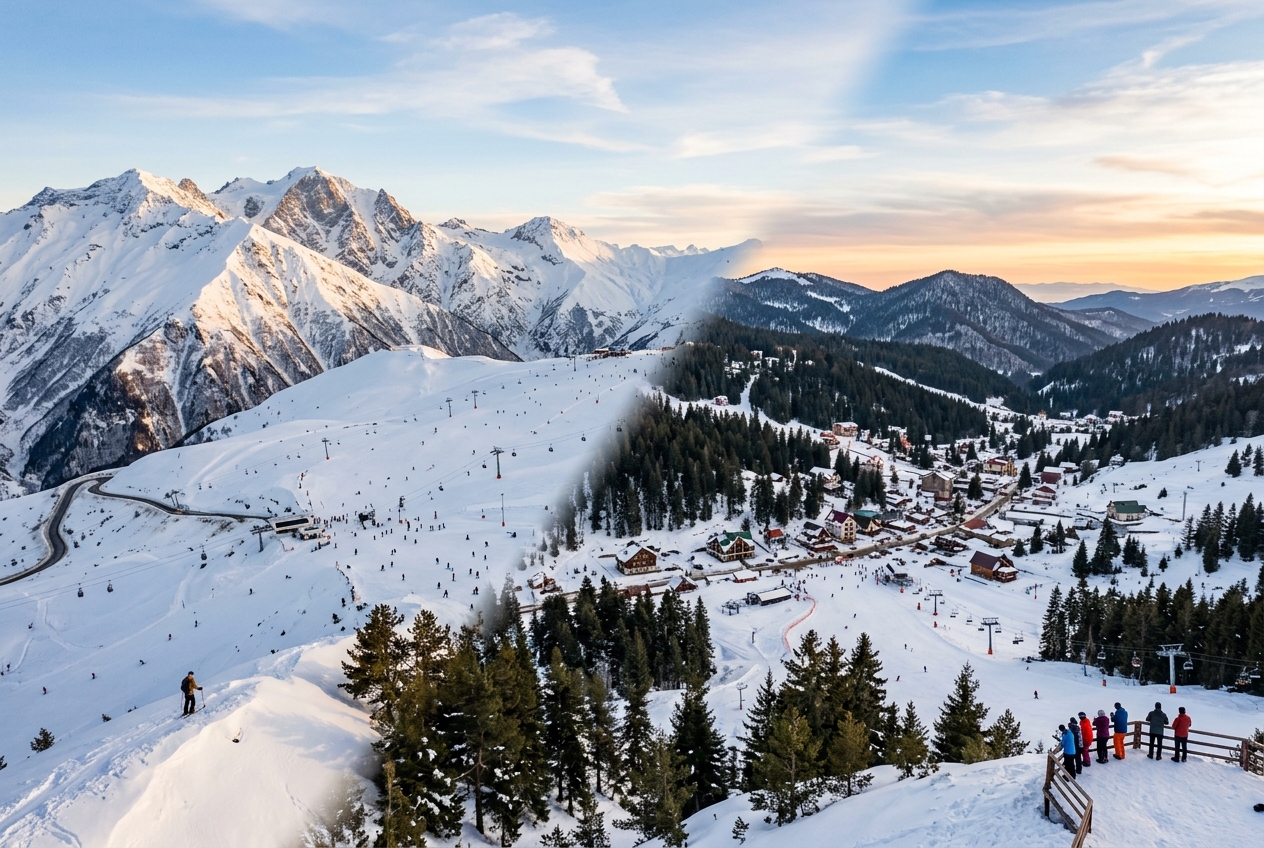
Georgia’s two biggest ski resorts sit just a few hours from Tbilisi, yet they feel like entirely different worlds. One is a high-altitude, wind-swept playground above the treeline; the other is a pine-forested, family-oriented retreat with a historic railway. If you’re planning a winter trip to the Caucasus and trying to decide between Gudauri and Bakuriani, the choice really depends on what kind of skier you are, who you’re traveling with, and what you want out of the trip beyond the slopes. I’ve spent time at both, and the honest answer is that neither is universally “better” – they serve different people well.
The Great Georgian Ski Debate: An Overview of Gudauri and Bakuriani
The question of which Georgian ski resort is better – Gudauri or Bakuriani – comes up constantly in travel forums, expat groups, and hostel conversations in Tbilisi. Both resorts have undergone significant development in recent years, but they’ve grown in different directions.
Gudauri is Georgia’s flagship ski destination, sitting on the southern slopes of the Greater Caucasus along the famous Georgian Military Highway. Its altitude ranges from 2,200 to 3,300 meters, putting it among the highest ski areas in the region. The resort has exploded in popularity: during the 2025-2026 season alone, it welcomed over 1.3 million visitors, a figure that reflects both growing international interest and heavy domestic tourism.
Bakuriani, by contrast, sits at a more modest 1,700 meters in the Borjomi Gorge area of the Lesser Caucasus. It’s been a resort town since the Soviet era, when it served as an Olympic training ground. The vibe here is quieter, more traditional, and distinctly Georgian in character. Where Gudauri draws adrenaline-seekers and international tourists, Bakuriani pulls in Georgian families, couples looking for a relaxed getaway, and beginners who want gentle slopes without the intimidation factor.
Here’s a quick side-by-side snapshot to orient you:
| Feature | Gudauri | Bakuriani |
|---|---|---|
| Altitude | 2,200 – 3,300 m | 1,700 – 2,700 m |
| Total Slopes | ~70 km | ~26 km |
| Day Pass Price | 70 GEL | 55 GEL |
| Best For | Intermediate/advanced, freeriders | Families, beginners, budget travelers |
| Distance from Tbilisi | ~2 hours | ~3 hours |
| Snow Season | December – April | December – March |
Terrain and Snow Quality: High Altitudes vs. Forested Slopes
The terrain difference between these two resorts is the single biggest factor in choosing between them. They’re not even close in this regard, and that’s not a criticism of either one.
Gudauri: A Paradise for Freeriders and High-Altitude Enthusiasts
Gudauri’s terrain sits almost entirely above the treeline, which gives it a wide-open, alpine feel that’s rare for a resort at this price point. The runs are long, the bowls are expansive, and the off-piste potential is genuinely world-class. If you’ve skied in the Alps and felt priced out, Gudauri delivers a similar experience for a fraction of the cost.
The snow quality benefits enormously from the altitude. At 3,000+ meters, the upper runs hold powder well into spring, and the season reliably stretches from December through April. Wind can be an issue – the exposed terrain means that on stormy days, upper lifts close and visibility drops to nothing. I’ve had days where the top gondola was shut by 11 a.m. due to wind, which is frustrating if you’re on a short trip.
For intermediate and advanced skiers, Gudauri is the clear winner. The red and black runs have genuine pitch, and the backcountry access from the top lifts opens up terrain that would cost you thousands of euros to access via heliski in other countries. Beginners can manage on the lower slopes near the gondola base, but honestly, the mountain isn’t designed with them as the priority.
Bakuriani: Diverse Trails and Sheltered Tree-Line Skiing
Bakuriani offers roughly 26 kilometers of groomed slopes, spread across two main ski areas: Kokhta and Didveli. The runs are shorter and gentler than Gudauri’s, but the tree-lined terrain provides something Gudauri simply can’t: shelter from wind and weather.
On days when Gudauri’s upper lifts are closed due to storms, Bakuriani’s forested slopes often remain perfectly skiable. The trees break the wind, improve visibility, and create a more intimate skiing experience. Didveli reaches up to about 2,700 meters and has some genuinely fun intermediate terrain, while Kokhta is ideal for beginners and families with young children.
The snow quality is less consistent than Gudauri’s. The lower altitude means warmer temperatures, and by late February, the lower runs can get slushy in the afternoon sun. If you’re planning a Bakuriani trip, aim for January or early February for the best conditions.
Resort Atmosphere and Target Audience
Skiing is only part of the equation. The feel of a resort – who’s there, what happens after the lifts close, how the evenings unfold – matters just as much for most travelers.
Family-Friendly Features and Kids’ Activities in Bakuriani
Bakuriani is, without question, the better choice for families with young children. The town itself has a walkable center with small restaurants, cafes, and shops that feel authentically Georgian rather than tourist-manufactured. Georgian families have been vacationing here for generations, and you’ll notice that the infrastructure caters to their needs: small playgrounds, gentle nursery slopes, and affordable dining options.
The pace is slower. Evenings involve strolling through town, eating khinkali at a family-run restaurant, and maybe taking a horse-drawn sleigh ride. If you’re traveling with kids under 10, this matters enormously. The ski school at Kokhta is affordable and patient with beginners, and the runs are short enough that a tired five-year-old can be carried back to the hotel without a major expedition.
Georgian hospitality – the concept of “stumari ghvtisaa” (the guest is from God) – shows up differently here than in Gudauri. In Bakuriani, you’re more likely to end up invited for a glass of wine by a guesthouse owner or chatting with a local grandmother who insists you try her churchkhela. The town still has that Soviet-era resort charm, a little rough around the edges but genuine.
Youthful Energy and Après-Ski Culture in Gudauri
Gudauri attracts a younger, more international crowd. On any given weekend, you’ll hear Russian, English, Hebrew, Arabic, and Georgian on the slopes. The après-ski scene is real here: there are bars, clubs, and restaurants that stay open late, and the energy after a powder day is electric.
The resort village itself is essentially a strip of hotels, apartments, and restaurants along the main road. It doesn’t have the “town” feel of Bakuriani – it’s more of a purpose-built ski village. That said, the newer developments have brought quality restaurants and bars that didn’t exist five years ago.
If you’re in your 20s or 30s, traveling with friends, and want to ski hard during the day and socialize at night, Gudauri is the obvious pick. Solo travelers also tend to gravitate here because the international crowd makes it easy to meet people. The hostel scene is active, and group freeride tours are simple to join.
Infrastructure, Accessibility, and Logistics
Travel Time and Transport from Tbilisi and Kutaisi
Gudauri sits about 120 kilometers north of Tbilisi along the Georgian Military Highway, making it roughly a two-hour drive in good conditions. Marshrutkas (minibuses) run regularly from Didube station, and ride-sharing apps like Bolt and Yandex Go make private transfers straightforward. In heavy snow, the highway can slow down significantly, and chains are occasionally required.
Bakuriani is about 180 kilometers from Tbilisi, typically a three-hour drive via Borjomi. The road is well-maintained but winding. From Kutaisi, Bakuriani is actually closer – about 2.5 hours – making it a better option if you’re flying into western Georgia. The famous Kukushka narrow-gauge train from Borjomi to Bakuriani is a transport option in its own right, though most people ride it for the experience rather than efficiency.
Both resorts are accessible without a car, but having one gives you flexibility. Download offline maps and a Georgian translation pack on Google Translate before you go – signage outside Tbilisi is inconsistent, and older generations in both resort areas are more likely to speak Russian than English.
Accommodation Options: Luxury Hotels vs. Cozy Guesthouses
Gudauri’s accommodation market has matured rapidly. You’ll find everything from budget hostels to premium apartments, with real estate prices ranging from $1,200 to $2,000 per square meter for ski-in/ski-out properties. New hotel developments have brought international-standard rooms, though the construction boom means some buildings feel hastily finished. Booking.com and Airbnb both work well here, with plenty of options in the 80-200 GEL per night range.
Bakuriani’s accommodation skews toward family-run guesthouses and small hotels. The prices are noticeably lower – you can find comfortable rooms for 50-120 GEL per night. The trade-off is that luxury options are limited. If you want a spa hotel with a pool, Gudauri has more to offer. If you want a warm guesthouse where the owner cooks you breakfast and tells you stories about Soviet-era skiing, Bakuriani is your place.
Off-Piste Adventures and Non-Skiing Activities
A ski trip to Georgia shouldn’t be just about the slopes. Both resorts offer activities that make the trip worthwhile even for non-skiers in your group.
Paragliding and Heliskiing Opportunities in Gudauri
Gudauri has become one of the most affordable heliskiing destinations in the world. Operators run trips from the resort into the surrounding Caucasus peaks, accessing terrain that gets virtually no traffic. A single heliski run costs a fraction of what you’d pay in Canada or Alaska, and the snow quality in the backcountry is often spectacular.
Tandem paragliding is the other signature Gudauri experience. You launch from near the top of the ski area and fly over the slopes with the Caucasus range spread out beneath you. It costs around 250-350 GEL for a tandem flight, and operators are active throughout the season. Snowkiting has also gained traction on Gudauri’s open plateaus, where consistent winds create ideal conditions.
For non-skiers, Gudauri offers snowshoeing, cross-country skiing, and some genuinely impressive mountain scenery that’s accessible via the gondola alone. The views from the top station on a clear day are worth the lift ticket by themselves.
Ice Skating, Snowmobiles, and the Kukushka Train in Bakuriani
Bakuriani’s non-skiing activities lean more toward family entertainment. Ice skating rinks, snowmobile rentals, and tubing parks are scattered around town, all at prices that won’t strain a family budget. Horse-drawn sleigh rides through the pine forests are a Bakuriani classic and genuinely charming, not just a tourist gimmick.
The Kukushka train deserves special mention. This narrow-gauge railway connects Borjomi to Bakuriani, climbing through snow-covered forest over about 2.5 hours. It’s slow, rattly, and beautiful. The train dates back to the late 19th century and feels like a time capsule. Even if you’re driving to Bakuriani, consider taking the Kukushka one way for the experience.
Bakuriani’s proximity to Borjomi also opens up a day trip to the famous mineral water springs and Borjomi-Kharagauli National Park. If you have non-skiers in your group, this combination of activities makes Bakuriani the more versatile base.
Budget Comparison and Best Time to Visit
Money talks, and there’s a meaningful cost difference between the two resorts. A day pass in Bakuriani costs 55 GEL, while Gudauri charges 70 GEL. That gap adds up over a week-long trip, especially for families buying multiple passes. Accommodation, food, and activities are all 20-30% cheaper in Bakuriani across the board.
For a rough budget comparison over a five-day trip for two adults:
| Expense | Gudauri (est.) | Bakuriani (est.) |
|---|---|---|
| Lift passes (5 days) | 700 GEL | 550 GEL |
| Accommodation | 600-1,000 GEL | 400-700 GEL |
| Food & drinks | 500-700 GEL | 350-500 GEL |
| Equipment rental | 300-400 GEL | 200-300 GEL |
| Estimated total | 2,100-2,800 GEL | 1,500-2,050 GEL |
The best time to visit Gudauri is mid-January through mid-March, when snow coverage is most reliable and the upper terrain is fully open. Late March and early April can offer spring skiing with longer days and softer snow, though conditions become less predictable.
Bakuriani’s sweet spot is narrower: January through mid-February gives you the best snow before the lower altitude starts working against you. Weekends at both resorts get crowded with Tbilisi visitors, so midweek trips offer shorter lift lines and better accommodation deals. Georgian public holidays, especially around Orthodox Christmas (January 7) and New Year, pack both resorts to capacity.
Final Verdict: Choosing the Right Resort for Your Winter Break
The question of whether Gudauri or Bakuriani is the better ski resort doesn’t have a single answer – it depends entirely on what you’re looking for.
Choose Gudauri if you’re an intermediate or advanced skier who wants challenging terrain, reliable snow, off-piste access, and a lively social scene. It’s the right call for friend groups, solo travelers, and anyone who prioritizes the quality and quantity of skiing above all else.
Choose Bakuriani if you’re traveling with family, skiing on a tighter budget, or prefer a quieter, more traditionally Georgian atmosphere. It’s ideal for beginners, mixed groups where not everyone skis, and anyone who values charm over adrenaline.
The smartest move, if you have the time? Do both. Spend three or four days at Gudauri pushing your limits on the mountain, then wind down with a couple of days in Bakuriani riding the Kukushka and enjoying the slower pace. Georgia is small enough to make this practical, and experiencing both resorts gives you the full picture of what Caucasus skiing has to offer.