
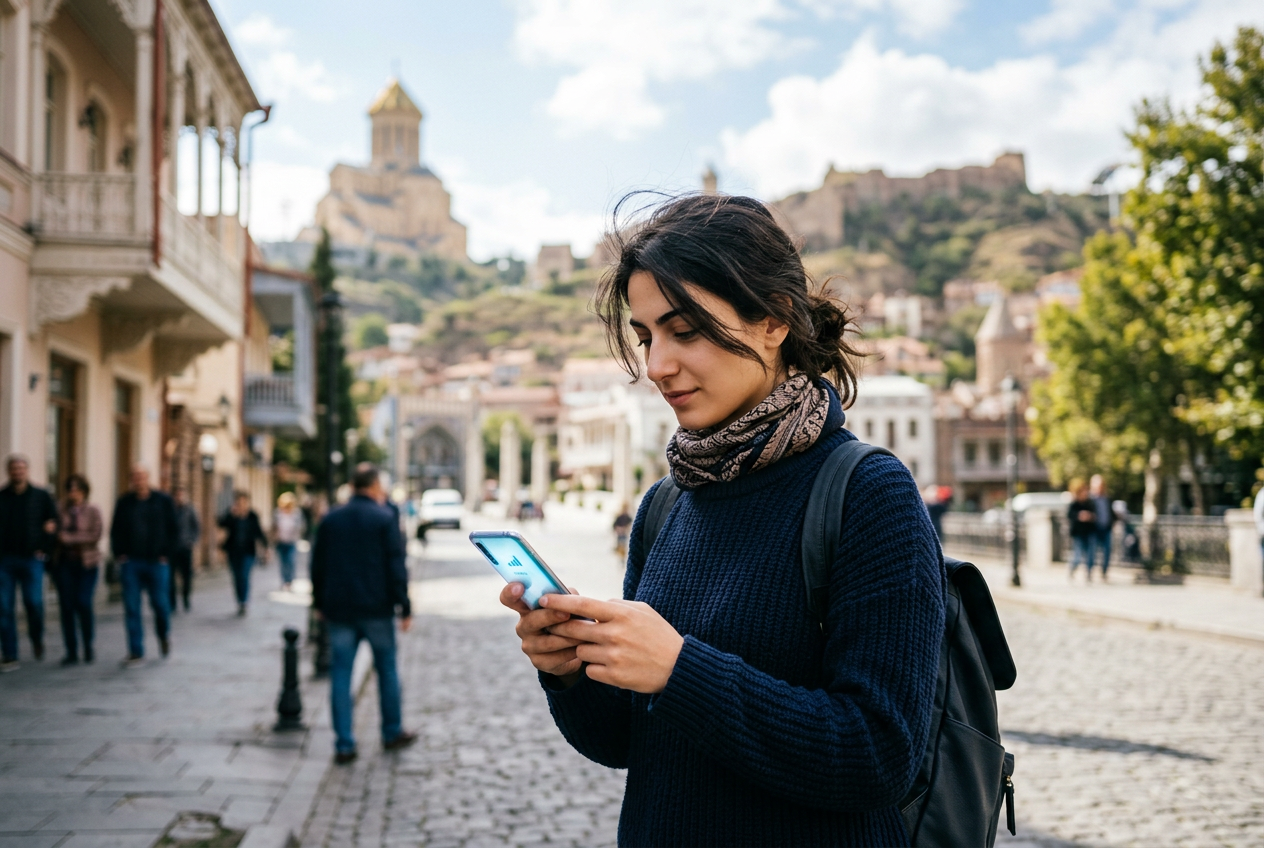
Arriving at Tbilisi International Airport with a dead phone and no local connectivity is a uniquely helpless feeling. You're standing in a country where the alphabet looks like beautiful calligraphy you can't decipher, taxi drivers are waving enthusiastically, and your offline Google Translate isn't cutting it. The question of which SIM is best in Georgia becomes surprisingly urgent when you're trying to navigate a city where street signs occasionally contradict your map app.
I've spent considerable time exploring Sakartvelo – as Georgians call their homeland – from the cobblestone streets of old Tbilisi to remote villages in Svaneti where cell towers are scarcer than English speakers. The mobile connectivity landscape here is straightforward once you understand it: three main operators, each with distinct strengths, serving a market where Georgians spent a record GEL 521 million on mobile services in just the first seven months of 2025. That's serious money flowing through a country of fewer than four million people, and it means competition keeps prices low and quality reasonably high.
What surprised me most about Georgian mobile service isn't the speed – though Georgia ranks 14th globally for mobile internet as of March 2024 – but how genuinely affordable staying connected is. We're talking about unlimited data plans that cost less than a single nice dinner in Tbilisi's restaurant district. The real question isn't whether you can afford good connectivity here; it's which provider matches your specific travel style.
Overview of Major Mobile Operators in Georgia
The Georgian telecom market, valued at USD 537.58 million in 2025, is dominated by three players who have carved out distinct market positions. Understanding their differences saves you from standing confused at an airport kiosk while jetlagged travelers pile up behind you.
MagtiCom: The Market Leader
MagtiCom – locals just call it Magti – holds the crown in Georgian telecommunications. During the second half of 2024, Magti delivered median download speeds of 168.07 Mbps, making it the fastest mobile provider in the country. Those aren't theoretical numbers; that's real-world performance measured by Ookla's Speedtest data.
The company has invested heavily in infrastructure, and it shows. Their 4G coverage blankets virtually every populated area, and they've been aggressive about 5G rollout in Tbilisi. Magti stores are everywhere – you'll spot their distinctive green branding in malls, airports, and busy commercial streets. The staff generally speaks enough English to handle tourist transactions, though having Google Translate ready never hurts.
Pricing sits at the premium end of the Georgian spectrum, though "premium" here means you might pay 30 GEL instead of 20 GEL for a monthly package. The difference is negligible for most travelers but adds up if you're staying several months.
Silknet (Geocell): The Strongest Competitor
Silknet, which absorbed the former Geocell brand, runs a close second in the Georgian market. Their network quality approaches Magti's in urban areas, and some travelers swear their coverage is actually better in certain rural regions. The truth probably varies by specific location.
What Silknet does exceptionally well is bundling. If you're renting an apartment with Silknet home internet (common in Tbilisi), adding a mobile plan creates attractive discounts. They've also been competitive on tourist-specific packages, recognizing that Georgia's booming tourism sector represents steady revenue.
Their retail presence is strong, with shops in most neighborhoods where tourists congregate. The Rustaveli Avenue flagship store in Tbilisi handles English-speaking customers smoothly.
Cellfie (formerly Beeline): The Budget-Friendly Choice
Cellfie rebranded from Beeline in recent years and has positioned itself as the value option. Their network coverage expanded by 28% in 2025, closing what was previously a significant gap with larger competitors.
For budget travelers, backpackers, or anyone who doesn't need blazing speeds, Cellfie delivers solid value. Their prices undercut competitors by 20-30% on comparable packages. The trade-off is slightly slower speeds and occasional coverage gaps in remote areas – though "remote" in Georgia often means places most tourists never visit anyway.
The brand has worked hard to shed its reputation as the budget afterthought. Recent infrastructure investments show, particularly in Batumi and the Black Sea coast where summer tourism drives demand.
Network Coverage and Signal Reliability
Best Performance in Tbilisi and Major Cities
Urban connectivity in Georgia is genuinely excellent. Walking through Tbilisi, you'll maintain strong 4G signals almost everywhere – from the sulfur baths in Abanotubani to the modern developments in Saburtalo. The same applies to Batumi, Kutaisi, and other major cities.
All three operators perform well in urban environments. The differences emerge in edge cases: underground metro stations, thick-walled Soviet-era buildings, or crowded festival venues. Magti generally handles these challenging environments best, but the margin isn't dramatic.
| Provider | Tbilisi Coverage | Batumi Coverage | Kutaisi Coverage | Typical 4G Speed |
|---|---|---|---|---|
| Magti | Excellent | Excellent | Excellent | 50-170 Mbps |
| Silknet | Excellent | Excellent | Very Good | 40-120 Mbps |
| Cellfie | Very Good | Very Good | Good | 30-80 Mbps |
For most travelers spending time primarily in cities, any provider works fine. The decision becomes more nuanced when your itinerary includes remote regions.
Reliability in Remote Mountainous Regions
Georgia's geography creates genuine connectivity challenges. The Greater Caucasus mountains in the north reach over 5,000 meters, and many villages sit in valleys where signal towers struggle to reach. If your trip includes Svaneti, Tusheti, Kazbegi, or other mountain destinations, coverage matters.
Magti maintains the most extensive mountain coverage, with towers in places that seem almost impossible to service. Driving the Georgian Military Highway to Kazbegi, you'll lose signal occasionally but regain it faster with Magti than alternatives.
Silknet performs reasonably in popular tourist mountain areas but drops off in truly remote villages. Cellfie's recent expansion helped, but they still lag in the most isolated regions.
Practical advice: if you're trekking to remote villages or planning multi-day hikes, Magti provides the best safety margin. For standard tourist routes – even mountain ones – any provider handles the main attractions.
Comparison of Prepaid Plans and Data Packages
Tourist-Specific SIM Card Offers
Georgian operators have recognized tourism's importance and created packages specifically for visitors. These typically bundle generous data with reasonable validity periods, eliminating the complexity of understanding local rate structures.
Magti's tourist SIM offers 20GB of data valid for 30 days, priced around 30 GEL (roughly $11 USD). The package includes some local calling minutes, though most travelers rely on WhatsApp or Telegram anyway.
Silknet counters with similar offerings, occasionally undercutting Magti by a few lari. Their 15GB tourist package at 25 GEL represents solid value for shorter stays.
Cellfie's tourist options emphasize data volume over speed, offering 25GB packages at competitive prices. For travelers primarily using messaging apps and occasional navigation, the slower speeds rarely matter.
One Georgian phrase worth knowing: "turistis SIM barati" (tourist SIM card). Most shop staff understand this, even without further explanation.
Unlimited Data and Social Media Bundles
True unlimited data plans exist in Georgia, though "unlimited" sometimes means throttled speeds after certain thresholds. Magti's unlimited package runs approximately 45 GEL monthly and genuinely delivers unrestricted high-speed data – a remarkable value by global standards.
Social media bundles deserve mention for heavy Instagram or TikTok users. All three operators offer packages where specific apps don't count against your data allocation. These make sense if you're documenting your trip extensively but don't need general high-speed access.
The math usually favors straight unlimited plans for stays exceeding two weeks. Shorter visits work fine with standard tourist packages.
eSIM Availability and Digital Services
Georgia has embraced eSIM technology, though implementation varies by operator. Magti and Silknet both offer eSIM activation, allowing you to set up Georgian connectivity before your flight lands. This convenience appeals particularly to travelers with eSIM-compatible phones who want to hit the ground connected.
The eSIM activation process typically requires downloading the provider's app and completing verification. Some travelers report smoother experiences purchasing eSIMs through third-party providers like Airalo or Holafly, which resell Georgian connectivity with English-language support.
Physical SIMs remain more straightforward for most visitors. The slight convenience of eSIM rarely outweighs the simplicity of walking into an airport shop and leaving five minutes later with a working connection. However, if your phone supports multiple eSIMs, having Georgian connectivity alongside your home number creates useful flexibility.
Digital services from Georgian operators have improved substantially. All three providers offer functional mobile apps for account management, balance checking, and package purchases. Magti's app includes English language support; Silknet's requires some creative navigation but works; Cellfie's app is basic but functional.
How to Buy and Activate a SIM Card in Georgia
Required Documentation and Registration
Georgian law requires SIM card registration with a valid passport. This isn't bureaucratic theater – shops actually check and record your passport details. The process takes five to ten minutes at properly staffed locations.
At Tbilisi International Airport, you'll find Magti and Silknet kiosks in the arrivals hall. Both operate extended hours to catch incoming flights, though late-night arrivals might find reduced staffing. The airport shops charge identical prices to city locations – no tourist markup.
City shops offer more options and often shorter queues. The Galleria Tbilisi mall contains all three operators, making comparison shopping easy. Rustaveli Avenue hosts multiple locations within walking distance.
What you'll need:
- Valid passport (they'll photograph the data page)
- Cash in Georgian Lari or card payment (most shops accept cards)
- Five minutes of patience
- Basic English or a translation app
The staff handles everything – SIM insertion, initial activation, and package selection. You'll walk out with a working Georgian number and active data.
Topping Up Credit and Using Mobile Apps
Maintaining your Georgian SIM couldn't be simpler. Top-up options include:
- Provider apps with card payment
- Bank of Georgia or TBC Bank ATMs (both offer mobile top-up)
- Convenience stores and small shops displaying provider logos
- Online through provider websites
The apps genuinely work well for ongoing management. You can purchase additional packages, check remaining data, and troubleshoot issues without visiting a physical store. Magti's app even provides English-language customer service chat.
One tip: Georgian phone numbers start with 5 and contain nine digits total. Save your new number somewhere accessible – you'll need it for various Georgian services, from restaurant reservations to museum bookings.
Final Verdict: Choosing Based on Your Travel Needs
The best SIM in Georgia depends entirely on how you're traveling. Here's my honest assessment after extensive use of all three networks.
Choose Magti if you're heading to remote mountain regions, need reliable video calls for work, or simply want the fastest, most dependable connection. Travel bloggers and remote workers consistently praise Magti's 4G/5G network as Georgia's best. The premium pricing barely registers given Georgian cost levels.
Choose Silknet if you're staying primarily in cities, appreciate bundled services, or found a good deal on their tourist packages. The network performs excellently where most tourists spend their time.
Choose Cellfie if budget matters more than speed, you're primarily using messaging apps, or you're a backpacker watching every lari. Their recent network expansion makes them genuinely viable for standard tourist routes.
For most visitors spending one to three weeks exploring Tbilisi, wine country, and perhaps a mountain excursion, Magti offers the best balance of coverage, speed, and peace of mind. The few extra lari buy genuine reliability in a country where connectivity enhances every experience – from translating menus to navigating winding mountain roads.
Walk into any airport kiosk, show your passport, and you'll be connected within minutes. Georgia makes this easy. The harder part is deciding where to point your newly-connected phone first.