
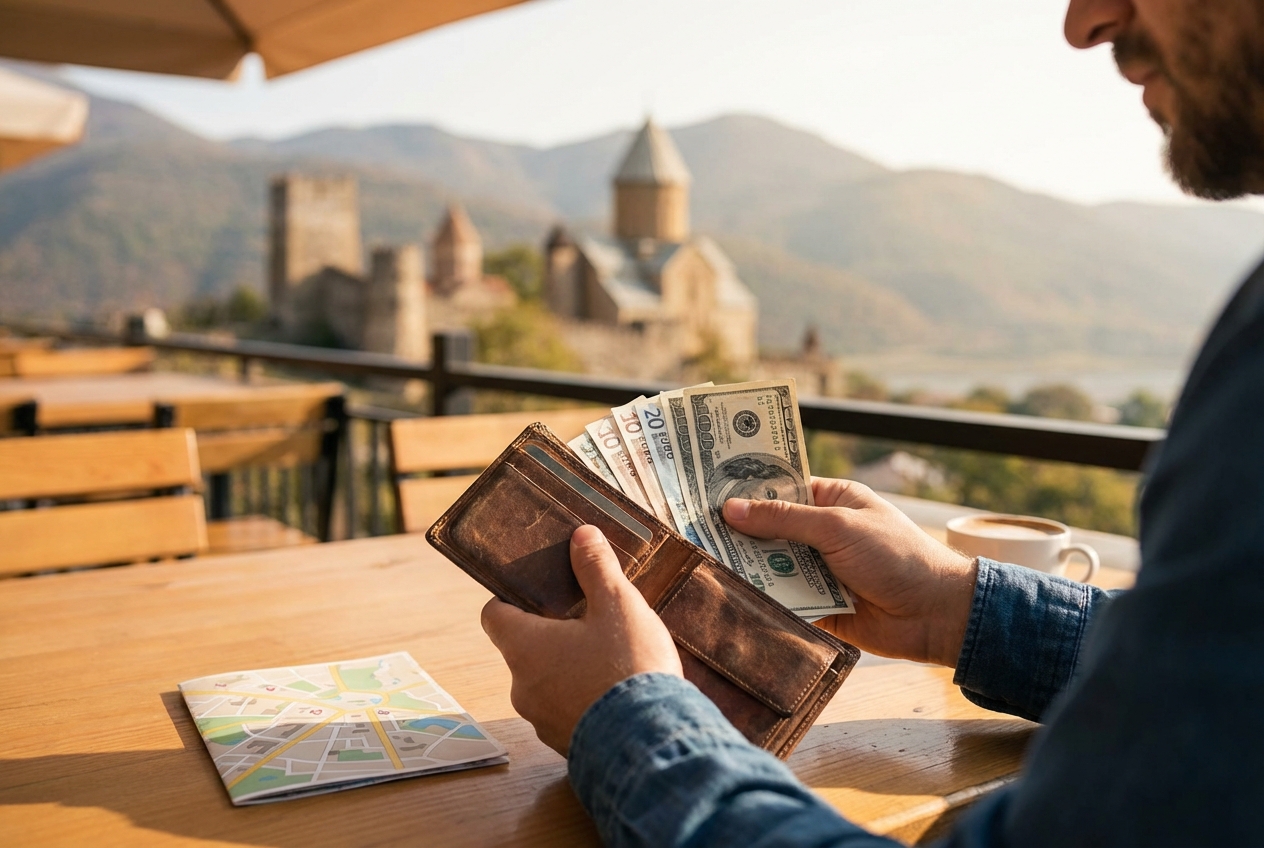
Landing in Tbilisi with a wallet full of the wrong currency can turn your first day into an expensive lesson. I've watched travelers lose 10-15% of their money simply because they brought euros when dollars would have served them better, or exchanged at the airport when a five-minute walk would have saved them serious cash.
So, is it better to carry USD or Euro to Georgia? The short answer: bring US dollars. But the complete answer involves understanding Georgia's unique currency ecosystem, knowing where to exchange, and avoiding the traps that catch thousands of tourists every year. The difference between smart currency management and careless exchanging can easily amount to hundreds of dollars over a two-week trip.
Georgia operates on the Georgian Lari (GEL), and while cards are increasingly accepted in Tbilisi's cafes and hotels, cash remains king for most transactions outside the capital. What you bring and how you exchange it matters more than you might expect.
Currency Landscape in Georgia: GEL vs. Foreign Cash
The Dominance of the Georgian Lari (GEL)
The Georgian Lari has been the country's official currency since 1995, and it's the only legal tender for domestic transactions. You'll see prices listed in GEL everywhere from Tbilisi's trendy wine bars to Svaneti's remote guesthouses. As of February 2026, exchange rates sit at approximately 1 USD to 2.6778 GEL and 1 EUR to 3.1692 GEL, according to Bank of Georgia.
Unlike some tourist-heavy destinations where dollars or euros are accepted alongside local currency, Georgia firmly expects you to pay in Lari. A few high-end hotels might quote rates in foreign currency, but the actual transaction happens in GEL. Street vendors, marshrutka drivers, and most restaurants won't accept anything else.
The Lari has shown moderate volatility over the past few years, which actually works in favor of dollar-carrying travelers. When you exchange at the right moment and the right place, you can stretch your travel budget further than expected.
Why Carrying Hard Currency is Essential
Despite Georgia's growing digital payment infrastructure, arriving without cash is a mistake. ATMs exist in cities but become scarce in mountainous regions like Kazbegi, Mestia, or Tusheti. Many guesthouses, local restaurants, and transportation options operate on a cash-only basis.
There's also a practical consideration: ATM fees add up quickly. Georgian banks typically charge 2-3% per withdrawal, and your home bank likely adds another fee on top. Bringing sufficient hard currency and exchanging it locally often proves cheaper than relying on ATM withdrawals throughout your trip.
One important regulation to keep in mind: amounts exceeding 30,000 GEL or its equivalent must be declared when entering Georgia, as noted by Georgia.to. For most tourists, this won't apply, but if you're planning major purchases or an extended stay, factor this into your planning.
Comparing USD and Euro for Travelers
Exchange Rate Stability and Availability
Here's where the practical difference becomes clear. USD enjoys wider acceptance and typically better exchange rates throughout Georgia. According to My Geo Trip, USD is generally slightly more favorable for exchanging into GEL compared to euros.
The reasons are historical and economic. Georgia maintains strong trade relationships with the United States, and many international transactions within the country are denominated in dollars. Exchange bureaus stock more dollars, competition is fiercer, and the spread between buying and selling rates tends to be tighter.
| Currency | Typical Exchange Rate | Rate Spread | Availability |
|---|---|---|---|
| USD | 2.67-2.68 GEL | 1-2% | Excellent |
| EUR | 3.15-3.17 GEL | 2-3% | Good |
| GBP | Varies widely | 3-5% | Limited |
| RUB | Often unavailable | N/A | Poor |
Euros certainly work, and if you're traveling from a Eurozone country, the convenience of not converting before departure might outweigh the slight rate disadvantage. But if you're starting from scratch, dollars give you more flexibility and better value.
Acceptance in Real Estate and High-Value Purchases
Planning to buy property, rent an apartment long-term, or make significant purchases? USD dominates these markets completely. Real estate listings quote prices in dollars, and landlords expect rent in dollars. Even used car sales often happen in USD.
This dollar preference extends to luxury goods, electronics, and any transaction above a few hundred Lari. Jewelers, antique dealers, and high-end service providers think in dollar terms. Bringing euros for these purposes means an extra conversion step and additional rate loss.
For regular tourism expenses like hotels, restaurants, and tours, the difference matters less. But if your Georgia trip includes any substantial purchases, USD becomes even more clearly the better choice.
Where to Exchange Money for the Best Rates
Bank vs. Street Exchange Booths
Georgia's exchange landscape differs dramatically from Western Europe. Street exchange booths, those small kiosks you'll see throughout Tbilisi and other cities, consistently offer better rates than banks. This surprises travelers accustomed to avoiding street exchanges in other countries, but Georgia's exchange market is legitimate, competitive, and well-regulated.
Banks typically add a 2-4% margin to their exchange rates. They're slower, require more paperwork, and often have limited hours. The only advantage: they can handle large amounts and provide official receipts for business travelers.
Street exchanges operate with razor-thin margins because competition is intense. In central Tbilisi, you might find a dozen exchange points within a single block. DW Auto notes that visiting 5-7 exchange points before swapping currency can lead to significant rate differences. Taking ten minutes to compare rates can save you 1-2% on each exchange.
The best rates cluster around specific areas:
- Rustaveli Avenue and surrounding streets in Tbilisi
- Near Liberty Square
- The area around Marjanishvili metro station
- Main commercial streets in Batumi and Kutaisi
Avoiding Airport and Hotel Currency Traps
Tbilisi International Airport's exchange counters offer rates 5-8% worse than city center options. If you absolutely need cash upon arrival, exchange only enough for a taxi to your hotel, then find a proper exchange point the next day.
Hotel front desks provide convenience but terrible value. They're essentially acting as middlemen, taking a cut on top of already unfavorable rates. Some hotels offer rates 10% below street exchanges. Unless you're desperate at 2 AM, avoid this option entirely.
The same caution applies to exchange services in tourist-heavy areas like the Old Town. They know their customers are convenient-seeking tourists and price accordingly. Walk five minutes toward more residential or commercial areas, and rates improve noticeably.
Practical Tips for Handling Cash in Georgia
The Importance of Banknote Condition
Georgian exchange bureaus are notoriously picky about bill condition. A dollar bill with a small tear, excessive creasing, or any writing on it may be rejected outright or accepted only at a reduced rate. I've seen travelers turned away from multiple exchanges because their bills showed normal wear.
Before leaving home, request crisp, new bills from your bank. Specify that you want uncirculated notes if possible. The 2013 or newer series of US bills are preferred, though older designs are still accepted if in excellent condition.
Keep your bills flat in a secure document holder rather than folded in a wallet. The effort of maintaining pristine currency pays off when you receive full value at exchange.
Small Denominations and Change Etiquette
Bring a mix of denominations. While $100 bills get slightly better rates at some exchanges, they create problems for everyday use. Many smaller exchanges can't break large amounts, and you'll end up with more Lari than you need for immediate expenses.
A practical mix for a two-week trip might look like:
- Several $100 bills for major exchanges
- Ten to fifteen $20 bills for flexibility
- A handful of $10 and $5 bills for smaller conversions
Once you have Lari, the change situation requires patience. Small shops and taxi drivers often claim they don't have change for larger bills. Carry small denominations (1, 2, 5, and 10 Lari notes) for everyday purchases. When you receive change from a larger transaction, hoard those small bills.
Digital Alternatives: ATMs and Card Payments
Card payments have expanded significantly in Georgian cities. Visa and Mastercard work at most restaurants, hotels, and larger shops in Tbilisi, Batumi, and Kutaisi. Contactless payments are increasingly common.
However, several caveats apply. Many establishments add a 2-3% surcharge for card payments, negating any convenience advantage. Smaller businesses, rural areas, and local markets remain cash-only. Your card is a backup, not a primary payment method.
ATMs from Bank of Georgia and TBC Bank are the most reliable. They dispense Lari and occasionally offer USD withdrawals. Withdrawal limits typically range from 400-1000 GEL per transaction. International fees vary by your home bank, but expect to pay $3-5 plus a percentage.
One important consideration for travelers: Advantour reports that all tourists are required to hold an insurance policy with minimum coverage of 30,000 GEL as of January 1, 2026. Having accessible funds for emergencies, whether through cards or cash reserves, supports this requirement.
Indian travelers face additional restrictions. According to Extravelmoney, Indian residents can carry a maximum of ₹25,000 while going outside India. This makes proper currency planning even more critical, as you'll need to exchange or withdraw most of your travel funds after arrival.
Final Verdict: Which Currency Should You Pack?
The answer is clear: bring US dollars to Georgia. They exchange at better rates, enjoy wider acceptance for large purchases, and give you more flexibility throughout your trip. Euros work fine as a backup or if you already have them, but dollars remain the practical choice.
Here's your action plan: Request crisp, new bills from your bank in mixed denominations. Exchange only minimal amounts at the airport, then find competitive street exchanges in city centers. Compare rates at multiple locations before committing. Keep small Lari denominations for daily expenses and save larger bills for significant purchases.
Carry enough cash for your entire trip's estimated expenses plus a 20% buffer. Supplement with a card for emergencies and larger hotel payments. This combination of prepared cash and backup plastic covers virtually any situation Georgia presents.
The difference between smart and careless currency handling easily reaches 8-10% of your total travel budget. For a $3,000 trip, that's $300 back in your pocket simply for bringing the right currency and exchanging it wisely. Your future self, enjoying an extra few nights in a Svaneti guesthouse or another case of Georgian wine, will thank you for the planning.