
Georgia sits at the crossroads of Europe and Asia, a country where ancient monasteries cling to cliff faces, wine flows from 8,000-year-old traditions, and the Caucasus Mountains pierce the sky with snow-capped peaks. But when travelers ask what is the number one attraction in Georgia, the answer depends entirely on what moves you.
Is it the raw natural beauty of canyons and waterfalls? The UNESCO-listed cave cities? The vibrant capital of Tbilisi with its sulfur baths and eclectic architecture? Georgia's tourism industry has exploded in recent years, with international visitor trips increasing by 1.3% in the first quarter of 2025 compared to the same period in 2024, bringing revenues to a record high of 826 million dollars. This small nation of fewer than four million people punches far above its weight in attractions.
The truth is, Georgia doesn't have a single top attraction because its appeal lies in the stunning variety packed into a territory smaller than South Carolina. What I can do is walk you through the destinations that consistently draw the most visitors, generate the most awe, and leave the deepest impressions. From the ancient streets of Tbilisi to the dramatic peaks of Kazbegi, here's your guide to Georgia's most compelling destinations.
Defining the Top Contender: Tbilisi's Old Town
If forced to name one place that captures Georgia's essence, most travelers point to Tbilisi's Old Town. The capital city serves as the gateway for nearly every visitor, and its historic core delivers an experience unlike anywhere else in Europe or Asia.
Scale and Architectural Diversity
Tbilisi's Old Town sprawls beneath the Narikala Fortress, a fourth-century citadel that has watched over the city through Persian, Arab, Mongol, and Russian rule. The architecture below tells this complicated story. You'll find Persian-style wooden balconies jutting over narrow lanes, Art Nouveau mansions from the Russian imperial period, and Soviet brutalist blocks visible on the skyline beyond.
The scale surprises first-time visitors. This isn't a manicured museum district but a living neighborhood where elderly women hang laundry from those famous carved balconies and children play football in courtyards that haven't changed in centuries. The famous sulfur baths in the Abanotubani district still operate as they have since the city's founding, when King Vakhtang Gorgasali supposedly discovered the hot springs while hunting.
The Sulfur Bath Experience
No visit to Tbilisi is complete without the sulfur baths. The domed brick bathhouses look like something from a Persian miniature painting, and the experience inside matches the exterior drama. Private rooms offer marble basins, scalding mineral water, and the option for a kisi scrub that removes approximately three layers of skin.
The baths cost anywhere from 50 to 150 Georgian Lari for a private room, depending on the establishment and time of day. Chreli Abano and Orbeliani Baths are the most photographed, but locals often prefer the simpler public baths for authenticity. The mineral-rich water genuinely does wonders for tired muscles after a day of climbing Tbilisi's steep streets.
Cultural and Culinary Heart
Tbilisi's Old Town also serves as the country's culinary epicenter. The city's restaurants have earned international recognition, with Georgian cuisine gaining devoted followers worldwide. Khinkali dumplings, khachapuri cheese bread, and wines fermented in clay qvevri vessels represent a food culture that UNESCO has recognized as intangible cultural heritage.
The Black Sea Arena was named Georgia's Leading Tourist Attraction in 2025 by the World Travel Awards, but Tbilisi remains the beating heart of Georgian tourism. The city's combination of history, food, nightlife, and accessibility makes it the logical starting point for any Georgian adventure.
The Cultural Significance of Vardzia Cave Monastery
Carved into the cliffs of the Erusheti Mountain, Vardzia represents one of humanity's most ambitious medieval construction projects. This cave monastery complex once housed 6,000 monks and stretched across 13 levels of tunnels, churches, and living quarters.
Natural Beauty and Engineering Marvel
Queen Tamar commissioned Vardzia in the 12th century as both a monastery and a fortress against Mongol invasion. The site originally featured over 3,000 caves connected by tunnels, though a 13th-century earthquake exposed much of the complex to the outside world. What remains is still staggering: hundreds of rooms carved directly into the volcanic rock, many still bearing original frescoes.
The setting amplifies the impact. The Mtkvari River curves below the cliff face, and the surrounding landscape of dry hills and distant peaks feels almost lunar. Visiting requires a drive of about four hours from Tbilisi, but the journey passes through the wine region of Kartli and the fortress town of Akhaltsikhe, making it a worthwhile road trip.
| Feature | Details |
|---|---|
| Construction Period | 1185-1205 CE |
| Original Caves | 3,000+ |
| Remaining Caves | ~600 |
| Height | 13 levels |
| UNESCO Status | On Tentative List |
Spiritual Significance and Active Worship
Vardzia isn't just a tourist site. A small community of monks still lives in the complex, and the Church of the Dormition holds regular services. The frescoes inside this church include a famous portrait of Queen Tamar herself, one of the few contemporary images of Georgia's most celebrated ruler.
Visitors can explore a significant portion of the complex, climbing through narrow passages and emerging onto balconies with commanding views. The experience requires reasonable fitness and comfort with heights, but the reward is a genuine sense of discovery that larger, more developed attractions can't match.
Exploring the Ancient Charm of Mtskheta
Just 20 kilometers from Tbilisi, Mtskheta served as Georgia's capital for nearly a thousand years and remains the spiritual center of the Georgian Orthodox Church. The entire town holds UNESCO World Heritage status, and its two main churches rank among the most important in Eastern Christianity.
The Iconic Jvari Monastery
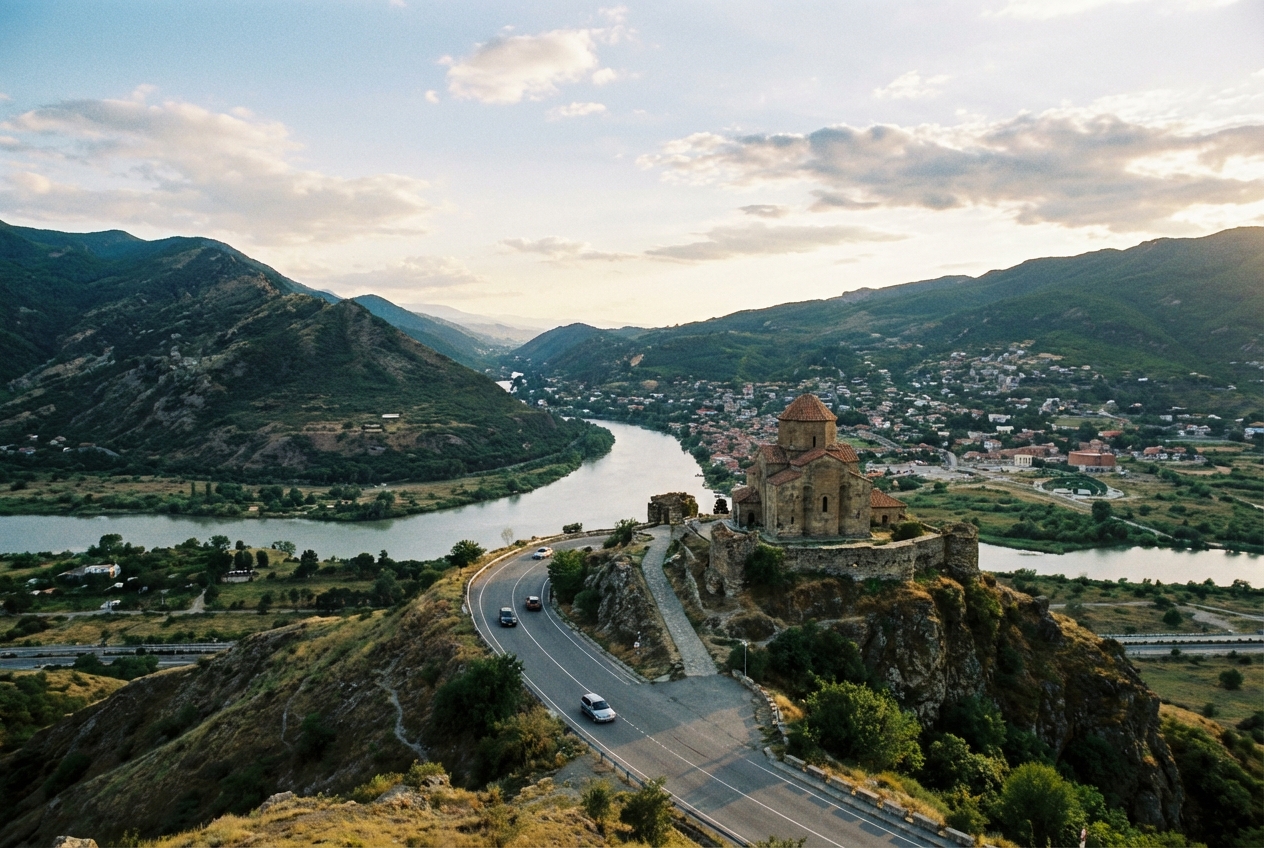
Jvari Monastery sits on a mountaintop overlooking Mtskheta, at the exact spot where St. Nino is said to have erected a wooden cross in the fourth century. The current stone church dates to the sixth century and established an architectural style that influenced Georgian church design for the next millennium.
The views from Jvari alone justify the visit. Below, the Mtkvari and Aragvi rivers merge in a dramatic confluence, with Mtskheta's terracotta roofs clustered along the banks. The monastery appears in countless Georgian paintings and poems, including Lermontov's famous work "The Novice." Reaching Jvari requires either a taxi or a steep hike from the town below.
Svetitskhoveli Cathedral and Sacred History
Svetitskhoveli Cathedral dominates Mtskheta's center, its massive stone walls enclosing one of Christianity's most sacred sites. According to tradition, the cathedral stands over the burial place of Christ's robe, brought to Georgia by a Jewish man named Elias who witnessed the crucifixion.
The current cathedral dates to the 11th century, though churches have stood on this spot since the fourth century. Inside, the scale overwhelms: massive stone pillars support a dome that seems impossibly high, and frescoes cover nearly every surface. Georgian kings were crowned and buried here, and the building remains the seat of the Catholicos-Patriarch of All Georgia.
Nature and Adventure in Kazbegi
The Kazbegi region, officially called Stepantsminda, delivers the dramatic mountain scenery that defines Georgia's tourism marketing. The drive from Tbilisi follows the Georgian Military Highway, one of the world's great road trips, climbing through alpine meadows to the Russian border.
Gergeti Trinity Church and Mount Kazbek
Gergeti Trinity Church might be Georgia's single most photographed site. The 14th-century church perches at 2,170 meters elevation, with the 5,033-meter peak of Mount Kazbek rising directly behind. On clear days, the composition of ancient stone church against eternal snows creates images that seem digitally enhanced.
Reaching the church requires either a 90-minute hike or a bumpy 4×4 ride. The hike offers better views and a genuine sense of pilgrimage, passing through meadows that explode with wildflowers in summer. The church itself remains active, and visitors should dress modestly and maintain respectful silence inside.
Trekking and Adventure Tourism
Kazbegi has developed into Georgia's premier adventure tourism destination. Multi-day treks lead to glacier camps on Mount Kazbek, while easier day hikes access waterfalls, alpine lakes, and abandoned villages. Paragliding operators offer tandem flights over the valley, and mountain biking trails wind through the surrounding hills.
The town of Stepantsminda provides comfortable accommodation and surprisingly good restaurants, making it possible to experience high mountain scenery without roughing it. Many visitors combine a Kazbegi trip with stops at the Ananuri Fortress and the Gudauri ski resort along the Georgian Military Highway.
Tbilisi's Urban Landmarks and Heritage
Beyond the Old Town, Tbilisi offers contemporary attractions that showcase Georgia's creative energy and complicated 20th-century history.
The Bridge of Peace and Modern Architecture
The Bridge of Peace, a wavy glass-and-steel pedestrian bridge designed by Italian architect Michele De Lucchi, has become a symbol of Tbilisi's post-Soviet transformation. Spanning the Mtkvari River, it connects the Old Town to Rike Park and the controversial new concert hall and exhibition center.
Tbilisi's architectural conversation between old and new generates strong opinions. Some see the modern additions as vital signs of progress, while others view them as jarring intrusions. Either way, the juxtaposition creates a visual energy that few cities can match. Walking from a medieval church to a cutting-edge contemporary building takes only minutes.
The Chronicle of Georgia and Soviet Legacy
The Chronicle of Georgia, also called the Stonehenge of Tbilisi, stands on a hill overlooking the Tbilisi Sea reservoir. This massive monument features 16 columns covered in carved scenes from Georgian history and biblical stories. Soviet sculptor Zurab Tsereteli began the project in 1985, and it remains officially unfinished.
The site receives fewer visitors than it deserves, partly because of its location outside the city center. But the scale impresses: each column stands 35 meters tall, and the carved figures include Georgian kings, queens, and religious figures. The views over the reservoir and city add to the experience, particularly at sunset.
How to Choose Your Must-Visit Georgia Destination
Selecting where to spend your time in Georgia depends on your interests, physical abilities, and travel style. Here's a practical framework for making that decision.
For first-time visitors with limited time: Focus on Tbilisi and a day trip to Mtskheta. You'll experience the country's cultural heart, taste the cuisine, and visit UNESCO World Heritage sites without exhausting travel days.
For nature lovers and hikers: Prioritize Kazbegi and the Svaneti region. The mountain scenery rivals the Alps at a fraction of the cost and crowds. Summer offers the best hiking conditions, while winter brings excellent skiing at Gudauri.
For history enthusiasts: Combine Vardzia with the cave town of Uplistsikhe and the wine region of Kakheti. This route covers Georgia's ancient past, medieval golden age, and 8,000-year wine tradition.
For adventure seekers: Consider the Tusheti region, accessible only by a terrifying mountain road that opens in summer. The isolation and traditional tower villages offer an experience increasingly rare in modern Europe.
Georgia rewards both careful planning and spontaneous exploration. The country's small size means you can cover significant ground in a week, but the depth of experiences available means you could easily spend a month without running out of discoveries.
Whether you're drawn by the sulfur baths of Tbilisi, the cave monasteries of Vardzia, or the alpine peaks of Kazbegi, Georgia delivers experiences that feel genuinely different from anywhere else. The number one attraction isn't a single place but the remarkable concentration of history, nature, and culture packed into this small Caucasian nation. Start planning your trip, and prepare to understand why visitor numbers keep climbing year after year.