
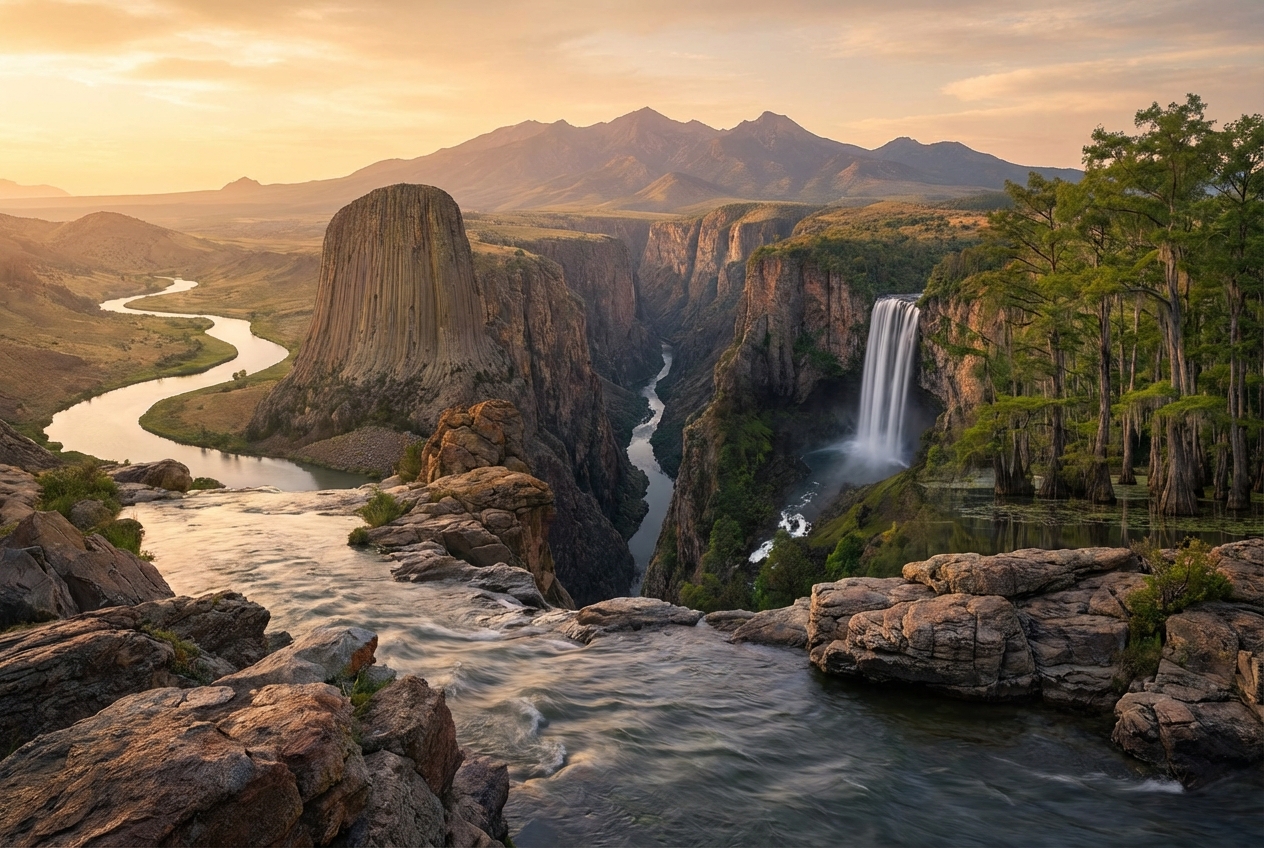
Georgia, the small nation nestled between the Greater and Lesser Caucasus mountains, contains some of the most dramatic landscapes in all of Eurasia. From thundering waterfalls to ancient healing springs, this country packs extraordinary geological diversity into a territory roughly the size of South Carolina. The seven natural wonders of Georgia represent the country’s most spectacular gifts from nature: places where the earth reveals its raw power and timeless beauty.
These sites draw visitors from across the globe, contributing to Georgia’s booming tourism industry. The country welcomed a record 174.2 million domestic and international visitors in 2024, many of them seeking exactly these natural treasures. What makes Georgia’s wonders particularly special is their accessibility. Unlike remote natural attractions in other countries, most of Georgia’s seven wonders can be reached within a day trip from Tbilisi. You can stand beneath a 700-foot waterfall in the morning and explore a prehistoric swamp by afternoon. Each wonder tells a different story about Georgia’s geological history, from ancient seabeds transformed into colorful canyons to underground rivers that surface as crystal-clear springs.
Defining the Seven Natural Wonders of Georgia
The concept of Georgia’s seven natural wonders emerged from a recognition that this small country punches far above its weight in geological diversity. The official list includes Amicalola Falls, Tallulah Gorge, Stone Mountain, Providence Canyon, Warm Springs, Okefenokee Swamp, and Radium Springs. Each represents a distinct type of natural formation, from granite monoliths to subterranean aquifers.
What qualifies as a natural wonder? These sites share several characteristics: they formed through natural processes over millions of years, they possess unique geological or ecological significance, and they inspire genuine awe in visitors. Stone Mountain, for instance, isn’t just a big rock. It’s the largest exposed granite monolith on Earth, a geological feature that has drawn human attention for thousands of years.
The seven wonders span Georgia’s three main geographic regions. The northern mountains contribute dramatic waterfalls and deep gorges carved by ancient rivers. The central Piedmont region offers thermal springs and granite outcrops. The southern coastal plain provides vast wetlands and mysterious springs that emerge from underground limestone caves. This geographic spread means that visiting all seven requires traveling across the entire country, experiencing Georgia’s full range of climates and ecosystems.
Tourism generated $5.1 billion in state and local tax revenues in 2024, saving each Georgian household an average of $1,285 in annual taxes. The natural wonders play a significant role in this economic contribution, drawing hikers, photographers, and nature enthusiasts who spend money at local hotels, restaurants, and guide services.
The Mountains and Gorges of North Georgia
Northern Georgia contains some of the most vertically dramatic terrain anywhere in the Caucasus foothills. Rivers have spent millions of years cutting through ancient rock, creating waterfalls and gorges that rival anything in the Alps or Rockies. Three of Georgia’s seven natural wonders cluster in this mountainous region, each offering a different perspective on the power of water and time.
Amicalola Falls: The Southeast’s Highest Waterfall
Standing at the base of Amicalola Falls, you feel the spray on your face before you fully comprehend the scale. Amicalola Falls is the tallest cascading waterfall in the Southeast, plunging 729 feet over a series of granite ledges. The name comes from a Cherokee word meaning “tumbling waters,” and it perfectly describes the way the water breaks and reforms as it descends.
The falls don’t drop in a single dramatic plunge like Niagara. Instead, water cascades down seven distinct steps, each creating its own mini-waterfall within the larger system. This cascading structure makes Amicalola particularly photogenic, with countless vantage points offering different compositions. The best views come from the 604-step staircase that climbs alongside the falls, though the hike will test your legs.
Spring runoff creates the most impressive flow, typically between March and May. By late summer, the cascade slows to a trickle, though the rock formations remain striking. The surrounding state park offers 12 miles of hiking trails, including the approach trail to the famous Appalachian Trail.
Tallulah Gorge: The Grand Canyon of the East
If Amicalola demonstrates water’s beauty, Tallulah Gorge reveals its destructive power. This canyon formation stretches 3 miles long and plunges 1,200 feet deep, carved over millions of years by the Tallulah River. The gorge earned its “Grand Canyon of the East” nickname honestly, offering sheer cliff walls, multiple waterfalls, and a suspension bridge that crosses 80 feet above the rocky floor.
The gorge contains six distinct waterfalls within its walls, ranging from gentle cascades to dramatic drops. Hurricane Falls, the tallest at 96 feet, thunders through a narrow chasm that amplifies its roar. Reaching the gorge floor requires a permit and significant climbing ability, as the trail involves metal staircases bolted to cliff faces.
For those preferring less extreme adventures, rim trails offer spectacular overlooks without the technical descent. The suspension bridge provides perhaps the most dramatic experience: standing above the void, feeling the bridge sway slightly, watching the river churn far below.
Stone Mountain: The World’s Largest Exposed Granite Monolith
Stone Mountain presents a different kind of wonder: not carved by water, but revealed by erosion. This massive granite dome rises 825 feet above the surrounding piedmont, a single piece of igneous rock that formed deep underground roughly 300 million years ago. As softer surrounding rock eroded away, the harder granite remained, eventually emerging as the exposed monolith visible today.
The mountain’s sheer scale defies easy comprehension. Its circumference measures five miles. The exposed granite face covers 583 acres. Geologists estimate the underground portion extends several miles deeper than the visible surface.
|
Stone Mountain Statistics |
Measurements |
|---|---|
|
Height above ground |
825 feet |
|
Circumference |
5 miles |
|
Exposed surface area |
583 acres |
|
Age of granite |
300 million years |
|
Summit elevation |
1,686 feet |
The walk-up trail to the summit covers about one mile of steep granite slope. The surface can become dangerously slick when wet, so dry conditions are essential. From the top, views extend across the Georgian countryside for miles in every direction.
Unique Geological Formations and Canyons
Beyond the northern mountains, Georgia contains geological oddities that seem almost out of place in this region. A miniature painted desert in the southwest. Thermal springs that attracted a president seeking healing. These formations reveal different chapters in Georgia’s geological story.
Providence Canyon: Georgia’s Little Grand Canyon
First-time visitors to Providence Canyon often stop in disbelief. The brilliant orange, pink, purple, and white striped walls look like they belong in Arizona or Utah, not the pine forests of southwestern Georgia. This “Little Grand Canyon” plunges 150 feet deep and stretches across 1,100 acres, a landscape that seems transported from another continent.
The canyon’s origin story contains an ironic twist: human activity accelerated its formation. Poor farming practices in the 1800s stripped vegetation from the land, allowing rainwater to erode the soft Providence formation sediments. What took nature millions of years to begin, humans dramatically accelerated in just two centuries.
The colorful striations come from different mineral compositions in the sediment layers. Iron oxides create the reds and oranges. Manganese produces purple hues. White kaolin clay provides contrast. As light shifts throughout the day, the colors seem to change and intensify.
Nine canyon “fingers” branch off from the main formation, each offering different color combinations and formations. The canyon floor trail winds through all nine, a 2.5-mile loop that takes most hikers two to three hours. The soft sand makes walking tiring but creates a surreal, almost lunar landscape.
Warm Springs: The Healing Waters of the Piedmont
Warm Springs earned its fame not for visual drama but for therapeutic properties. These naturally heated waters emerge from underground at a constant 88 degrees Fahrenheit, carrying dissolved minerals that have drawn health seekers for centuries. The Cherokee people used these springs long before European settlement.
The springs gained international recognition when Franklin D. Roosevelt discovered them in 1924. Suffering from polio, Roosevelt found that the buoyant, warm water allowed him to exercise muscles that couldn’t function on land. He eventually built the Little White House nearby and founded a polio treatment center that operated for decades.
The geological mechanism behind the springs involves rainwater percolating deep into the earth, being heated by geothermal energy, then rising back through fractured rock. The specific mineral content includes calcium, magnesium, and trace amounts of other elements that gave the water its reputation for healing properties.
Coastal and Wetland Marvels
Georgia’s southern reaches contain natural wonders of a different character: vast wetlands and mysterious springs that emerge from underground aquifers. These sites lack the vertical drama of northern Georgia but possess their own profound beauty and ecological significance.
Okefenokee Swamp: The Land of the Trembling Earth
The Okefenokee Swamp covers nearly 700 square miles of blackwater wetland, one of the largest intact freshwater ecosystems in North America. Its name comes from a Seminole word meaning “Land of the Trembling Earth,” describing the floating peat islands that shake when walked upon. This primordial landscape looks much as it did thousands of years ago, a window into prehistoric Georgia.
The swamp supports an extraordinary diversity of life. American alligators number in the thousands. Sandhill cranes nest in the marshes. Carnivorous pitcher plants trap insects in the nutrient-poor waters. Cypress trees draped in Spanish moss create cathedral-like canopies over the blackwater channels.
Kayaking through the Okefenokee feels like traveling back in time. The tea-colored water, stained by tannins from decaying vegetation, creates mirror-like reflections of the overhanging trees. Alligators slide silently into the water as you approach. Bird calls echo across the marsh. The absence of human noise becomes almost disorienting.
However, this ancient ecosystem faces modern threats. The Okefenokee Swamp is threatened by proposed mining on Trail Ridge, which could destroy the structural integrity of the ridge and dewater wetlands. Environmental organizations continue fighting to protect this irreplaceable natural wonder from industrial development.
Radium Springs: The Deep Blue Subterranean Waters
Radium Springs offers perhaps the most visually striking single moment among Georgia’s natural wonders. The spring emerges from underwater caves at a constant 68 degrees, with 70,000 gallons per minute flowing from deep within the Floridan Aquifer. The water’s clarity and depth create an intense blue color that seems almost artificial.
The spring’s name comes from trace amounts of naturally occurring radium in the water, though the levels are far too low to pose any health concern. Early 20th-century visitors believed the radium provided health benefits, a notion now understood as pseudoscience but which contributed to the spring’s early popularity.
The spring pool measures 25 feet deep at its center, with visibility extending to the bottom on calm days. The limestone cave system that feeds the spring extends for unknown distances underground, part of the vast Floridan Aquifer that underlies much of the southeastern coastal plain.
|
Georgia’s Seven Natural Wonders |
Type |
Key Feature |
|---|---|---|
|
Amicalola Falls |
Waterfall |
729-foot cascade |
|
Tallulah Gorge |
Canyon |
1,200 feet deep |
|
Stone Mountain |
Granite monolith |
Largest exposed in world |
|
Providence Canyon |
Eroded canyon |
Colorful sediment layers |
|
Warm Springs |
Thermal spring |
88°F constant temperature |
|
Okefenokee Swamp |
Wetland |
700 square miles |
|
Radium Springs |
Subterranean spring |
70,000 gallons per minute |
How to Visit and Preserve Georgia’s Natural Heritage
Experiencing all seven natural wonders requires planning, as they spread across the country’s diverse geography. A comprehensive tour takes at least a week, though many visitors choose to focus on one region per trip. The northern wonders cluster close enough for a long weekend, while the southern sites require separate expeditions.
Timing matters significantly. Spring brings the heaviest waterfall flows and comfortable hiking temperatures. Summer offers the longest days but also the most intense heat, particularly at Providence Canyon where the exposed sediments absorb and radiate solar energy. Fall provides spectacular foliage at the northern sites. Winter allows solitude at all locations, though some facilities operate on reduced schedules.
Preservation of these wonders requires active engagement from visitors. Stay on marked trails at Providence Canyon, where foot traffic accelerates erosion of the soft sediments. Maintain distance from wildlife at Okefenokee, where alligators deserve respect as apex predators. Pack out all trash, as even biodegradable items can take years to decompose in these ecosystems.
Supporting local conservation organizations helps protect these sites for future generations. The Georgia Conservancy, Georgia Rivers Network, and individual state park foundations all accept donations and volunteers. Even simple actions like sharing responsible tourism practices on social media can influence how others interact with these fragile environments.
Georgia’s seven natural wonders represent millions of years of geological history compressed into accessible, awe-inspiring sites. From the thundering cascade of Amicalola Falls to the primordial stillness of the Okefenokee, these places remind us that nature’s most spectacular creations often require nothing from humans except our presence and our protection. Visit them, photograph them, share them with others, but above all, help ensure they remain for the generations who will discover them after us.