
Table of Contents
- What is Barbaroba? St. Barbara’s Day and the Lobiani Tradition
- The History and Religious Significance of 17 December
- Comparing Georgian Breads: Lobiani vs Khachapuri vs Kubdari
- Regional Variants: From Classic to Racha Ham Lobiani
- Where to Try Good Lobiani in Tbilisi and on the Road
- A Short Simple Lobiani Recipe for Barbaroba
- Frequently Asked Questions About Barbaroba and Lobiani
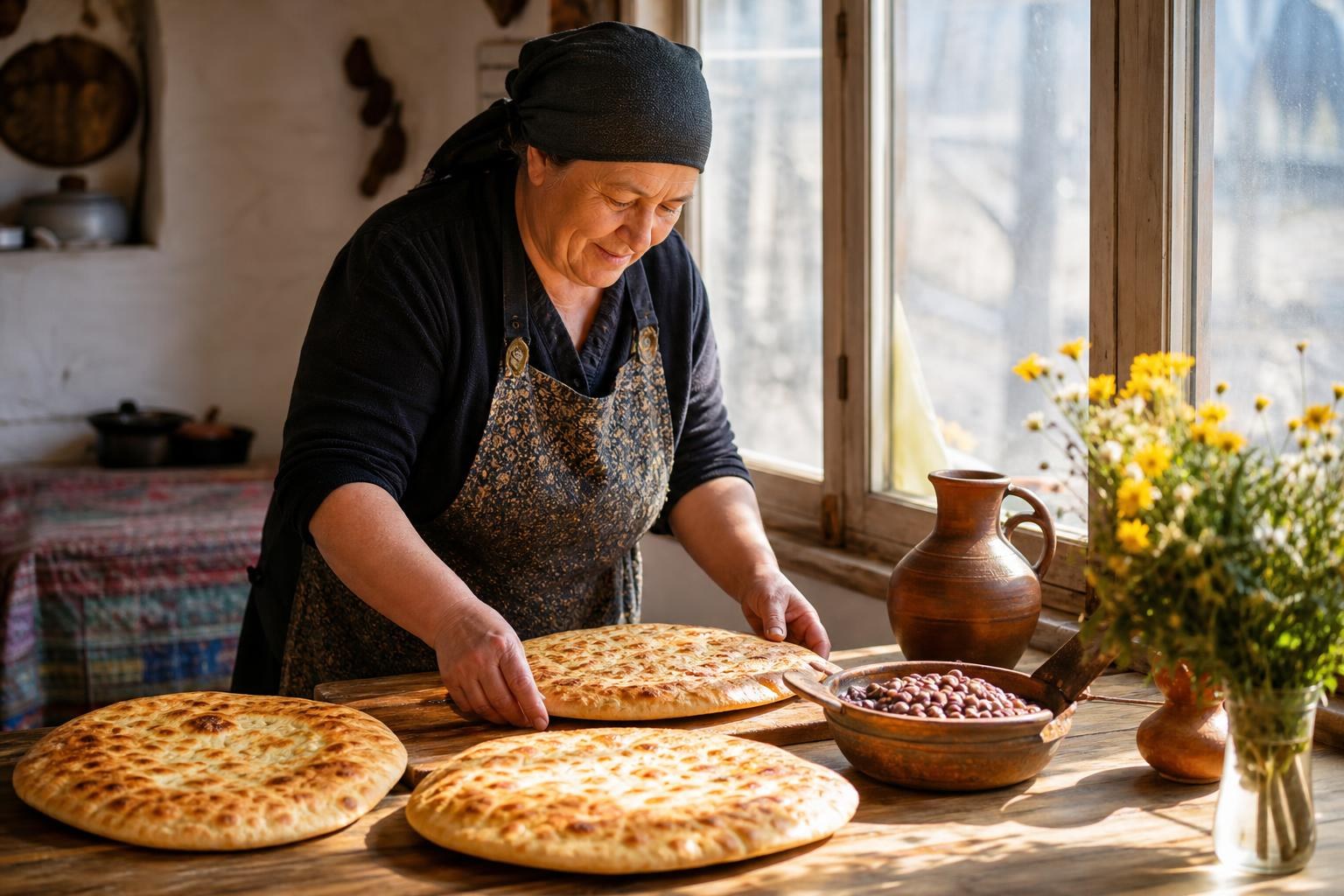
Barbaroba is St. Barbara’s Day in Georgia, celebrated every year on 17 December, and the food that defines it is lobiani: a round flatbread stuffed with spiced, mashed kidney beans. It falls during the Orthodox Nativity Fast, so meat is off the table and bean bread takes centre stage in nearly every Georgian kitchen.
If you’re in Georgia in mid-December, expect bakeries, home kitchens and roadside stalls to turn out lobiani in unusual quantities. Here’s what the day means, how the bread compares with its cheesy cousins, where to find a good one, and how to bake your own.
What is Barbaroba? St. Barbara’s Day and the Lobiani Tradition
Barbaroba (ბარბარობა) takes its name from Barbare, the Georgian form of Barbara. The saint is honoured as a protector of health, and families mark the day quietly at home rather than with public festivities. You won’t see parades or street closures. Instead, you’ll smell baking bread on almost every residential street.
The food rule is simple: on Barbaroba you eat lobiani. The name comes from lobio, the Georgian word for beans, and the bread is, as one food writer puts it, the meeting point of two Georgian obsessions: bread and beans. It turns humble bean stew into something portable and filling.
The day carries a second layer of meaning. Many Georgians treat 17 December as a “day of destiny,” believing that how you behave and who first crosses your threshold (the mekvle, or first-footer) will shape your luck for the coming year. Some families plan the first visitor carefully, choosing someone cheerful and kind.
For travellers, that means a few practical things:
- Homes are busy: if you’re invited in, accept a piece of lobiani. Turning down food is taken more personally here than in most Western countries.
- Bakeries sell out: popular spots can run low by evening on 17 December.
- Shops and roads run normally: it isn’t an official public holiday, so plan driving days as usual.
The History and Religious Significance of 17 December
Barbaroba is St. Barbara’s Day, and Georgians have marked it on 17 December for a very long time: the tradition dates back to the 9th century. Saint Barbara was an early Christian martyr, and in Georgian folk belief she became linked to protection from illness, especially smallpox and childhood diseases. Older generations still mention her when wishing someone good health.
The date matters as much as the saint. The Georgian Orthodox Church follows the Julian calendar, so Christmas falls on 7 January. The 40-day Nativity Fast before it runs from November 28 into early January, and during that period devout believers avoid meat, and many also skip dairy and eggs.
That’s exactly why lobiani became the official food of the day. A bean-filled bread is fast-friendly when made with a lean dough, yet rich enough to feel like a feast. Khachapuri, with its cheese and egg, simply doesn’t fit the rules.
There’s an older, pre-Christian echo here too. Ethnographers note that ritual breads and porridges marking seasonal feasts appear across the Caucasus. Beans and bread at the darkest point of the year likely carried hopes for abundance long before the saint’s name was attached to the day.
Note: Not every Georgian fasts strictly in 2026, especially in Tbilisi. Rural families tend to follow the rules more closely, so village lobiani on Barbaroba is more likely to be fully lean.
Comparing Georgian Breads: Lobiani vs Khachapuri vs Kubdari
Visitors often lump all Georgian filled breads together. They’re quite different in filling, region and when you’d eat them.
| Bread | Filling | Home region | Fasting-friendly? | Best for |
|---|---|---|---|---|
| Lobiani | Mashed kidney beans, onion, spices | Nationwide; Racha has a ham version | Yes (classic version, lean dough) | Barbaroba, cold days, cheap filling meal |
| Khachapuri (Imeruli/Megruli) | Sulguni or Imeretian cheese | Imereti, Samegrelo, nationwide | No | Everyday meals, supras |
| Adjaruli khachapuri | Cheese, butter, raw egg | Adjara (Batumi) | No | A heavy sit-down meal |
| Kubdari | Chopped beef or pork, onion, Svan spices | Svaneti | No | Mountain trips, hearty dinners |
Lobiani is the most forgiving of the three on your stomach and your budget. Kubdari is the one to hunt down in Mestia, and khachapuri is the one you’ll eat whether you plan to or not.
Tip: If you’re travelling with vegetarians or vegans, a classic lobiani is often the safest bakery choice. Ask “ukhortsoa?” (is it without meat?) since some bakers use lard or a ham-based filling.
Regional Variants: From Classic to Racha Ham Lobiani
The classic lobiani you’ll find in Tbilisi uses boiled red kidney beans mashed with fried onion, salt, black pepper and herbs such as summer savory (kondari) or dried coriander. Some bakers add a little butter; strict fasting versions use oil. The dough is usually a soft yeasted one, baked in a tone oven or on a tray.
Racha, the mountainous region in western-central Georgia, does something different. Rachan cooks boil the beans with smoked ham, known as Rachuli lori, which gives the filling a deep, smoky flavour. The bread is often glazed and baked until the crust is glossy and dark. It’s richer, heavier and, for many Georgians, the best version in the country.
Because it contains pork, Racha-style lobiani isn’t a fasting dish. You’ll find it year-round in Racha and in Tbilisi restaurants specialising in regional food.
Other variations you might spot:
- Imeretian style: thinner dough, sometimes baked on a ketsi (clay dish).
- Guria and Samegrelo: spicier fillings with ajika or more chili.
- Home versions: smashed beans with walnut or a pinch of blue fenugreek (utskho suneli).
If you want to try lori-filled lobiani at the source, it’s worth building a drive into Racha around it. See our Racha guide for routes into Ambrolauri and Oni, road conditions on the mountain passes, and where to stay.
Where to Try Good Lobiani in Tbilisi and on the Road
You don’t need a restaurant to eat great lobiani, but a few places stand out.
Mapshalia, the long-running canteen-style Megrelian restaurant on Agmashenebeli Avenue in Tbilisi, is a reliable stop for no-frills Georgian food at local prices. The lobiani is simple and filling. Expect plastic menus, fast service and a mostly Georgian crowd: the opposite of the polished Old Town places aimed at tourists.
The Tbilisi metro underpasses are where most locals actually buy their lobiani. Small bakery windows near metro stations sell hot bean bread and khachapuri to commuters all day. Quality varies stall by stall, so follow the queue. A stall with a line at 8 a.m. is usually baking fresh batches.
Salobie, on the edge of Mtskheta, is the one to drive to. The name roughly means “bean place,” and beans are the point: lobio served in clay pots alongside mchadi (cornbread) and lobiani. It’s a favourite lunch stop for Georgians on day trips to Jvari and Svetitskhoveli.
Important: Opening hours and prices change often, and Salobie can be packed on weekends and holidays, including Barbaroba itself. Check current hours on Google Maps before setting off.
Getting There by Car: The Drive to Salobie Mtskheta
- Start: central Tbilisi
- Distance: roughly 20-25 km depending on your start point
- Drive time: about 25-40 minutes outside rush hour; longer in evening traffic leaving the city
- Road condition: paved main road (the Mtskheta highway), no 4×4 needed
- Parking: on-site and roadside parking is usually available, but weekend lunches fill up fast
- Seasonal notes: no seasonal closures on this route; in December, watch for early darkness and occasional icy patches in the mornings
Renting a car in Tbilisi makes this an easy half-day loop: lunch at Salobie, then Jvari Monastery and Svetitskhoveli Cathedral before dark.
A Short Simple Lobiani Recipe for Barbaroba
This makes two medium breads, enough for four people. Plan for soaking overnight and about 2.5 hours of active and baking time the next day.
Ingredients:
- Beans: 300 g dried red kidney beans, soaked overnight
- Onion: 1 large, finely chopped
- Fat: 3 tbsp sunflower oil (or butter if you’re not fasting)
- Seasoning: 1 tsp dried summer savory, salt, black pepper, optional pinch of chili
- Dough: 500 g flour, 7 g dried yeast, 1 tsp sugar, 1 tsp salt, 300 ml warm water, 2 tbsp oil
Method:
- Drain the soaked beans, cover with fresh water and boil hard for 10 minutes, then simmer until very soft, about 1-1.5 hours.
- Meanwhile, mix the dough ingredients, knead for 8-10 minutes until smooth, cover and leave to rise until doubled (around an hour).
- Fry the onion in oil until golden. Drain the beans well and mash them with the onion, savory, salt and pepper. The filling should be thick and dry, not soupy.
- Divide the dough in two. Flatten each piece into a disc, place half the filling in the middle, gather the edges up and pinch closed.
- Turn seam-side down and gently press out into a flat round, about 1.5 cm thick. Prick the top with a fork.
- Bake at 220°C for 20-25 minutes until golden. Brush with butter or oil while hot.
Tip: Boil red kidney beans properly. Undercooked kidney beans can make you ill, so don’t skip the hard boil at the start.
Frequently Asked Questions About Barbaroba and Lobiani
Is Barbaroba a public holiday in Georgia?
No. It’s a religious and family occasion, so banks, shops and government offices stay open. Traffic and road travel aren’t affected.
Can I eat lobiani cold?
Yes. Many Georgians pack leftover slices for long drives or picnics. It reheats well in a dry pan too.
Is lobiani always vegan?
Not always. Classic fast-day versions are, but some bakers use butter, egg wash or lard, and Racha-style bread contains ham. Ask before you buy.
What do Georgians drink with lobiani?
Usually tea, Borjomi mineral water or tarragon soda. Homemade pickles (mzhave) often come on the side.
Can I find lobiani outside December?
Easily. It’s sold year-round in bakeries across the country. Barbaroba is just the day when nearly everyone eats it.
Barbaroba is one of the easiest Georgian traditions for a visitor to join: no tickets, no dress code, just a warm slice of bean bread on a cold December day. If you’re in Tbilisi on the 17th, grab one from a metro stall in the morning, then drive out to Mtskheta for a proper bean lunch. And if the smoky Racha version wins you over, that’s a good excuse to plan your next road trip into the mountains.