
Table of Contents
- Why Dmanisi Matters: 1.8-Million-Year-Old Hominin Finds
- The Dmanisi Archaeological Site and Museum
- Exploring the Medieval Town and Dmanisi Sioni
- Getting There by Car: Tbilisi to Kvemo Kartli
- Planning Your Visit: Opening Months and Hours
- The Perfect Kvemo Kartli Itinerary
- Regional Travel Logistics Table
- Practical Tips for the Kvemo Kartli Region
- Frequently Asked Questions
Dmanisi, a hilltop village in Georgia’s Kvemo Kartli region, is where archaeologists found the oldest human fossils known outside Africa: skulls and bones roughly 1.8 million years old. It sits about 95 km southwest of Tbilisi, around two hours by car on decent roads, so it makes an easy day trip if you have a rental car or a driver.
The same plateau holds a ruined medieval trading town and a 6th-century cathedral, which means you get prehistoric and Christian history at a single stop. Pair it with Bolnisi Sioni and the Samshvilde canyon and you have one of the most rewarding full days you can drive out of the capital.
This guide covers what you will see, how to get there, how long each stop takes, and when the site is likely to be open.
Why Dmanisi Matters: 1.8-Million-Year-Old Hominin Finds
Until the early 1990s, the standard textbook story was fairly tidy. Early humans evolved in Africa, and the first ones to leave were large-brained, long-legged Homo erectus, equipped with fairly sophisticated stone tools. The usual assumption was that you needed a big brain and advanced technology before you could walk out of Africa and survive in Eurasia.
Dmanisi broke that story. In 1991, excavators digging beneath the medieval town found a hominin jawbone. More finds followed over the next two decades: five skulls, several jaws, and a growing collection of limb bones. They were dated to around 1.8 million years ago, which makes them the oldest securely dated human remains anywhere outside Africa.
These were not the hominins the old model predicted. Their brains were small, some barely larger than a chimpanzee’s in the smallest skull. Their tools were simple choppers and flakes of the Oldowan type, not the refined hand axes linked to later Homo erectus. Even so, they had travelled thousands of kilometres from Africa to the southern Caucasus, where winters are cold and the landscape is nothing like the East African savanna.
Three big questions came out of this:
- Who left Africa first? If small-brained hominins with basic tools could disperse this far, then intelligence and technology may not have driven the first migration.
- Where did Homo erectus evolve? Some researchers have suggested that parts of the erectus lineage may have developed in Eurasia rather than only in Africa.
- How varied were early humans? The Dmanisi skulls differ a lot from each other, which has fuelled a long-running argument about whether they represent one species or more than one.
That last debate is very much alive in 2026. A recent study of the teeth found that differences in crown dimensions support the hypothesis of two distinct taxa living at the site. The researchers linked these to Homo georgicus and a second proposed species, Homo caucasi. They argue this has big implications for how Homo spread out of Africa.
The lead researcher put it in plain terms. The results suggest that the first Homo specimens to leave Africa were intermediate between Homo habilis and Homo erectus, with some features that recall even older australopith ancestors. That is a minority view. Many palaeoanthropologists still read the five skulls as a single, highly variable population of early Homo erectus.
For a visitor, this matters in a practical way. You are not walking into a settled museum display of “the answer”. You are standing at a place where the answer is still being argued over, and where excavators keep finding new material every season.
The Dmanisi Archaeological Site and Museum
The Dmanisi Museum-Reserve covers a basalt promontory where two rivers, the Mashavera and the Pinezauri, have cut deep gorges on either side. That natural defence is why medieval builders chose the spot. It also explains why the fossils survived: animal and hominin remains were buried quickly in volcanic ash and sediment on top of an ancient lava flow.
The reserve combines three things in one compact area. You have the palaeontological dig, a small museum, and the ruins of the medieval town with its cathedral. Most visitors walk between them on foot, and the whole complex can be done in two to three hours without rushing.
The Famous Dmanisi Skulls
The headline finds are the five skulls, often called the “Dmanisi Five”. Each one has a catalogue number, and specialists talk about them that way: Skull 1, Skull 2, and so on up to Skull 5.
Here is what makes the main ones stand out:
- Skull 5 (with mandible D2600): The most complete early Homo skull ever found. It has a tiny braincase of roughly 546 cubic centimetres, combined with a large, projecting face and heavy jaw. That mix of “primitive” and “advanced” features is why it became famous when it was published in 2013.
- Skull 4 (D3444): Belonged to an older individual who had lost almost all of their teeth years before death. Some researchers have suggested this person may have survived with help from others, though that interpretation is debated.
- The 1991 jaw (D211): The first hominin find at the site, and the discovery that started international interest in Dmanisi.
The original fossils are extremely valuable and are not kept on open display in the village under normal conditions. Treat what you see at the site as high-quality casts and reconstructions unless staff tell you otherwise. Originals have historically been held in Tbilisi, and access to them is managed by the national museum system.
Note: if seeing the original fossils matters to you, ask at the Georgian National Museum in Tbilisi before your trip. Display arrangements change, and it is better to know in advance than to be disappointed on the plateau.
The Museum/Viewing Shelter Experience
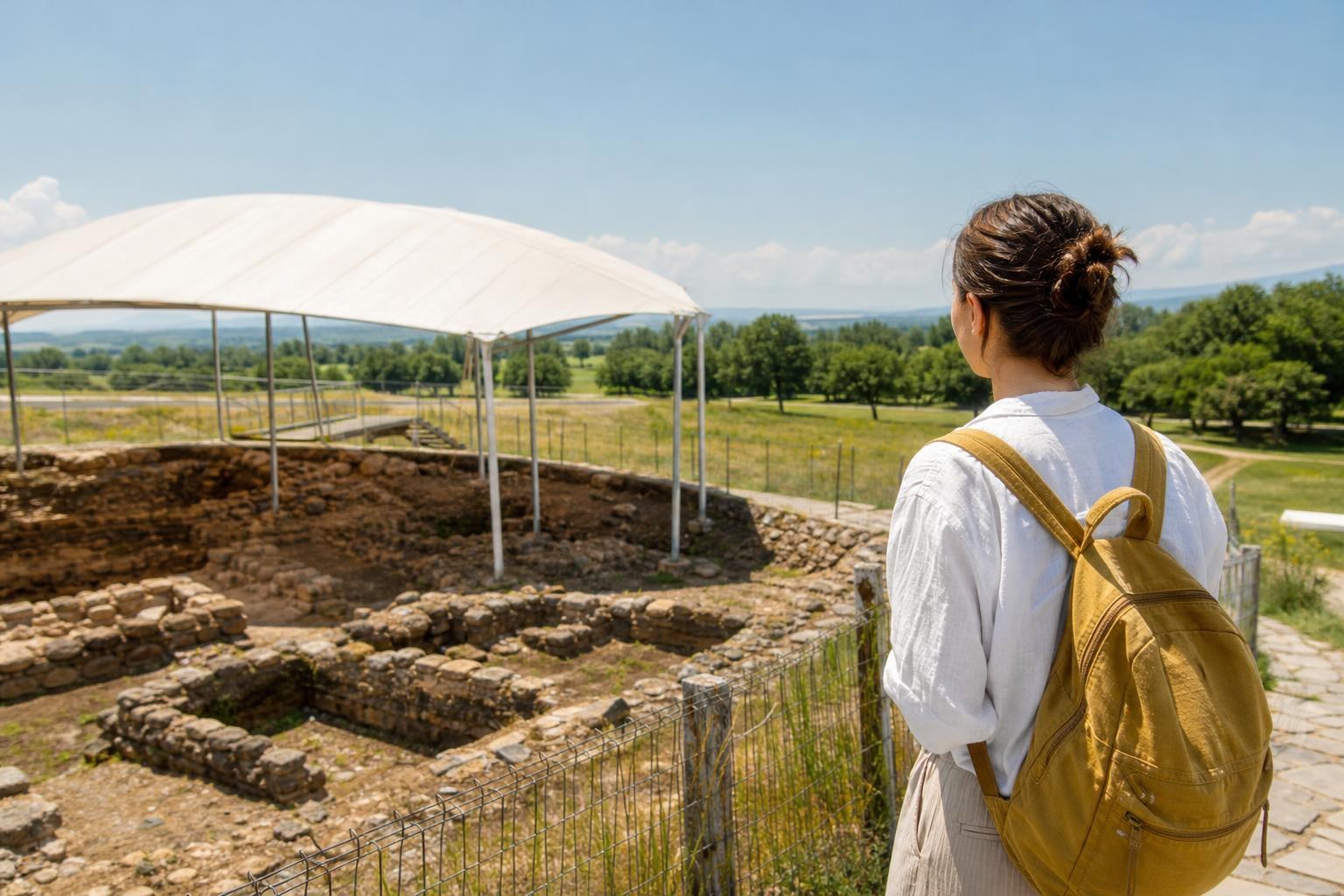
The part that makes Dmanisi different from most fossil museums is the protective shelter built over the excavation itself. Instead of looking at bones in a glass case far from where they were found, you stand on a walkway above the actual dig.
From there you can see the stratigraphic layers in the cut walls of the trench. The darker basalt at the base is the old lava flow. Above it sit the ash and sediment layers that trapped the fossils, and higher still are medieval storage pits that later residents dug straight down into the prehistoric deposits. In fact, the first finds came to light partly because of those medieval pits.
If you visit during the excavation season, typically in summer, you may see researchers working in the trench below. They brush, sieve and record finds a few centimetres at a time. It is slow, careful work, and watching it gives you a much better sense of how a jaw or a horse tooth ends up in a textbook.
The museum section displays casts of the hominin skulls alongside fossils of the animals that shared the landscape. These include sabre-toothed cats, giant cheetahs, ostriches, rhinos and early horses. Seeing those animals together helps you picture the environment: a mosaic of woodland and grassland near a lake, with very real predators.
Labels and signage include English, but the depth of explanation varies. A guided visit adds a lot here. The scientific story only really clicks when someone walks you through what each layer means.
Exploring the Medieval Town and Dmanisi Sioni
Most people come for the fossils, then end up spending as much time in the ruins above them. Medieval Dmanisi was a serious city, not a village outpost. It sat on trade routes linking the Black Sea, Armenia, Persia and the Caucasus, which put it in the path of every power that wanted control of the region.
The town’s story follows the larger history of Georgia as a crossroads of empires. It was held at different times by Arab emirs, Seljuk Turks and Georgian kings, then attacked by Mongol and Timurid armies. By the late Middle Ages, it was declining, and it was eventually abandoned. What remains is a spread of stone foundations, a citadel, bathhouses, wine cellars, streets and storage pits across the plateau.
Walk out along the promontory and you get the reason for the location immediately. The ground drops sharply into the river gorges on both sides, with only a narrow neck of land to defend. The fortress walls on that side still stand in sections, and you can trace the gate and some of the defensive towers.
Things worth finding on the plateau:
- The citadel area: The fortified upper part of the town, with the best views over both gorges.
- Bathhouse remains: Evidence of a comfortable urban life that surprises many visitors expecting a rough frontier town.
- Qvevri and storage pits: Large clay wine vessels and grain pits show how central storage and wine were to daily life, a tradition still alive across rural Georgia.
- The secret tunnel: A passage leading down toward the river, used to secure water during sieges. Check with staff before attempting it, as access and safety vary.
The centrepiece is Dmanisi Sioni, the cathedral of the old town. The name “Sioni” comes from Zion, and Georgia has several churches with this name, each a reminder of how deeply the early Georgian church looked toward Jerusalem. Dmanisi Sioni is a basilica dating from the 6th century, built in the soft, warm-toned stone typical of the region.
The cathedral is still a working church. Dress modestly, which for women usually means covering shoulders and wearing a headscarf, and men should remove hats. Scarves are often available at the entrance of Georgian churches, but bring your own to be safe.
Look closely at the narthex, the entrance hall added in the 13th century. It is decorated with fine carved stonework and carries Georgian inscriptions linked to the reign of King Giorgi IV Lasha, who ruled during the height of medieval Georgian power. These inscriptions are a big part of why historians value the church: they tie the building directly to the royal court of the Georgian golden age.
The contrast is striking. Inside the protective shelter, you look at hominins from 1.8 million years ago. A few hundred metres away, you stand in a church where Georgians still light candles today. Few places put that much time into such a short walk.
Getting There by Car: Tbilisi to Kvemo Kartli
Dmanisi lies in Kvemo Kartli, which means “Lower Kartli”, the region southwest of Tbilisi that stretches toward the borders with Armenia and Azerbaijan. It is a less touristy region than Kakheti or Kazbegi. That is partly why it is such a good drive.
Here is the practical summary:
- Starting city: Tbilisi
- Distance: Roughly 95 km to Dmanisi
- Drive time: About 2 hours each way without stops
- Road condition: Generally good asphalt the whole way
- 4×4 needed? No. A standard car is fine in normal conditions
- Parking: Available near the site entrance (verify on arrival, as arrangements can change)
- Seasonal closures: Site access is seasonal and can be closed in winter due to snow or bad weather
The usual route takes you out of Tbilisi to the southwest, past Marneuli and then on through Bolnisi toward Dmanisi. Once you clear the Tbilisi suburbs, traffic thins out quickly. Expect to share the road with trucks heading for the borders, slow-moving tractors near villages, and the occasional herd of cows that has no interest in your schedule.
The final stretch climbs onto a high plateau, and the scenery opens up. You get rolling grassland, scattered villages and long views. Fuel up before you leave the main towns, since stations get sparse once you head into the higher countryside.
Tip: download offline maps for the whole region before leaving Tbilisi. Google Maps works well for routing, while Yandex Maps sometimes has better detail on small village roads. Mobile coverage is generally fine, but there are dead spots in the gorges.
Kvemo Kartli has a large ethnic Azerbaijani population, especially around Marneuli, and in some villages Azerbaijani is spoken more than Georgian. Russian is widely understood across generations. English gets thin outside tourist sites, so a Google Translate offline pack for Georgian and Russian is worth the download.
This is where renting a car really pays off. Public transport to Dmanisi exists in the form of marshrutka minibuses, but schedules are irregular, and combining several sites in one day without your own wheels is close to impossible.
Important: in winter, check the weather on the plateau, not just in Tbilisi. Dmanisi sits much higher than the capital, and it can be snowing or icy there while Tbilisi is merely grey and damp. If snow is forecast, consider postponing.
Planning Your Visit: Opening Months and Hours
This is the section where you should trust a phone call more than any website, including this one. Parts of the archaeological site are seasonal, and opening times change.
Here is what can be said with confidence:
- The excavation and parts of the archaeological site operate seasonally.
- Active digging is a summer activity, so that is when you are most likely to see researchers at work.
- Winter closures are common, either planned or because snow and weather make the plateau unsafe.
- Hours can shift between seasons and from year to year.
What this guide will not do is give you an exact opening time and ticket price for 2026, because those details could not be verified. Publishing a specific time would risk sending you two hours out of Tbilisi to a locked gate.
How to check before you go:
- Look up the Dmanisi Museum-Reserve through the Georgian National Museum’s official channels, which manage many of the country’s museum-reserves.
- Ask at the tourist information centre in Tbilisi. Staff there can often call ahead.
- If you are staying in a guesthouse, ask your host to phone the site in Georgian. This tends to get faster and more accurate answers than email.
- Check recent visitor reviews on Google Maps for photos of posted hours, but treat them as a hint, not confirmation.
For timing within the year, late spring through early autumn is the easiest window. May and June bring green grass on the plateau and wildflowers in the gorges. September and early October have stable weather and softer light for photos. Midsummer can be hot in the lowlands around Marneuli, but the plateau is noticeably cooler.
Plan to arrive at Dmanisi late morning or around midday if you are combining sites. That gives you time for Bolnisi on the way out and keeps Samshvilde for the afternoon.
If you prefer not to drive, organised options exist. Private day trips from Tbilisi covering Dmanisi and Bolnisi typically last 8 to 10 hours. Guided tours of the Dmanisi Museum-Reserve generally cost between $25 and $50 USD per person (2026 market range), depending on group size. Prices change often, so confirm the current rate when booking.
The Perfect Kvemo Kartli Itinerary
Dmanisi on its own justifies the drive. Add Bolnisi Sioni and the Samshvilde canyon, though, and the day becomes a tour through roughly 1.8 million years of human presence in one region: prehistoric hominins, one of the oldest churches in Georgia, and a medieval royal city on the edge of a gorge.
A sensible order for drivers looks like this:
- Leave Tbilisi early, ideally by 8:00, to beat the city traffic.
- Stop at Bolnisi Sioni on the way out, since it sits roughly on the route.
- Continue to Dmanisi for the fossils, museum, ruins and cathedral.
- Head to Samshvilde in the afternoon for the canyon and fortress.
- Drive back to Tbilisi in the evening.
This works out to a long but very manageable day. If you prefer a slower pace, split it: Dmanisi and Bolnisi one day, Samshvilde on another trip combined with the area around Tetritskaro.
One thing that makes this region feel different from the Tbilisi experience is the pace. In the capital, you get cafés, English menus and a cosmopolitan crowd. Out in Kvemo Kartli, villages run on farming rhythms, roadside stops are simple, and hospitality is more personal than polished. Georgians often say “stumari ghvtisaa”, meaning “a guest is from God”. In rural areas, that idea still shapes how people treat a lost driver asking for directions.
Bolnisi Sioni: Georgia’s Oldest Church Scripts
Bolnisi Sioni sits in the village of Bolnisi Kapanakchi, just south of the town of Bolnisi. It is one of the oldest surviving churches in Georgia, built in the late 5th century, generally dated to between 478 and 493.
The building is a large three-nave basilica made of stone, with a calm and slightly austere interior. It feels very different from the later Georgian churches with their tall drums and conical domes.
What brings historians here are the inscriptions. Bolnisi Sioni carries some of the oldest dated texts in Georgian script, written in Asomtavruli, the earliest of the three Georgian alphabets. Seeing these carved letters gives you a direct line to the beginnings of written Georgian, the same script family that now appears on every street sign in the country.
Spend 45 minutes to an hour here. Look for the carved capitals and decorative details, which include motifs that later became symbols of the Georgian church. The “Bolnisi cross” design is now used on the Georgian flag and military insignia.
Hiking to Samshvilde Canyon
Samshvilde is the wild-feeling stop of the day. The ruins of a medieval city spread across a narrow promontory high above the gorge of the Khrami river, at its meeting with the Chivchavi. Like Dmanisi, it was chosen because the cliffs made it close to impregnable.
Samshvilde was an important royal and military centre in medieval Georgia. Today you will find fortress walls, the remains of a large cathedral and scattered buildings, with dramatic drops into the canyon.
The walk from the village to the ruins is short but uneven. Wear proper shoes and keep children close to the edges, since there are no railings in many places. There are also trails that drop into the canyon itself for anyone wanting a longer hike, but give yourself time and check conditions locally before committing.
Note: allow 1.5 to 2 hours at Samshvilde if you just want the fortress and viewpoints. Add more time if you plan to hike down into the canyon.
Regional Travel Logistics Table
Distances below are approximate road distances from central Tbilisi. Actual figures depend on your route and starting point in the city, so treat them as planning estimates rather than exact numbers.
| Stop | Km from Tbilisi (approx.) | Time needed at location | Notes |
|---|---|---|---|
| Tbilisi | 0 km | Start point | Leave by 8:00 to avoid traffic; fuel up and grab snacks |
| Bolnisi Sioni | Around 60 km | 45 minutes to 1 hour | Working church; modest dress required |
| Dmanisi | Around 95 km | 2 to 3 hours | Fossil shelter, museum, medieval ruins, Dmanisi Sioni; seasonal access |
| Samshvilde | Around 80 to 100 km depending on route | 1.5 to 2 hours (more for canyon hikes) | Uneven ground, no railings; best in afternoon light |
The total day usually runs 9 to 11 hours door to door with driving, stops and lunch. That lines up with the 8 to 10 hours that organised private day trips typically allow for just Dmanisi and Bolnisi. Adding Samshvilde pushes it toward the longer end.
Important: in late autumn and winter, daylight is short. If you are travelling outside the main season, consider dropping one stop so you are not driving back on unfamiliar rural roads in the dark.
Practical Tips for the Kvemo Kartli Region
A few things make a real difference on this trip, and most come down to food, language, timing and expectations.
Food options are limited at the sites themselves. Pack water and snacks before leaving Tbilisi, and plan lunch around Bolnisi or Dmanisi town, where simple local cafés serve khachapuri, khinkali, soups and grilled meat. Menus may only be in Georgian or Russian, so pointing and a translation app go a long way.
Cash is still handy outside Tbilisi. Card payments are common in the capital, but small cafés, entrance desks and guesthouses in rural Georgia may prefer lari (GEL). Withdraw cash in Tbilisi or a larger town like Marneuli before heading into the countryside.
Other practical points:
- Dress for churches: Covered shoulders and knees for everyone; headscarves for women at Dmanisi Sioni and Bolnisi Sioni.
- Wear real shoes: Both Dmanisi and Samshvilde involve uneven stone, loose gravel and steep edges.
- Layer up: The plateau is windier and cooler than Tbilisi, even in summer.
- Respect the dig: Do not step off marked paths in the excavation area or pick up stones and fragments. Everything here is a potential piece of evidence.
- Drive defensively: Watch for livestock, slow farm vehicles and drivers overtaking on blind bends. Georgian driving can feel assertive if you are used to calmer roads.
- Ask, then photograph: People in villages are generally welcoming, but ask before photographing anyone up close, especially older residents.
Language is worth a moment of thought. Across Kvemo Kartli, you will hear Georgian, Azerbaijani, Armenian and Russian. A simple “gamarjoba” (hello) and “madloba” (thank you) in Georgian gets a warm reaction in Georgian villages. In predominantly Azerbaijani villages, Russian is often the more useful common language, so a few words of Russian can help.
Tip: if you are new to driving in Georgia, Kvemo Kartli is a good first region outside Tbilisi. Traffic is lighter than on the Georgian Military Highway, the roads are flat or gently rolling, and there are no high mountain passes on this route.
For more route planning across Georgia by car, Triproadwayplanner covers other day trips, road conditions and seasonal advice that pair well with a Kvemo Kartli loop.
Frequently Asked Questions
What are the “Dmanisi Five” skulls?
They are five fossil hominin skulls found at the site between 1999 and 2005, all around 1.8 million years old. Together they form the most complete collection of early Homo skulls from a single location. Scientists still disagree on whether they represent one variable species or two coexisting ones, with recent dental research pointing toward two.
Can I see the original fossils at the site?
Usually not. Expect casts and reconstructions at the site museum. The originals are protected and managed by the national museum system, so ask in Tbilisi if you want to know whether any are currently on public display.
What is the best time of year to visit Dmanisi?
Late spring to early autumn, roughly May through early October, is the easiest window. Weather is stable, the plateau is green or golden, and summer is when excavations are usually active. Winter visits are risky because closures due to snow and weather are common.
Why are the Dmanisi Sioni inscriptions significant?
The inscriptions in the 13th-century narthex connect the cathedral to the court of King Giorgi IV Lasha, during the high point of the medieval Georgian kingdom. They help historians date the additions to the building and show how important Dmanisi was as a royal and commercial city at the time.
Is the drive from Tbilisi difficult?
No. It is about 95 km and two hours on mostly good asphalt, and a regular car is fine. The main hazards are livestock, slow trucks and winter weather on the higher plateau.
Dmanisi rewards anyone willing to give it a full day. In one compact plateau, you see where some of the first humans to leave Africa lived, walk through a medieval trading city, and stand inside a cathedral still used by local worshippers. Add Bolnisi’s ancient Georgian inscriptions and the cliffs of Samshvilde, and you have a day out of Tbilisi that covers more history than most week-long itineraries.
Go between spring and autumn, confirm opening times before you set off, and leave early. If you have a car, this is one of the best-value drives in Georgia. You come back knowing the human story is still being written, sometimes in a trench in the hills of Kvemo Kartli.