
Table of Contents
- Ushguli: A Guide to Europe’s Highest Inhabited Settlement
- The Drive from Mestia to Ushguli: Road Conditions and Logistics
- Exploring the Four Communities of Ushguli Georgia
- Hiking to the Shkhara Glacier
- Seasonal Access and Winter in the High Caucasus
- Practicalities: Where to Stay, Food, and Cash Essentials
- Frequently Asked Questions about Visiting Ushguli
Perched at roughly 2,200 meters above sea level in Georgia’s Upper Svaneti region, Ushguli holds a reputation as Europe’s highest permanently inhabited settlement. That claim gets debated – a handful of villages in the Alps and Pyrenees compete for the title – but what isn’t debatable is the sheer visual impact of the place: medieval stone towers rising against the backdrop of Mount Shkhara, Georgia’s tallest peak. Getting there is half the adventure, with a mountain road from Mestia that tests both your nerves and your vehicle’s suspension. Whether you’re renting a car in Tbilisi and driving the full route yourself or catching a shared jeep from Mestia, this guide covers the practical details you actually need: road conditions, seasonal windows, where to sleep, and what to do once you arrive.
Ushguli: A Guide to Europe’s Highest Inhabited Settlement
The community commonly called Ushguli is actually a cluster of four small villages sitting in the upper Enguri River valley, surrounded by peaks that exceed 4,000 meters. Year-round residents number somewhere around 200 to 300 people, though that figure swells during summer when guesthouses open and hikers arrive. The settlement earned UNESCO World Heritage status as part of the broader Upper Svaneti listing, and the Georgian government has been investing in highland communities through its 2024-2030 Strategy for the Development of Highland Settlements, which includes infrastructure improvements in the region.
What makes this place genuinely special isn’t just the altitude. It’s the density of Svan defensive towers – some dating to the 9th century – still standing in tight clusters against a landscape that feels more like Central Asia than Europe. Svaneti was historically so remote that it served as a vault for Georgian national treasures during invasions. Icons and manuscripts were sent here for safekeeping, and some remain in small local museums.
The isolation that preserved Svan culture also means limited infrastructure. Electricity can be unreliable, mobile signal is spotty, and the nearest ATM is back in Mestia, about 45 kilometers away. This isn’t a polished tourist destination. That’s precisely what draws people here.
The Drive from Mestia to Ushguli: Road Conditions and Logistics
The road between Mestia and the high villages is one of the most talked-about drives in Georgia, and for good reason. It’s rough, scenic, and demands respect. The route runs approximately 45 kilometers, but don’t let that short distance fool you: expect 2.5 to 4 hours of driving depending on conditions, your vehicle, and how often you stop.
The first section out of Mestia is paved and relatively straightforward. After that, the road deteriorates into gravel, dirt, and rocky stretches. River crossings are common, particularly in spring and early summer when snowmelt is heavy. Landslide-prone sections can shift conditions from week to week.
Important: The road is not maintained in winter and is typically impassable from November through late May. Even in summer, check locally before departing – heavy rain can wash out sections overnight.
Getting There by Car: Practical Route Details
| Detail | Info |
|---|---|
| Starting point | Mestia center |
| Distance | ~45 km |
| Drive time | 2.5-4 hours |
| Road surface | Paved first 10 km, then gravel/dirt |
| 4×4 required? | Strongly recommended |
| Fuel | Fill up in Mestia; no fuel available en route |
| Parking | Free, informal lots at village entrance |
| Seasonal access | Typically June through October |
An alternative route now exists that changes the logistics significantly. Travelers can drive a loop from Kutaisi through to Ushguli and onward to Mestia, which cuts about 3 hours compared to the old approach through Zugdidi. The majority of this roughly 160-kilometer Svaneti Loop is paved, though gravel sections remain in landslide-prone areas. This loop option is excellent if you’re planning a multi-day Svaneti circuit rather than an out-and-back from Mestia.
Self-Driving vs. Hiring a 4×4 Jeep
If you’ve rented a standard sedan in Tbilisi, leave it in Mestia. The road beyond the paved section will punish low-clearance vehicles, and most rental agreements explicitly exclude this route from coverage. A Mitsubishi Delica, Suzuki Jimny, or similar high-clearance 4×4 is the minimum.
Hiring a local driver with a jeep from Mestia is the most popular option and costs roughly 200-300 GEL per car (2026 prices – confirm locally as rates fluctuate). The driver typically waits 3-4 hours while you explore, which is enough for a solid visit. Shared jeeps that split the cost among passengers leave from Mestia’s central square most mornings during summer.
Self-driving gives you freedom to stop at viewpoints and stay overnight, but you need genuine off-road experience. I’ve seen confident city drivers freeze at the first river crossing. If that sounds like you, hire a driver.
Tip: If you’re self-driving and planning routes through Svaneti, resources like Triproadwayplanner can help with current road condition updates and practical route planning for Georgia’s mountain roads.
Exploring the Four Communities of Ushguli Georgia
The four villages that make up the settlement are Zhibiani, Chvibiani, Murkmeli, and Chazhashi. They sit within walking distance of each other along the valley floor, and you can cover all four on foot in a couple of hours. Each has its own character, but Chazhashi and Zhibiani get the most visitor attention.
Zhibiani is where most guesthouses are concentrated and where jeeps typically drop passengers. It’s the first village you reach and serves as the practical base. Murkmeli sits slightly apart and has a partially ruined fortress that’s worth a quick detour. Chvibiani connects the others and has a few family-run cafes where you can get khachapuri and strong coffee.
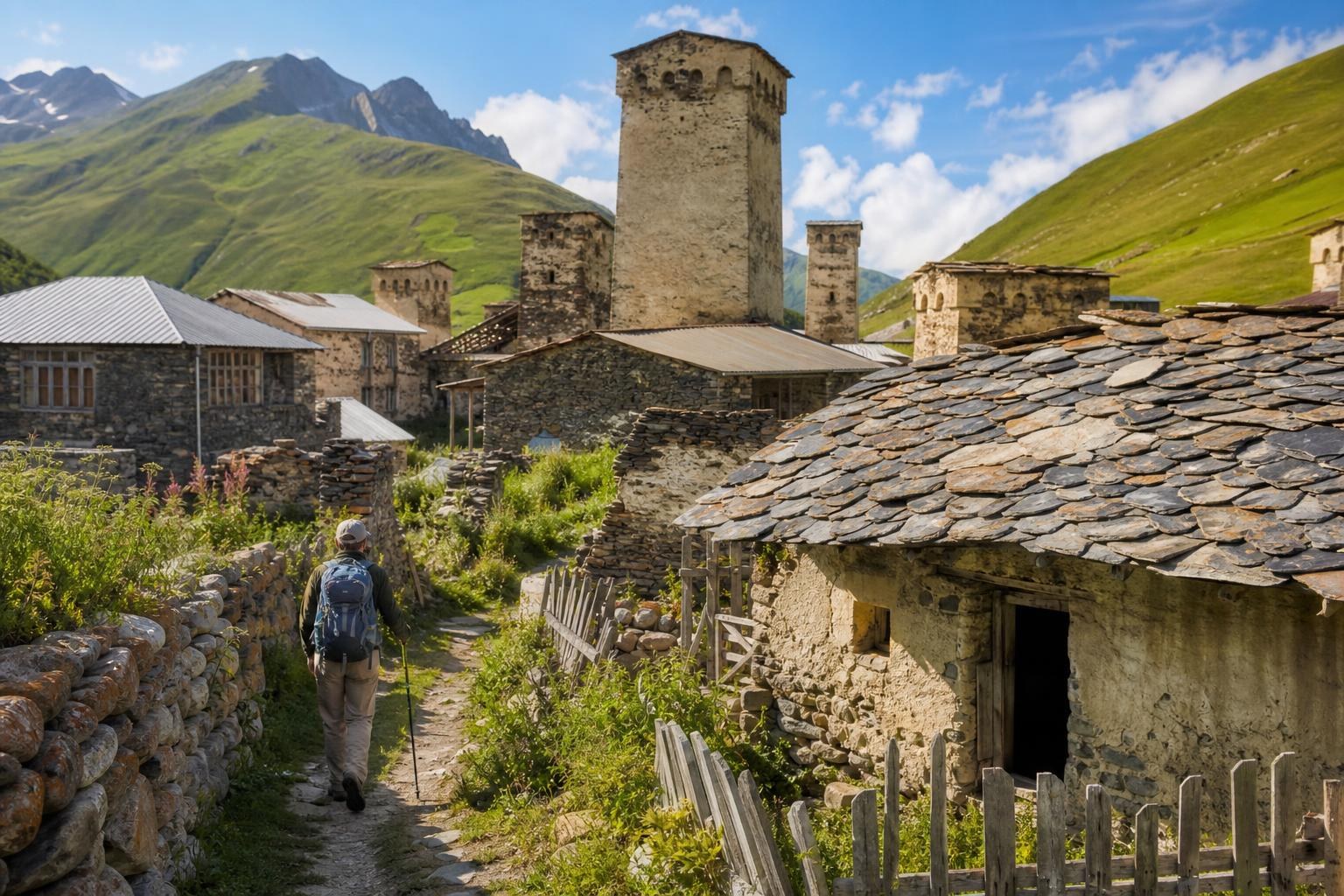
Walking between the villages on the dirt paths, surrounded by free-roaming cows and pigs, with those ancient towers in every direction – it’s one of those rare places where the reality matches the photographs.
Chazhashi: The UNESCO World Heritage Heart
Chazhashi is the most architecturally intact of the four villages and the primary reason for the UNESCO designation. The cluster of Svan towers here is the densest in the region, with roughly 30 towers still standing in various states of preservation. These weren’t decorative: each family built a tower as a defensive refuge during blood feuds and external attacks, with thick stone walls and minimal windows.
A small ethnographic museum in Chazhashi displays Svan artifacts, icons, and weapons. Entry is a few lari, and the collection is modest but genuine. The building itself is a converted tower, which gives you a sense of the cramped, vertical living conditions these structures imposed.
Lamaria Church and Ancient Svan Towers
Perched on a hill above Zhibiani, the Church of the Assumption (commonly called Lamaria Church) dates to at least the 12th century, though some scholars push it earlier. The location is strategic – elevated, visible from all four villages, and framed perfectly against Mount Shkhara behind it. This is the photograph you’ve seen on every Georgia travel poster.
The church interior is simple, with fragments of medieval frescoes still visible on the walls. It functions as an active place of worship, so dress modestly if you enter. The walk up takes about 10 minutes from the main path and offers the best panoramic view of the entire settlement and the glacier valley beyond.
The Svan towers throughout the area generally date from the 9th to 13th centuries. They stand between 20 and 25 meters tall, built from local stone without mortar in some cases. Families would retreat to the upper floors during conflicts, pulling up ladders behind them. Several towers lean noticeably but have stood that way for centuries.
Hiking to the Shkhara Glacier
The hike from the villages to the toe of the Shkhara Glacier is the main outdoor activity here and one of the best day walks in Georgia. The trail follows the Enguri River valley southeast, gaining elevation gradually over roughly 7 to 8 kilometers one way. Round trip takes 4 to 6 hours at a moderate pace.
The path is well-trodden and doesn’t require technical skills, but it’s not a manicured trail either. You’ll cross streams, navigate muddy sections, and scramble over rocky patches near the glacier. Proper hiking boots are essential – I’ve watched people attempt this in sneakers and regret it within the first kilometer.
- Start early (before 9 AM) to avoid afternoon clouds that obscure the glacier views
- Bring at least 2 liters of water per person, sun protection, and a rain layer
- The glacier itself is receding and can be unstable at the edges – keep a safe distance
- No facilities or shelters exist along the route
- Dogs from the village may follow you; they’re generally friendly but carry snacks out of reach
Mount Shkhara rises to 5,193 meters directly above the glacier, making it the highest point in Georgia. On a clear morning, the scale of the mountain wall is staggering. The glacier’s blue-grey ice, streaked with moraine debris, sits at the base of near-vertical rock faces. This isn’t a gentle Alpine scene; it’s raw and imposing.
Note: Glacier conditions change year to year. In 2026, the glacier has retreated further than historical norms. Stay on established paths and don’t venture onto the ice without proper equipment and experience.
Seasonal Access and Winter in the High Caucasus
The practical travel window runs from June through October, with July and August being peak season. The Zagari Pass on the road from the south typically doesn’t open until late May at the earliest, and early-season conditions can still mean snow patches and muddy roads even in June.
September and early October offer the best combination of stable weather, fewer visitors, and golden autumn light. The towers look extraordinary against fall colors. By late October, the first serious snowfall usually arrives, and most guesthouses close.
Winter transforms the settlement completely. Snow depths can exceed 2 meters, the road becomes impassable, and the remaining residents rely on stockpiled supplies. A handful of hardy travelers reach the area on snowshoes or skis during winter, but this requires serious mountain experience and self-sufficiency. There are no rescue services, no heated shelters along the road, and no guaranteed communication.
The Georgian government’s highland development strategy includes provisions for improving winter accessibility in remote settlements, but as of 2026, winter travel here remains an expedition, not a trip.
Practicalities: Where to Stay, Food, and Cash Essentials
Accommodation is exclusively in family-run guesthouses. There are no hotels, hostels, or camping facilities with amenities. Expect simple rooms with shared bathrooms, wood-heated stoves, and home-cooked meals included in the nightly rate. Prices in 2026 typically run 80-120 GEL per person including dinner and breakfast, but confirm directly as these change.
Booking ahead during July and August is smart – there are only about 15 to 20 guesthouses across all four villages, and they fill up. Booking.com lists a few, but many operate through word of mouth or direct phone calls. Your guesthouse host in Mestia can usually arrange a recommendation.
Food is hearty Svan cuisine: kubdari (meat-filled bread), tashmijabi (cheese and potato mash), bean dishes, and whatever the family has harvested or preserved. Vegetarians can eat well on cheese, bread, and vegetables, but don’t expect a menu. You eat what the family cooks.
- Bring cash in Georgian lari: no ATMs, no card machines
- The nearest ATM is in Mestia
- Mobile coverage is limited to Georgian carriers, and even then it’s unreliable
- Pack basic medications and first-aid supplies: the nearest pharmacy is in Mestia
- Electricity can cut out, so bring a headlamp or flashlight
- Drinking water from village taps is generally safe, but a filter bottle adds insurance
Tip: Carry at least 200 GEL in small bills per person per day. This covers accommodation, a possible museum entry, and any snacks or drinks you buy. Having exact change helps since guesthouse owners rarely have change for large notes.
Frequently Asked Questions about Visiting Ushguli
Is Ushguli really the highest village in Europe?
It’s commonly described that way, and the claim appears in UNESCO documentation and Georgian tourism materials. However, several settlements in the Alps (like Juf in Switzerland) and other Caucasus villages sit at similar or higher elevations. The safest phrasing is “one of the highest permanently inhabited settlements in Europe,” which is accurate and hard to dispute.
Can I visit as a day trip from Mestia?
Yes, and most visitors do exactly this. A hired jeep leaves Mestia in the morning, gives you 3-4 hours to explore, and returns by evening. It’s enough to see the towers, visit Lamaria Church, and walk between villages. If you want to hike to the glacier, you’ll need to stay overnight.
Do I need a 4×4 to drive there?
Strongly recommended. The road includes unpaved sections, river fords, and rocky stretches that will damage a standard car. Most rental companies won’t cover damage on this route. If you don’t have a 4×4, hire a local driver from Mestia.
Is it safe?
The area is generally very safe. Crime against tourists is extremely rare in Svaneti. The main risks are road conditions, weather changes, and the remoteness itself. Carry a basic first-aid kit, tell someone your plans, and don’t attempt the road in poor visibility or heavy rain.
What should I pack?
Layers (temperatures drop sharply after sunset even in summer), rain gear, sturdy hiking shoes, cash in small bills, sunscreen, a headlamp, and any personal medications. A portable battery pack is useful since charging opportunities are limited.
The settlement sits at the end of a long, rough road in one of Europe’s most dramatic mountain landscapes. That remoteness is exactly the point. The towers, the glacier, the home-cooked meals, the silence at 2,200 meters: these are experiences that reward the effort of getting there. Plan for the logistics, bring enough cash, respect the conditions, and you’ll understand why people keep making the journey.