
Table of Contents
- Visiting the Katskhi Pillar: Georgia’s Remarkable Limestone Monolith
- History and Legends of the Monk’s Rock
- What to Expect: Visiting the Katskhi Column Today
- Self-Drive Guide: Getting to Katskhi Pillar by Car
- The Perfect Day Trip: Combining Katskhi with Chiatura
- Route Logistics and Drive Time Comparison
- Essential Tips for Independent Travelers
- Frequently Asked Questions About Katskhi Pillar
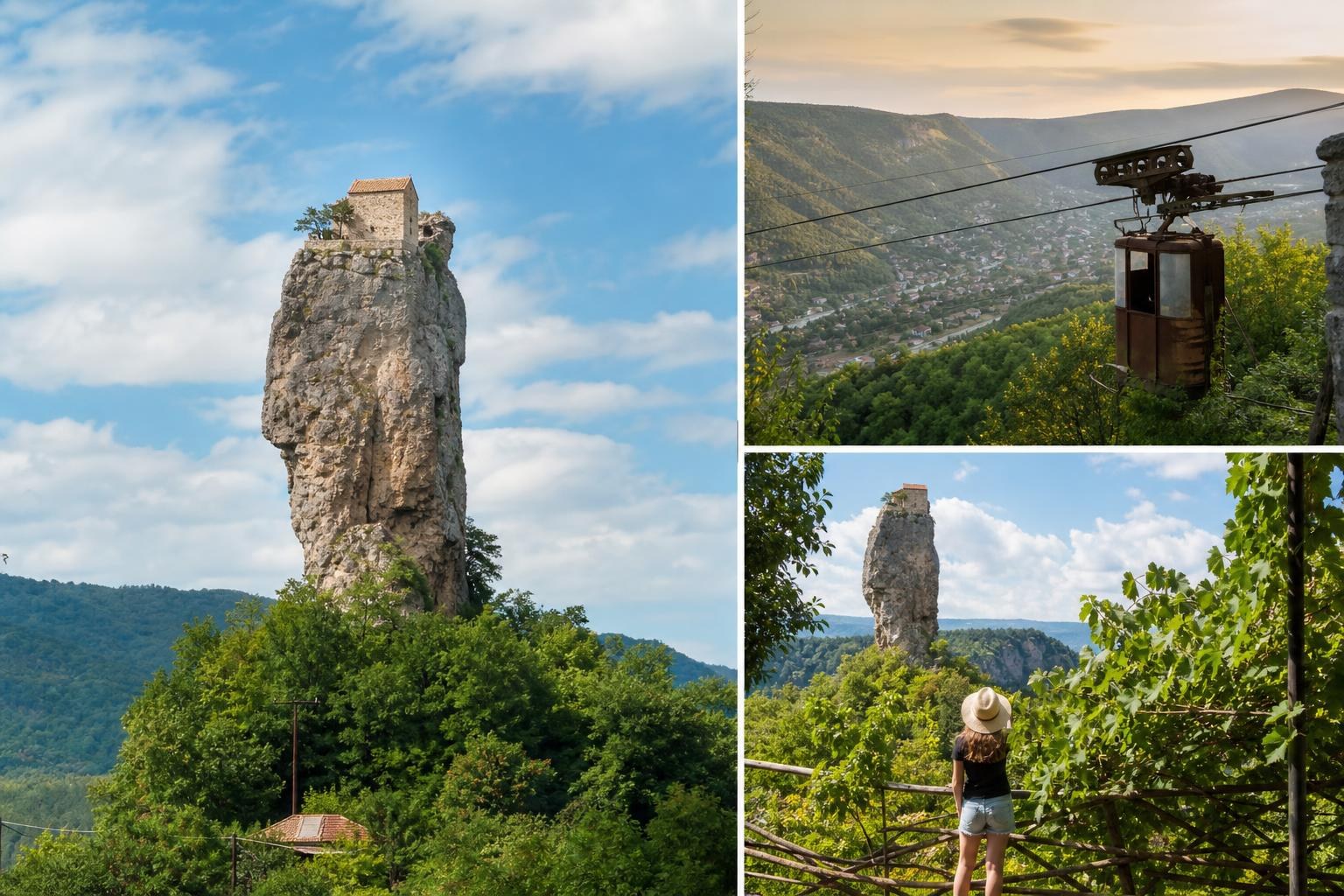
Standing 40 meters above the valley floor in Georgia’s Imereti region, the Katskhi Pillar is a natural limestone monolith topped by a tiny church and hermit cells that have drawn monks and pilgrims since at least the 9th century. If you’re planning a trip to this part of the country, the good news is that you can easily pair a visit to the pillar with the post-industrial town of Chiatura and its Soviet-era cable cars, making for one of the most rewarding day trips from Kutaisi. You can’t climb to the top (access is strictly off-limits to the public), but what you can see from the ground, including a small monastery and museum, is well worth the detour. Here’s everything you need to know to plan the trip yourself, whether you’re driving from Kutaisi or Tbilisi.
Visiting the Katskhi Pillar: Georgia’s Remarkable Limestone Monolith
The Katskhi column rises from a hillside near the village of Katskhi in the Chiatura municipality, roughly 72 km northeast of Kutaisi. It’s a freestanding chunk of limestone, sheer on all sides, with a small church and several hermit cells perched on its flat summit. From below, the whole thing looks almost impossible: a structure built on a platform barely wider than a tennis court, accessible only by a metal ladder bolted to the rock face.
What makes this site unusual isn’t just the geology. It’s the fact that for centuries, and again in the modern era, monks have chosen to live on top of it in near-total isolation. The pillar has become one of Georgia’s most distinctive religious landmarks, drawing visitors who are curious about both the natural formation and the ascetic tradition it represents.
The surrounding landscape is green and hilly, typical of Imereti. There’s a small parking area at the base, a lower church, a museum, and a gift shop. The site is managed by the Georgian Orthodox Church and protected by the state as a cultural monument. You won’t find crowds here, even in peak season: this isn’t Tbilisi’s Holy Trinity Cathedral. Expect a quiet, contemplative atmosphere and maybe a handful of other travelers.
History and Legends of the Monk’s Rock
The pillar has been a site of religious activity for over a thousand years. Recent scholarship has revised the dating of the summit complex, with the current consensus placing the principal church and hermit cells to the 9th or 10th century. That means monks were climbing this rock and building on its summit during a period when Georgia was experiencing a cultural and religious flowering under the Bagrationi dynasty.
For much of its history, the pillar served as a retreat for stylites: Christian ascetics who lived on pillars or elevated platforms as a form of extreme devotion. The tradition takes its name from Simeon Stylites, the 5th-century Syrian monk who spent decades atop a column near Aleppo. Georgia’s version of this practice found its most dramatic expression here, where the height and isolation of the natural rock made artificial pillars unnecessary.
After the Ottoman invasions disrupted monastic life across the region in the 15th and 16th centuries, the summit was abandoned. For roughly 500 years, nobody climbed it. Local legends grew up around the rock: some villagers believed it was cursed, others that it held treasure. The truth, when climbers finally reached the top in 1944, was more interesting than any legend. They found the ruins of a small church, wine storage vessels, and the remains of hermit cells.
The Life of Father Maxime and the Hermit Tradition
The modern chapter of the pillar’s story begins with Father Maxime Qavtaradze, a Georgian monk who first climbed the column in the early 1990s. By his own account, he was drawn to the ascetic tradition and felt called to restore the summit as a place of prayer. He began living on top of the pillar, initially in very basic conditions, and over the following years helped organize the reconstruction of the small church on the summit.
Father Maxime’s story attracted international media attention. A monk living on a 40-meter rock in post-Soviet Georgia was, understandably, a compelling image. He reportedly spent years ascending and descending via a ladder, enduring harsh winters and near-total solitude. His presence revived interest in the site and helped secure funding for restoration work.
He continued to use the pillar for prayer and retreat well into the 2010s. The tradition he represents is not just historical curiosity: it’s a living practice within Georgian Orthodoxy, where the tension between community and solitude has deep theological roots.
What to Expect: Visiting the Katskhi Column Today
Visiting the site is straightforward, but you should set your expectations correctly. You will not be climbing the pillar. You will be viewing it from below, visiting the lower church and grounds, and spending time in the small museum. For most people, this takes 45 minutes to an hour.
The monastery complex at the base is open daily from 09:00 to 20:00 and includes a recently renovated museum and gift shop. The museum covers the history of the stylite tradition and the archaeological discoveries made on the summit. The gift shop sells candles, icons, and small souvenirs.
Tip: Dress modestly. Women should cover their heads and shoulders (scarves are sometimes available at the entrance). Men should wear long trousers. This is an active religious site, not a tourist attraction in the commercial sense.
Access Rules and Restrictions for Climbing
This is the part that disappoints some visitors, so let’s be clear: climbing the Katskhi Pillar is strictly prohibited by both the Georgian Patriarchate and the National Agency for Cultural Heritage Preservation. The restriction exists for safety reasons and to protect the religious sanctity of the summit. This isn’t a suggestion or a guideline: it’s enforced, and there’s no permit process for tourists.
The metal ladder you’ll see bolted to the rock face is used only by authorized monks. Don’t ask the staff if you can climb it. The answer is no.
Exploring the Lower Church and Grounds
The lower church is a small, simple structure worth stepping into. It contains icons and candles, and services are occasionally held there. The grounds around the base of the pillar offer good vantage points for photographs, especially in the morning when the light hits the eastern face of the rock.
Take time to walk around the full perimeter if you can. The pillar looks different from each angle, and from the south side you get the best sense of its height and the improbability of the structures on top. The museum, while small, is genuinely informative and provides context that makes the visit richer.
Self-Drive Guide: Getting to Katskhi Pillar by Car
Driving is the most practical way to reach the site, and the route from Kutaisi is simple.
| Route | Distance | Drive Time | Road Condition | 4×4 Needed? |
|---|---|---|---|---|
| Kutaisi to Katskhi | ~72 km | 1 hr 15 min | Paved, some rough patches near Katskhi village | No |
| Tbilisi to Katskhi | ~220 km | 3 hr 30 min | Mostly highway, then regional roads | No |
From Kutaisi, head northeast on the road toward Chiatura. The turnoff to Katskhi village is well-signed. The final 2-3 km to the pillar is on a narrower road that’s paved but can be potholed. Any standard rental car handles it fine.
Parking is free and available at the base of the site. There’s space for roughly 15-20 cars, which is rarely a problem. If you’re coming from Tbilisi, the drive takes about 3.5 hours via the E60 highway and then regional roads through Zestaponi.
Important: If you don’t have your own car, marshrutkas (minibuses) run from Kutaisi to Chiatura for about 10 GEL (2026 pricing). From Chiatura, you’ll need a taxi to the pillar itself, roughly 15-20 minutes away. Agree on the fare before getting in.
For those renting a car in Kutaisi or Tbilisi, this is one of those day trips that’s dramatically easier with your own wheels. Public transport gets you to Chiatura, but the last stretch to the pillar requires either a taxi or hitchhiking.
The Perfect Day Trip: Combining Katskhi with Chiatura
The real trick to making this trip worthwhile is combining the Katskhi column with Chiatura, the nearby mining town that’s become one of Georgia’s most fascinating stops for curious travelers. The two sites are only about 15 km apart, and together they fill a full, satisfying day.
Chiatura is being repositioned as a heritage and “dark tourism” destination under the Imereti Region Growth and Development Plan running through 2036. The town’s appeal lies in its raw, unpolished character: Soviet-era infrastructure, dramatic canyon setting, and a network of cable cars that feel like time machines.
Here’s a suggested itinerary for a day trip from Kutaisi:
- Leave Kutaisi by 08:30
- Arrive at the Katskhi Pillar by 09:45, spend 45-60 minutes
- Drive to Chiatura by 10:45
- Ride cable cars and explore the town until 13:00
- Visit Mghvimevi Monastery (10-minute drive), spend 45 minutes
- Return to Kutaisi by 15:30-16:00
Chiatura’s Industrial Heritage and Soviet Cable Cars
Chiatura was built around manganese mining in the late 19th century, and by the Soviet period it had become one of the most important mining centers in the USSR. The town sits in a deep gorge, and because the terrain made roads impractical for connecting the various mining settlements on the canyon rim, Soviet engineers installed a network of aerial cable cars starting in the 1950s.
Several of these lines have been modernized with Poma gondolas, and rides cost just 0.50 GEL (roughly $0.19 USD as of late 2026), payable via Metromoney card or contactless payment. The historic Sashevardno line, originally built in 1966 and relaunched in late 2024, retains its Soviet-era aesthetic and climbs at a 48-degree incline. Riding it feels like stepping into a documentary.
The town itself is not pretty in a conventional sense. Buildings are weathered, infrastructure shows its age, and the mining legacy is visible everywhere. That’s precisely what makes it interesting. Chiatura offers a window into Soviet industrial history that you simply don’t get at polished tourist sites.
Mghvimevi Monastery: The Hidden Rock-Cut Gem
About 10 minutes by car from Chiatura’s center, Mghvimevi is a medieval cave monastery carved into a cliff face. It’s open to visitors between 10:00 and 18:00, and there’s no entrance fee. The monastery includes rock-cut churches, frescoes, and monk cells that date back several centuries.
The site is quieter than the pillar and receives far fewer visitors. If you enjoy religious architecture or simply want to see something that most travelers in Georgia miss entirely, Mghvimevi is worth the short detour. The path up to the caves is steep but manageable in regular shoes.
Route Logistics and Drive Time Comparison
Planning your route depends on where you’re starting and how much time you have. Here’s a comparison of the most common approaches:
| Starting Point | Total Distance (round trip) | Total Drive Time | Recommended Duration |
|---|---|---|---|
| Kutaisi | ~160 km | ~2 hr 45 min driving | Full day (6-7 hours) |
| Tbilisi | ~440 km | ~7 hr driving | Overnight recommended |
| Batumi | ~370 km | ~6 hr driving | Overnight recommended |
From Kutaisi, this is a comfortable day trip. From Tbilisi, it’s doable in a long day but tiring: you’re better off spending a night in Kutaisi and combining the trip with other Imereti attractions like Prometheus Cave or Gelati Monastery. From Batumi, an overnight stop is essential.
Note: Roads between Kutaisi and Chiatura are generally in good condition but watch for livestock on the road, especially in the early morning and late afternoon. Speed limits through villages are enforced by camera in some areas.
Essential Tips for Independent Travelers
- Fuel up in Kutaisi. There are gas stations along the route, but the last reliable one before Chiatura is about 20 km out. Don’t count on finding fuel in Katskhi village.
- Bring cash. The museum gift shop and any small vendors near the pillar may not accept cards. ATMs are available in Chiatura but not at the pillar itself.
- Download offline maps. Cell coverage is spotty between Chiatura and Katskhi. Google Maps or Maps.me with offline data for Imereti will save you from wrong turns.
- Pack water and snacks. There’s no café at the pillar site. Chiatura has a few small restaurants and bakeries, but options are limited compared to Kutaisi.
- Best months to visit: April through October. Winter visits are possible but the road to the pillar can be icy, and the site feels exposed in cold wind.
If you’re using Triproadwayplanner’s route guides for Imereti, the Kutaisi-Chiatura corridor is covered with current road condition updates that can save you from surprises.
Frequently Asked Questions About Katskhi Pillar
Can you climb to the top of the Katskhi Pillar?
No. Climbing is prohibited by both the Georgian Orthodox Patriarchate and the National Agency for Cultural Heritage Preservation. The restriction applies to all visitors without exception. Only authorized monks may ascend using the metal ladder.
How long should I spend at the Katskhi Pillar?
Most visitors spend 45 minutes to one hour. That’s enough time to walk around the base, visit the lower church, browse the museum, and take photographs. If you’re combining with Chiatura, budget a full day from Kutaisi.
Is the Katskhi Pillar worth visiting if you can’t climb it?
Yes. The pillar is visually striking from the ground, and the museum provides excellent context about the stylite tradition and archaeological discoveries. The real value of the trip increases significantly when you combine it with Chiatura and Mghvimevi.
Do I need a 4×4 to reach the pillar?
No. The road from Kutaisi to the pillar is fully paved, though the last few kilometers can have potholes. Any standard rental car is fine year-round, though winter conditions may require caution on the final stretch.
Is there an entrance fee?
The site itself is free to enter. The museum and gift shop are included. You might want to leave a small donation at the church if you feel moved to do so: this is common practice at Georgian religious sites.
The Katskhi Pillar and Chiatura together represent one of the most rewarding day trips from Kutaisi: a combination of ancient religious devotion, Soviet industrial history, and Georgia’s wild Imereti landscape. Neither site takes long to visit on its own, but together they tell a story about this region that you won’t find anywhere else in the country. Drive it yourself, take your time, and don’t skip Mghvimevi on the way back.