
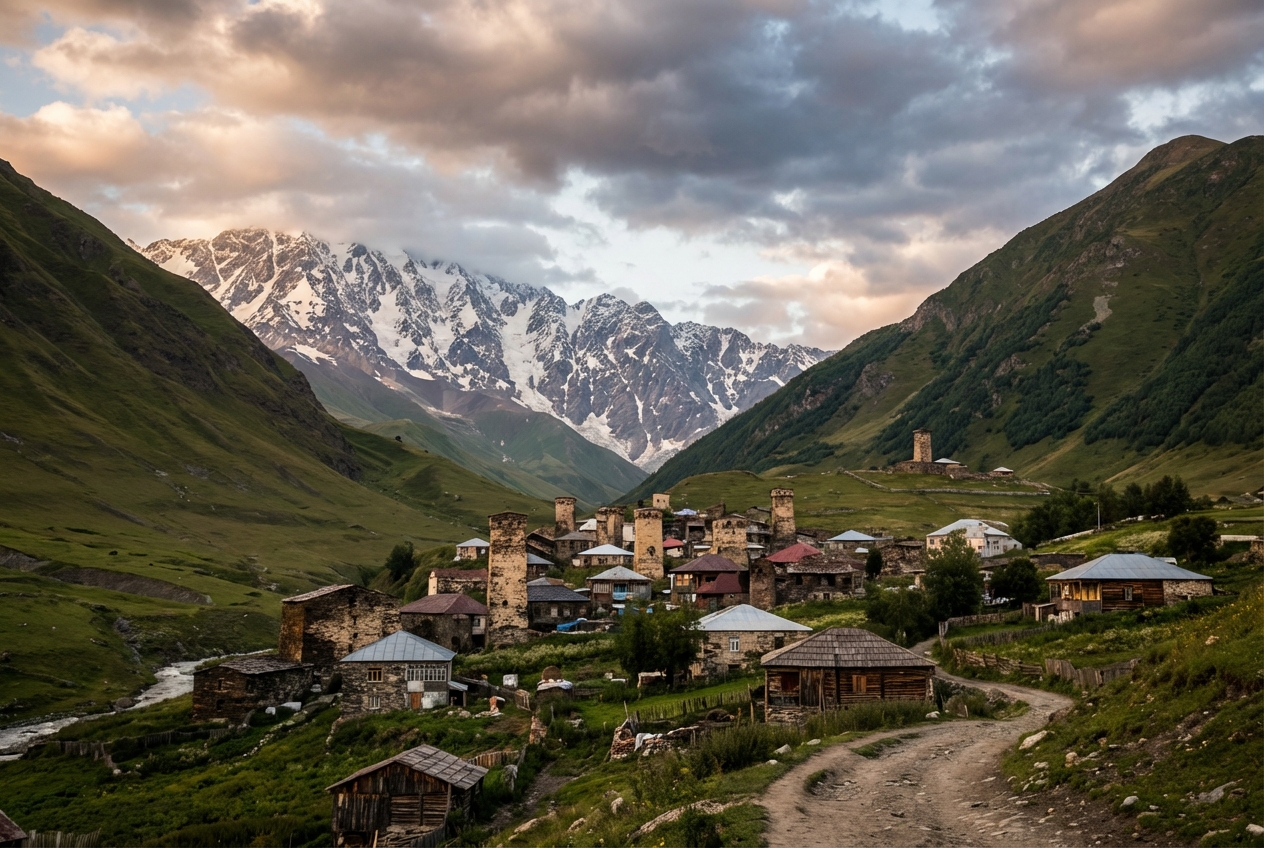
Georgia sits at the crossroads of Europe and Asia, a country where ancient churches cling to mountain peaks, wine flows from clay vessels buried underground, and cobblestone streets wind through neighborhoods that have seen empires rise and fall. With Tbilisi drawing 3.39 million tourists in 2024 and earning recognition as Europe's most affordable city break destination, this small Caucasian nation punches far above its weight when it comes to memorable travel experiences.
The question of which places to visit in Georgia depends largely on what moves you. History buffs could spend weeks exploring cave monasteries and medieval fortresses. Wine lovers find paradise in the rolling vineyards of Kakheti. Adventure seekers head straight for the Caucasus peaks, while those craving relaxation discover Black Sea beaches and thermal baths. The beauty of Georgia lies in its compact size: you can experience mountain villages, coastal cities, and ancient ruins all within a single trip. Here's where to focus your time.
Exploring the Vibrant Capital of Tbilisi
Tbilisi rewards wanderers. The city sprawls along the banks of the Mtkvari River, its skyline a jumble of Soviet-era blocks, art nouveau mansions, and ultra-modern glass structures. Most visitors spend at least three days here, and even that feels rushed once you discover the hidden courtyards, rooftop bars, and underground wine cellars tucked into every neighborhood.
Historic Old Town and Narikala Fortress
The Old Town, known locally as Dzveli Tbilisi, feels like stepping into a living museum. Narrow streets twist past carved wooden balconies draped in grapevines, leading to tiny churches that have survived earthquakes and invasions. The architecture tells Georgia's complex story: Persian influences blend with Russian imperial styles, while Orthodox crosses top buildings that once served as caravanserais on the Silk Road.
Narikala Fortress dominates the hillside above the Old Town, its crumbling walls dating back to the 4th century. You can hike up or take the cable car from Rike Park for panoramic views that stretch across the entire city. The fortress itself is free to explore, and the Mother of Georgia statue stands nearby, her sword raised toward enemies and wine bowl extended to friends: a perfect symbol of Georgian hospitality.
The Sulfur Baths of Abanotubani
The sulfur baths gave Tbilisi its name. According to legend, King Vakhtang Gorgasali discovered the hot springs while hunting in the 5th century, and the word "tbili" means warm in Georgian. The brick domes of Abanotubani still pump natural sulfur water into private rooms where visitors soak and receive traditional scrub treatments.
Prices range from 50 to 150 Georgian lari for private rooms, depending on the bathhouse and time slot. Orbeliani Baths, with its striking blue-tiled facade, attracts the most tourists, but locals often prefer the less crowded Gulo's Thermal Spa or Royal Bath. Book evening sessions during peak season, as walk-ins frequently face hour-long waits.
Modern Landmarks: Bridge of Peace and Rustaveli Avenue
The Bridge of Peace arches across the Mtkvari River in a wave of steel and glass, its LED lights creating a nightly spectacle that divides opinion among Tbilisians. Some love the bold contemporary statement; others find it jarring against the ancient backdrop. Either way, it connects the Old Town to Rike Park and has become one of the city's most photographed landmarks.
Rustaveli Avenue serves as Tbilisi's main artery, lined with theaters, galleries, and the imposing Parliament building. The Georgian National Museum sits here, housing the Treasury with its stunning collection of pre-Christian gold artifacts. Café culture thrives along this stretch, and evening strolls reveal street musicians, art vendors, and the constant hum of a city that never seems to sleep before midnight.
Majestic Peaks and Ancient Churches of the Caucasus Mountains
The Greater Caucasus range forms Georgia's northern border, a wall of snow-capped peaks that sheltered isolated communities for centuries. These mountains hold some of the country's most iconic images and demand at least a few days of your itinerary.
Stepantsminda and the Iconic Gergeti Trinity Church
The drive from Tbilisi to Stepantsminda (formerly Kazbegi) takes about three hours along the Georgian Military Highway, one of the most scenic routes in the Caucasus. The road climbs past the Ananuri fortress complex, through the ski resort of Gudauri, and over the Jvari Pass at 2,379 meters before descending into the dramatic Dariali Gorge.
Gergeti Trinity Church sits at 2,170 meters, perched on a hilltop with Mount Kazbek rising behind it. The 14th-century church appears in countless travel photos for good reason: the combination of medieval stone architecture against glacial peaks creates an almost surreal scene. The hike up takes about 90 minutes, or you can hire a 4×4 taxi for around 80 lari round trip. Clear mornings offer the best views, as clouds often roll in by afternoon.
The Remote Towers of Svaneti and Mestia
Svaneti represents Georgia at its most wild and isolated. This UNESCO-protected region in the northwestern mountains preserves defensive towers that families built during medieval blood feuds, some standing over 25 meters tall. The towers cluster in villages like Ushguli, which at 2,200 meters claims to be the highest continuously inhabited settlement in Europe.
Mestia serves as the regional capital and base for exploring Svaneti. The Svaneti Museum of History and Ethnography displays remarkable icons and manuscripts that villagers hid from Soviet authorities for decades. Trekking routes connect the villages, with the four-day hike from Mestia to Ushguli ranking among Georgia's finest walks. Winter brings skiing, though infrastructure remains basic compared to European resorts.
Wine Tasting and Cultural Heritage in Kakheti
Georgia claims 8,000 years of continuous winemaking, making it arguably the oldest wine-producing region on Earth. Kakheti, in the country's east, produces about 70% of Georgian wine and offers the most immersive tasting experiences.
Sighnaghi: The City of Love
Sighnaghi perches on a hilltop overlooking the Alazani Valley, its restored 18th-century walls encircling pastel-colored houses and cobblestone streets. Couples flock here because the town's registry office performs marriages 24 hours a day, no advance notice required: a quirk that earned Sighnaghi its romantic nickname.
Beyond weddings, the town offers excellent wine cellars, a museum dedicated to the primitivist painter Niko Pirosmani, and some of the best valley views in Kakheti. The surrounding countryside holds numerous monasteries, including the Bodbe Convent where Saint Nino, who brought Christianity to Georgia, lies buried.
Traditional Qvevri Winemaking in Telavi
Telavi, Kakheti's largest town, sits at the heart of Georgia's wine country. The surrounding villages maintain qvevri traditions, fermenting wine in large clay vessels buried underground. This method, recognized by UNESCO as intangible cultural heritage, produces amber wines with distinctive tannins and flavors unlike anything from conventional winemaking.
| Winery | Specialty | Tasting Cost |
|---|---|---|
| Shumi | Modern and traditional methods | 30-50 lari |
| Twins Wine Cellar | Qvevri-only production | 40-60 lari |
| Khareba Winery | Cave tunnels, large selection | 25-45 lari |
| Pheasant's Tears | Natural wines, farm-to-table | 50-80 lari |
Most wineries welcome visitors without appointments, though calling ahead ensures someone English-speaking can guide you. Harvest season in September and October brings festivals, grape-stomping events, and the freshest chacha (grape brandy) you'll ever taste.
Seaside Relaxation and Modern Architecture in Batumi
Batumi has transformed from a sleepy Soviet resort into Georgia's flashiest city. The Black Sea port serves as the capital of Adjara, an autonomous region with its own distinct character and cuisine. Glass towers now line the waterfront, casinos attract visitors from neighboring countries where gambling is restricted, and a 20-kilometer boulevard connects beaches, parks, and increasingly ambitious architecture.
The Alphabetic Tower celebrates Georgia's unique script with a DNA-helix design incorporating all 33 letters. Nearby, the moving metal sculpture of Ali and Nino depicts lovers from a famous novel, their figures passing through each other every ten minutes. The old town, though smaller than Tbilisi's, holds charming squares and the best examples of Adjaran wooden architecture.
Summer brings crowds to the pebble beaches, but spring and fall offer pleasant weather without the congestion. The botanical garden, established in 1912, spreads across hillsides above the city with specimens from around the world and sweeping coastal views.
Journey Through Georgia's Ancient Cave Cities
Georgia's cave cities reveal how communities carved entire settlements from rock, creating structures that served as refuges, monasteries, and trading posts across millennia.
The Massive Rock-Cut Monastery of Vardzia
Vardzia stretches across a cliff face in southern Georgia, a honeycomb of caves, tunnels, and chambers that once housed up to 50,000 people. Queen Tamar commissioned this monastery-fortress in the 12th century, and despite earthquake damage, around 300 rooms remain accessible today.
The Church of the Dormition preserves remarkable frescoes, including a portrait of Queen Tamar herself. The site requires significant walking and climbing, so wear sturdy shoes and bring water. Allow at least half a day, and consider hiring a guide to appreciate the complex's full history and hidden corners.
Uplistsikhe: One of the Oldest Urban Settlements
Uplistsikhe predates Vardzia by over a thousand years. This cave city flourished from the early Iron Age through the medieval period, serving as a major center on the Silk Road. Archaeologists have identified a pagan temple, a theater, and an early Christian basilica among the carved structures.
The site sits about an hour from Tbilisi, making it an easy day trip often combined with the nearby Stalin Museum in Gori. Unlike Vardzia's Christian focus, Uplistsikhe reveals Georgia's pre-Christian traditions and the transition between religious eras.
Spiritual Centers and Natural Wonders of Western Georgia
Western Georgia holds treasures that rival anything in Tbilisi or Kakheti, yet sees fewer international visitors. This region rewards those willing to venture beyond the standard circuits.
Kutaisi: Bagrati Cathedral and Gelati Monastery
Kutaisi, Georgia's second-largest city, served as the capital of ancient Colchis: the mythological land of the Golden Fleece. The Bagrati Cathedral dominates the skyline, its recent reconstruction controversial but undeniably impressive. The original 11th-century structure collapsed centuries ago, and the modern restoration sparked debates about authenticity that led UNESCO to delist the site.
Gelati Monastery, a short drive outside the city, faces no such controversy. This 12th-century complex remains one of Georgia's most important medieval sites, its academy once considered the Athens of the East. The mosaics and frescoes inside rank among the finest in the Caucasus.
Canyons and Caves: Martvili and Prometheus
The natural wonders around Kutaisi offer dramatic contrasts to the religious sites. Martvili Canyon provides boat rides through turquoise waters beneath overhanging cliffs, a peaceful experience that feels worlds away from Georgia's busy tourist hubs. The canyon gets crowded in summer, so early morning visits work best.
Prometheus Cave extends over a kilometer underground, its chambers filled with stalactites, stalagmites, and underground rivers. Guided tours include a boat ride through the final section, drifting past illuminated rock formations. The cave maintains a constant temperature around 14°C year-round, making it a welcome escape from summer heat or winter chill.
Planning Your Georgian Adventure
Georgia packs remarkable diversity into a country smaller than South Carolina. Two weeks allows a comprehensive circuit hitting most major destinations, though even a week reveals why travelers keep returning. Spring and fall offer the best weather and fewer crowds, while summer brings beach season and winter opens ski slopes.
The infrastructure continues improving, with new highways cutting travel times and guesthouses appearing in ever-more-remote villages. Prices remain remarkably low by European standards, and the legendary Georgian hospitality means strangers often become friends over shared meals and endless toasts.
Start in Tbilisi, venture into the mountains or wine country, and save time for at least one unexpected detour. The places worth visiting in Georgia extend far beyond any list, and the best discoveries often come from following local recommendations down unmarked roads.