
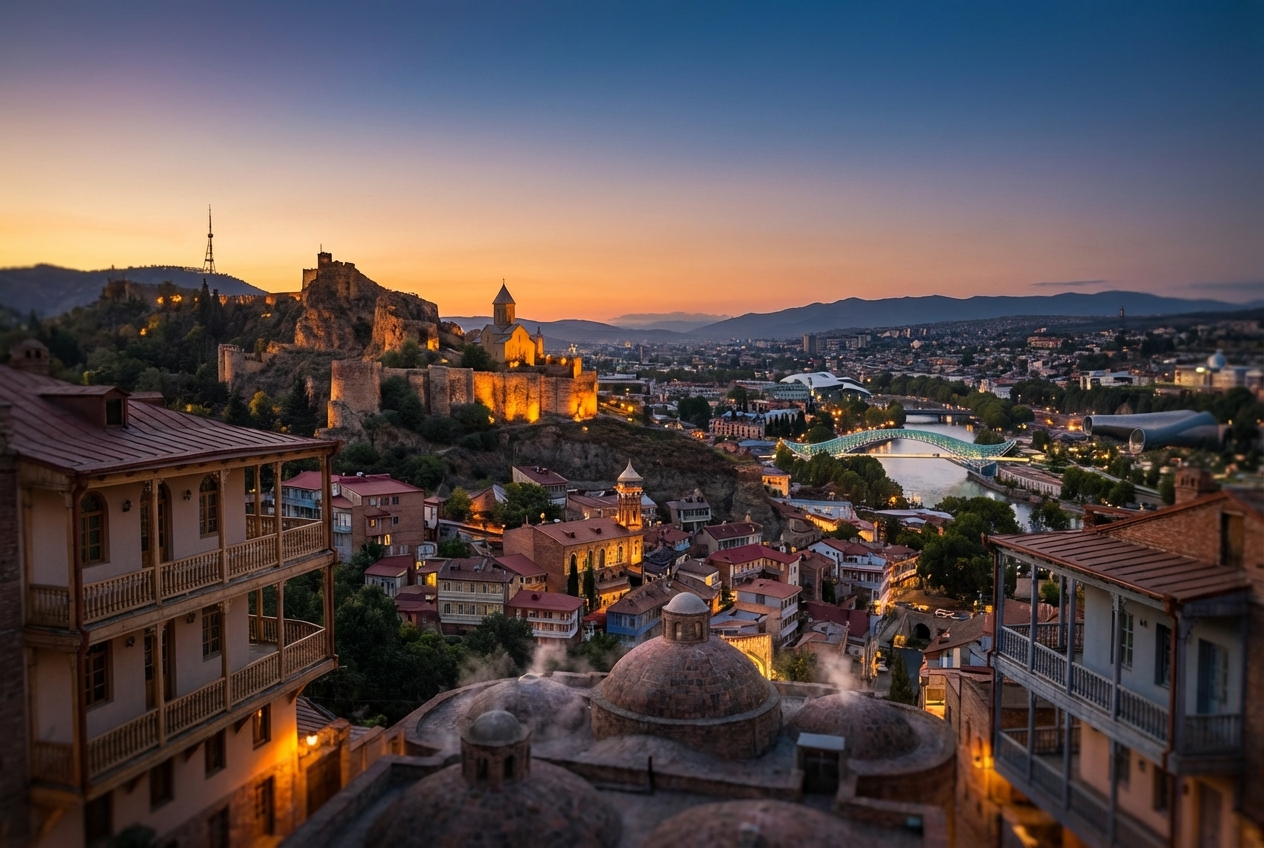
The first time I walked through Tbilisi’s cobblestone streets, I understood why travelers keep returning to this city. There’s something magnetic about a place where crumbling 19th-century balconies lean against Soviet-era apartment blocks, where ancient churches share skylines with glass-and-steel bridges, and where strangers invite you to share wine and toast to life. Georgia’s capital isn’t just famous for one thing: it’s famous for being impossible to categorize. The city welcomed 2,505,000 visitors in 2023 alone, making it Georgia’s most-visited destination according to georgia.travel. Those numbers reflect a growing awareness that Tbilisi offers something increasingly rare: authentic experiences that haven’t been sanitized for mass tourism. What is Georgia Tbilisi famous for? The answer depends on who you ask. Foodies point to khinkali dumplings and natural wines aged in clay vessels. Architecture enthusiasts rave about the collision of Byzantine, Persian, Art Nouveau, and brutalist styles. Party-goers whisper about underground techno clubs that rival Berlin. And wellness seekers seek out sulfur baths that have drawn visitors for centuries. This city refuses to be just one thing, and that’s precisely its appeal.
The Heart of the Caucasus: Tbilisi’s Unique Identity
Tbilisi sits in a valley along the Mtkvari River, cradled by the Greater Caucasus Mountains to the north. This geographic position made the city a crossroads of civilizations for over 1,500 years. Founded in the 5th century by King Vakhtang Gorgasali, legend says he discovered the location while hunting: his falcon fell into a hot spring, and the king decided any place with naturally heated water deserved a city.
That origin story captures something essential about Tbilisi’s character. The city has always been shaped by what flows through it: trade routes, invading armies, cultural influences, and yes, thermal waters. Persian, Ottoman, Russian, and Soviet rulers left their marks here, but none erased what came before. The result is a layered city where you can trace history through architecture, cuisine, and customs.
Georgia’s tourism industry has exploded recently, with 7.8 million travelers visiting the country in 2025, a 5.9% increase from the previous year, as reported by georgia.travel. Tourism revenues hit US$4.4 billion in 2024, up 7.3% year-on-year. Air travel to Georgia increased by 17% in 2025 compared to 2024, and visitors are staying longer: the average length of stay reached 5.6 nights in 2025.
|
Tourism Metric |
Value |
Change |
|---|---|---|
|
Total visitors (2025) |
7.8 million |
+5.9% |
|
Tourism revenue (2024) |
US$4.4 billion |
+7.3% |
|
Tbilisi visitors (2023) |
2.5 million |
Top destination |
|
Air travel growth (2025) |
— |
+17% |
|
Average stay (2025) |
5.6 nights |
+1.6% |
Georgia’s strategy focuses on what officials call “value vs volume”: attracting fewer but higher-spending tourists for sustainable development rather than pursuing mass tourism that overwhelms local infrastructure.
A Fusion of Ancient and Modern Architecture
Tbilisi’s architectural identity defies easy description. Walking through the city feels like flipping through an architecture textbook where someone shuffled all the chapters together. A Persian-influenced bathhouse sits near a Soviet-era metro station, which leads to a street lined with Art Nouveau mansions, which opens onto a plaza dominated by a glass bridge that looks like it landed from the future.
Old Town (Altstadt) and the Narikala Fortress
The Old Town, locally called Kala, spreads beneath the Narikala Fortress on the slopes of Sololaki Hill. Narrow streets wind between traditional Georgian houses with their distinctive wooden balconies, many carved with intricate patterns and painted in faded pastels. These balconies aren’t just decorative: they served as outdoor living rooms in a city where summers run hot and apartments ran small.
Narikala Fortress dates to the 4th century, though most of what stands today was built between the 7th and 12th centuries. The fortress changed hands repeatedly: Arabs, Mongols, Persians, and Russians all controlled it at various points. A cable car now carries visitors from Rike Park to the fortress walls, offering panoramic views of the city’s terracotta rooftops and the river cutting through the valley below.
Futuristic Landmarks: Bridge of Peace and Public Service Hall
The Bridge of Peace, completed in 2010, spans the Mtkvari River like a giant glass caterpillar. Italian architect Michele De Lucchi designed the pedestrian bridge with a steel frame and glass canopy that lights up at night with thousands of LEDs. Some locals love it; others think it clashes with the historic skyline. That debate itself captures Tbilisi’s ongoing negotiation between preservation and progress.
The Public Service Hall, finished in 2012, looks like a cluster of mushrooms or perhaps alien spacecraft. Georgian-born architect Giorgi Khmaladze designed the building to house government services under one roof, but its dramatic form makes it a destination for architecture tourists. Both structures represent Georgia’s post-Soviet push to signal modernity and openness to the world.
Religious Heritage: Sameba and Anchiskhati Basilica
The Holy Trinity Cathedral of Tbilisi, known as Sameba, dominates the city skyline from Elia Hill. Completed in 2004, it’s the largest religious building in the South Caucasus, with a main dome reaching 84 meters. The cathedral’s traditional Georgian ecclesiastical style deliberately references medieval architecture, though its massive scale and gold-covered dome make it unmistakably contemporary.
Anchiskhati Basilica offers a different experience entirely. Built in the 6th century, it’s the oldest surviving church in Tbilisi. The modest stone structure sits in the heart of the Old Town, its interior dark and cool, icons blackened by centuries of candle smoke. Attending a service here, with polyphonic hymns echoing off ancient walls, connects you to traditions that have survived invasions, earthquakes, and ideological purges.
World-Famous Sulfur Baths and Wellness Traditions
The sulfur baths of Tbilisi aren’t just a tourist attraction: they’re the reason the city exists. King Vakhtang Gorgasali’s legendary falcon fell into these very hot springs, and people have been soaking in the naturally heated, sulfur-rich waters ever since. The smell hits you first: that distinctive rotten-egg scent of hydrogen sulfide. But after a few minutes, you stop noticing it, and the minerals start working on your muscles.
The History of Abanotubani District
Abanotubani, the bath district, sits at the base of Narikala Fortress where hot springs bubble up naturally. The domed brick bathhouses look almost Middle Eastern, reflecting Persian architectural influence from centuries of cultural exchange. Some bathhouses date to the 17th century, though the bathing tradition here is far older.
The experience varies by establishment. Public baths offer communal soaking for a few lari, while private rooms at places like Chreli Abano or Royal Bath House provide tiled chambers where attendants scrub you with rough mitts until your skin glows pink. Alexander Dumas visited these baths in the 1850s and wrote that he’d never felt so clean in his life. Pushkin soaked here too, declaring the experience superior to anything in Russia.
Water temperatures range from 35 to 40 degrees Celsius, and the mineral content includes sulfur, calcium, and magnesium. Locals swear by the waters for treating skin conditions, joint pain, and respiratory issues. Whether or not you believe the health claims, spending an afternoon alternating between hot pools and cold plunges, followed by tea in a tiled courtyard, ranks among Tbilisi’s essential experiences.
A Culinary Capital: Georgian Flavors and Wine Culture
Georgian cuisine deserves its growing international reputation. The food here isn’t delicate or subtle: it’s bold, generous, and designed for sharing. Meals stretch for hours, punctuated by toasts and refills. Leaving a Georgian table hungry requires deliberate effort.
Signature Dishes: Khinkali and Khachapuri
Khinkali are soup dumplings, twisted at the top into a knob you hold while biting into the meat-filled pouch. The proper technique matters: you bite a hole, slurp the broth, then eat the dumpling, discarding the doughy knob. Counting discarded knobs at the end of a meal becomes competitive among friends. Fillings range from spiced beef and pork to mushrooms or cheese, and a serious eater might consume a dozen or more.
Khachapuri, cheese-filled bread, comes in regional variations. The Adjarian version arrives boat-shaped, filled with molten cheese, topped with butter and a raw egg you stir into the mixture. Imeruli khachapuri is round and stuffed. Megruli adds cheese on top as well as inside. Every Georgian has opinions about which version reigns supreme, and every bakery has its loyal customers.
Beyond these famous dishes, look for badrijani, eggplant rolls stuffed with walnut paste; pkhali, vegetable patés bound with ground walnuts and spices; and mtsvadi, skewered pork grilled over grapevine cuttings. The walnut appears constantly: ground into sauces, stuffed into vegetables, coating meats. Georgian cooking without walnuts would be unrecognizable.
The Birthplace of Wine: Qvevri Traditions in the City
Georgia claims to be the birthplace of wine, with archaeological evidence of winemaking dating back 8,000 years. The traditional method uses qvevri, large clay vessels buried in the ground where grape juice ferments and ages. UNESCO recognized qvevri winemaking as Intangible Cultural Heritage in 2013.
Tbilisi wine bars and restaurants showcase both traditional amber wines, made with extended skin contact, and more conventional styles. The amber wines, sometimes called orange wines, have a tannic, almost savory quality that surprises palates trained on European whites. Grape varieties like Rkatsiteli, Saperavi, and Mtsvane produce wines unlike anything from France or California.
Wine isn’t just a beverage here: it’s woven into hospitality, religion, and national identity. The traditional supra feast revolves around wine and toasts, with a tamada, or toastmaster, guiding the evening through prescribed themes: to God, to Georgia, to the deceased, to women, to children, to peace. Understanding Georgian wine culture means understanding Georgia itself.
The Spirited Culture of Hospitality and Nightlife
Georgians take hospitality seriously. The phrase “guest is from God” isn’t just a saying: it’s a cultural imperative. Visitors often find themselves invited to homes for meals, offered more food than they can possibly eat, and toasted repeatedly until their glasses never seem to empty.
The Supra: A Traditional Georgian Feast
The supra is more than dinner: it’s a structured ritual with rules, roles, and rhythms. The tamada leads toasts in a specific sequence, and guests are expected to respond. Toasts aren’t quick: they’re speeches, sometimes lasting several minutes, touching on philosophy, history, and emotion. Drinking without a toast is considered rude; raising your glass before the tamada finishes is worse.
Food arrives in waves, covering the table until plates stack on plates. Refusing food insults your host, but the quantities make finishing everything impossible. The solution is to pace yourself, take small portions, and accept that you’ll leave uncomfortably full. Supras can last four, five, or six hours, with singing and dancing emerging as the evening progresses.
Techno and Arts: Bassiani and the Creative Renaissance
Tbilisi’s nightlife scene gained international attention through Bassiani, a techno club built in a former Soviet swimming pool beneath Dinamo Arena. The club’s reputation for quality sound systems, respected DJs, and marathon sessions drew comparisons to Berlin’s Berghain. When police raided Bassiani in 2018, thousands of Georgians protested outside Parliament, dancing to techno in defiance.
That protest revealed something important about Tbilisi’s creative class. The city has become a hub for artists, designers, and musicians attracted by low costs, permissive attitudes, and a sense of possibility. Galleries, studios, and performance spaces have multiplied, particularly in the Fabrika complex, a former Soviet sewing factory converted into a hostel, co-working space, and cultural center. The creative energy here feels genuine rather than manufactured.
Natural Beauty and Panoramic Views
Tbilisi’s setting provides natural drama. The city fills a valley, with hills rising on both sides and mountains visible in the distance. Getting above street level reveals how the urban fabric drapes over the terrain, following contours shaped by the river and ridgelines.
Mtatsminda Park and the Funicular Railway
Mtatsminda, or Holy Mountain, rises 770 meters above sea level on Tbilisi’s western edge. A funicular railway built in 1905 carries passengers up the steep slope, passing through a tunnel before emerging at the summit. The views from the top encompass the entire city: the fortress, the cathedral, the river, the Soviet-era housing blocks, and the modern towers.
Mtatsminda Park occupies the summit, offering amusement rides, restaurants, and walking paths through forested slopes. The park itself is somewhat dated, with a Soviet-era charm that some find endearing and others find shabby. But nobody disputes the views, particularly at sunset when the city glows golden and the mountains beyond turn purple.
The Leaning Clock Tower and Puppet Theater
Rezo Gabriadze’s Puppet Theater in the Old Town features a leaning clock tower that looks like it wandered out of a fairy tale. Every hour, a mechanical angel emerges to strike a bell, and twice daily, a small puppet show plays out in a window. The tower deliberately tilts, covered in mismatched tiles and topped with a copper cupola that’s turned green with age.
Gabriadze, a beloved Georgian artist who passed away in 2021, created the theater and tower as expressions of whimsy in a city that needed more of it. The puppet shows inside, performed for small audiences in an intimate space, deal with themes of love, loss, and longing. The tower has become one of Tbilisi’s most photographed landmarks, a symbol of the city’s capacity for playfulness amid its heavier history.
Why Tbilisi Deserves Your Attention
Tbilisi succeeds because it hasn’t tried to become something it’s not. The city hasn’t torn down its crumbling balconies to build generic glass towers, hasn’t replaced its sulfur baths with spa chains, hasn’t sanitized its rough edges for tourist comfort. What is Georgia Tbilisi famous for? Authenticity, ultimately. The food tastes like grandmothers still make it. The wine comes from clay vessels buried in earth. The hospitality feels genuine because it is.
The city isn’t perfect. Infrastructure can be frustrating, stray dogs roam some neighborhoods, and not everyone speaks English. But those imperfections are part of what makes Tbilisi feel real rather than curated. Visit soon, before the secret spreads further and the charm gets polished away. Book a sulfur bath, order more khinkali than you can finish, and let a stranger teach you how to toast properly. You’ll understand why people keep coming back.