
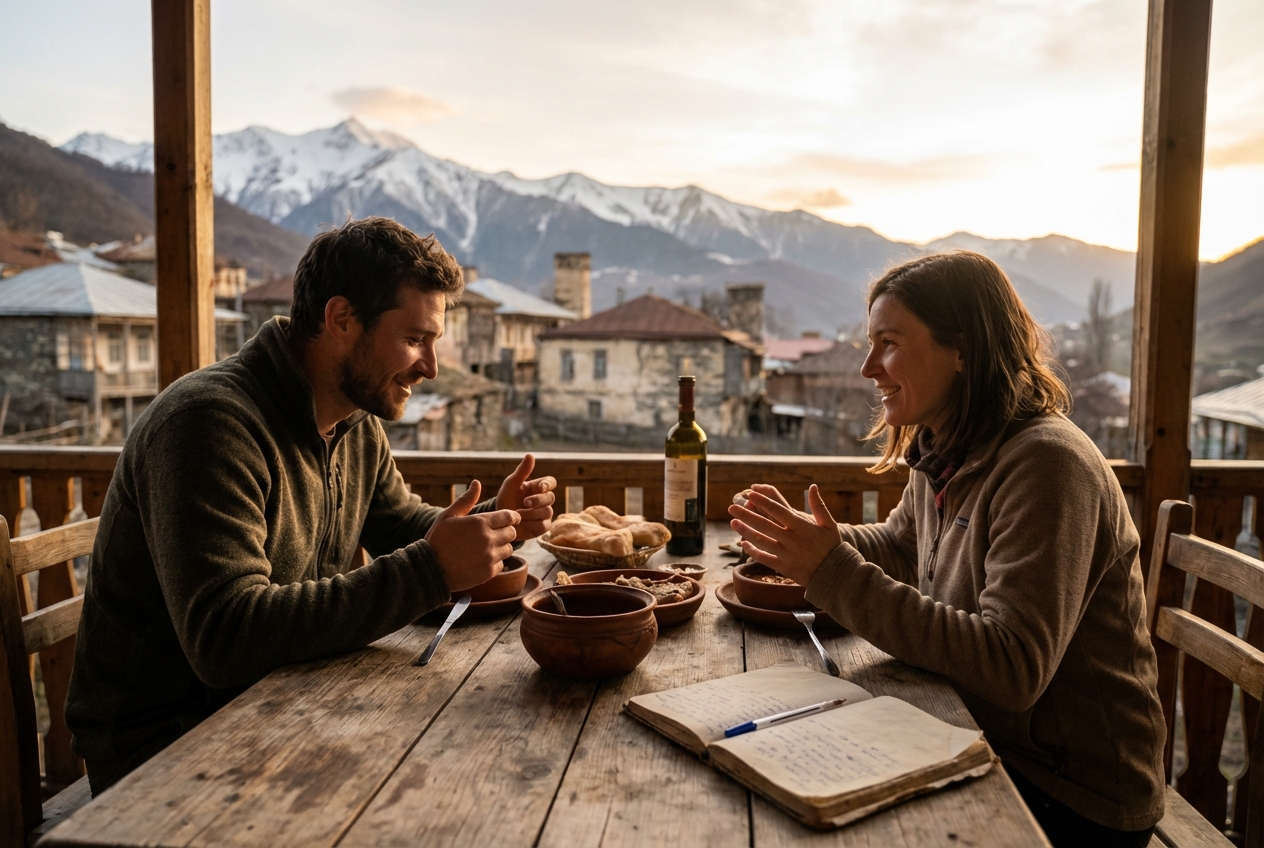
Georgia sits at the crossroads of Europe and Asia, where ancient winemaking traditions meet snow-capped Caucasus peaks and hospitality runs deeper than anywhere else on earth. Walk into any home, shop, or restaurant in this small but mighty country, and you'll quickly discover that Georgians take genuine pride in their unique language and culture.
So what are some common Georgian phrases that will help you connect with locals? The answer goes far beyond simple phrasebook translations. Georgian carries centuries of history in its sounds, and even basic attempts at speaking it will transform your interactions from polite tourist exchanges into moments of real connection. I've watched travelers stumble through a simple "thank you" and receive beaming smiles, extra food, and invitations to family dinners in return.
The Georgian language uses its own alphabet, one of only fourteen unique writing systems still in use worldwide. The script looks intimidating at first glance, all loops and curves that seem impossible to decode. But here's the good news: Georgian is a phonetic language, so everything is pronounced exactly as it's written. Once you crack the pronunciation code, reading becomes surprisingly straightforward.
Another relief for language learners: Georgian has no grammatical gender, which eliminates one major headache familiar to anyone who's wrestled with French or German. You won't need to memorize whether a table is masculine or feminine. The challenges lie elsewhere, particularly in those consonant clusters that can feel like tongue twisters at first.
Essential Greetings and Daily Etiquette
Georgian greetings carry more weight than simple hellos. They reflect a culture built on respect, warmth, and genuine interest in others' wellbeing. Master these basics and you'll immediately stand apart from tourists who breeze through without engaging.
Formal vs. Informal Greetings
The word you'll use most often is "Gamarjoba" (გამარჯობა), the standard greeting for hello. What makes this word special is its literal meaning: "Victory to you!" This isn't just a casual hey, it's a wish for success and triumph in whatever the other person faces. Use it with shopkeepers, hotel staff, and anyone you meet for the first time.
For informal situations with friends or younger people, "Salami" works as a casual hello borrowed from other languages. You might also hear "Rogor khar?" (How are you?) in everyday conversation, pronounced roughly "ROH-gor khar."
When addressing elders or people in positions of authority, stick with "Gamarjoba" and add "Batono" (sir) or "Kalbatono" (madam) to show extra respect. These honorifics matter enormously in Georgian culture.
Saying Goodbye and Wishing Well
"Nakhvamdis" (ნახვამდის) means goodbye and literally translates to "until we see each other again." For more casual farewells among friends, "Kai" (okay/good) with a wave works fine.
When someone's heading out on a journey, wish them "Kargi mgzavroba" (good travels). If it's nighttime, "Ghame mshvidobisa" (peaceful night) shows thoughtfulness. Georgians appreciate these small gestures of care, and using the right farewell for the situation demonstrates cultural awareness that locals notice and remember.
Navigating Social Situations and Politeness
Georgian culture places enormous emphasis on courtesy and respect. The right words at the right moment can open doors, literally and figuratively.
Expressing Gratitude and Apologies
"Madloba" (Thank you) can win the heart of every Georgian you meet. This simple word, pronounced "mahd-LOH-bah," should become second nature during your time in Georgia. Use it liberally: when receiving change, when someone holds a door, when a taxi driver navigates chaotic Tbilisi traffic.
For stronger gratitude, "Didi madloba" (many thanks) emphasizes your appreciation. "Gmadlobt" is a more formal version you might use with elders or in professional settings.
When you need to apologize, "Bodiashi" (excuse me/sorry) covers most situations. For more serious apologies, "Mapatiет" (forgive me) carries greater weight. Georgians generally forgive quickly and don't hold grudges, especially with visitors making genuine efforts to respect local customs.
Common Courtesies for Strangers
"Tu sheidzleba" (if it's possible/please) softens requests and shows politeness. Combine it with pointing or gesturing to ask for things politely when your vocabulary runs short.
"Diakh" means yes, while "Ara" means no. Simple but essential. When you don't understand something, "Ver gavige" (I don't understand) or "Ar vitsi kartuli" (I don't know Georgian) helps explain the language barrier without causing confusion.
One crucial cultural note: pointing with your index finger is considered rude in Georgia; use your whole hand instead. This gesture etiquette applies when indicating directions, items in shops, or anything else you might normally point at.
Dining Out and the Georgian Supra
Food sits at the absolute center of Georgian culture, and the traditional feast called a supra represents hospitality at its most elaborate. Understanding dining vocabulary enhances every meal, from casual khachapuri stops to multi-hour celebrations.
Ordering Food and Drinks
| Georgian Phrase | Pronunciation | English Meaning |
|---|---|---|
| Menus, tu sheidzleba | MEH-nus too sheh-EED-zleh-bah | Menu, please |
| Ra girts'evt? | rah geer-TSEVT | What do you recommend? |
| Es ra aris? | es rah AH-ris | What is this? |
| Ghvino | GHVEE-no | Wine |
| Tsivi ts'qali | TSEE-vee TSKAH-lee | Cold water |
| Angarishi | ahn-gah-REE-shee | The bill/check |
When ordering, "Minda" (I want) followed by pointing at a menu item works in most situations. "Ert…" (one…) or "Or…" (two…) before a dish name helps specify quantities.
Georgian cuisine features dishes that might be unfamiliar, so "Es ra aris?" becomes invaluable. Servers generally love explaining local specialties, and your curiosity shows appreciation for their food culture.
Toastmaster Basics and Table Talk
The supra revolves around the tamada, or toastmaster, who leads a series of increasingly elaborate toasts throughout the meal. Understanding this ritual transforms a dinner from confusing to magical.
"Gaumarjos!" (გაუმარჯოს) is the essential toast, meaning "cheers" or "to victory." You'll hear it dozens of times during a proper supra. When the tamada finishes a toast, everyone responds with "Gaumarjos!" and drinks.
Never sip wine casually between toasts at a formal supra. Wait for the tamada to speak, then drink when everyone drinks. This might feel restrictive, but it's deeply important to Georgian hosts.
"Gvinda" (we want) followed by a toast subject lets you propose your own toast if invited. Common subjects include family, friendship, Georgia itself, and deceased loved ones. Keep toasts sincere and heartfelt rather than joking or ironic.
Practical Phrases for Travelers
Beyond social situations, you'll need functional vocabulary for getting around, finding things, and handling daily logistics.
Asking for Directions and Transportation
"Sad aris…?" (Where is…?) followed by a place name covers most navigation needs. Point on a map or show an address on your phone to clarify if pronunciation fails you.
Useful direction vocabulary includes:
- Marjvniv – right
- Marcxniv – left
- Pirdapir – straight ahead
- Axlos – nearby
- Shors – far
For transportation, "Metro sadguri sad aris?" asks where the metro station is. "Avtobusi" means bus, "taksi" means taxi, and "matarеbeli" means train. "Ramdeni ghirs?" (How much does it cost?) helps negotiate taxi fares before getting in, which is standard practice.
"Gaacheret ak, tu sheidzleba" tells a taxi driver to stop here, please. Essential when you spot your destination or realize you've gone too far.
Shopping and Bargaining at Local Markets
Georgian markets, especially the Dezerter Bazaar in Tbilisi, offer incredible produce, spices, cheese, and churchkhela (the famous grape and walnut candy). Knowing market vocabulary makes these visits far more enjoyable.
"Ramdeni ghirs?" (How much does it cost?) starts every transaction. Vendors often quote prices verbally, so knowing numbers helps:
- Erti (1), ori (2), sami (3), otkhi (4), khuti (5)
- Ekvsi (6), shvidi (7), rva (8), tskhra (9), ati (10)
- Lari is the currency name
"Dzviria" (It's expensive) opens bargaining, though aggressive haggling isn't really part of Georgian market culture. A gentle "Sheidzleba naklebi?" (Is less possible?) works better than hard negotiation.
"Ert kilo" (one kilogram) or "Nakhevari kilo" (half kilogram) helps when buying produce by weight. Point and smile when words fail, and vendors will usually help you figure out quantities.
Understanding Unique Idioms and Cultural Expressions
Georgian idioms reveal how locals actually think and communicate. These expressions don't translate literally but carry cultural weight that enriches your understanding.
"Sheni ch'iri me" literally means "your trouble on me" but expresses deep affection, roughly equivalent to "I'd take your pain upon myself." Georgians use it with loved ones to show they'd bear any burden for them.
"Genats'vale" is an untranslatable term of endearment meaning something like "I'd sacrifice myself for you." You'll hear it constantly between family members, friends, and even from shopkeepers to customers they like. It reflects the Georgian tendency toward emotional warmth and dramatic expression.
"Puri da marili" (bread and salt) represents hospitality itself. Offering bread and salt to guests is an ancient tradition, and the phrase has come to symbolize welcome and generosity.
When someone sneezes, say "Ichvedet" (may you live long). The response is "Shen ghenats'vale" (may I sacrifice myself for you), which sounds intense but is perfectly normal.
Learning basic Georgian phrases shows respect for the culture and people. Georgians appreciate when visitors take the time to learn their language. Even imperfect attempts earn enormous goodwill, so don't worry about making mistakes.
Tips for Pronouncing Georgian Sounds
Georgian pronunciation challenges English speakers with sounds that simply don't exist in our language. The consonant clusters can feel impossible at first, but breaking them down helps.
The "kh" sound (ხ) comes from the back of the throat, similar to the Scottish "loch" or German "Bach." Practice by saying "k" while exhaling more air.
Georgian has two types of "k" sounds: a regular "k" (კ) and an ejective "k'" (ყ) made by closing the throat and releasing air explosively. The ejective sounds sharper and more forceful.
The "ts" (ც) and "ch" (ჩ) sounds exist in English but appear in unusual positions in Georgian, often at the beginning of words where English speakers don't expect them. "Ts'qali" (water) starts with this cluster.
The "gh" (ღ) sound resembles a French "r" or the sound of gargling. It's voiced and produced in the throat, different from the "kh" sound.
Practice these combinations slowly:
- Gamarjoba: gah-mar-JOH-bah
- Madloba: mahd-LOH-bah
- Nakhvamdis: nahkh-vahm-DEES
- Gaumarjos: gah-oo-mar-JOHS
Don't stress perfection. Georgians understand that their language is difficult for foreigners and appreciate any effort. A mangled "madloba" still communicates gratitude and earns smiles.
Making Georgian Your Gateway to Connection
The phrases covered here represent just the beginning of Georgian language learning, but they're enough to transform your experience in this remarkable country. From the moment you say "Gamarjoba" to a shopkeeper to the final "Gaumarjos!" at a supra, each word builds bridges that generic tourist interactions never could.
Georgian hospitality already ranks among the world's most generous. Add genuine attempts at speaking the language, and you'll unlock experiences that guidebooks can't describe: invitations to homes, stories shared over homemade wine, and friendships that outlast your trip.
Start with "Gamarjoba" and "Madloba." Use them constantly. Let locals correct your pronunciation and teach you new words. The language barrier becomes a connection point rather than an obstacle when you approach it with humility and enthusiasm.
Georgia rewards those who engage deeply with its culture. Learning even basic phrases signals that you're not just passing through, you're genuinely interested in the people and traditions that make this country extraordinary. That interest gets repaid tenfold in warmth, generosity, and memories you'll carry forever.