
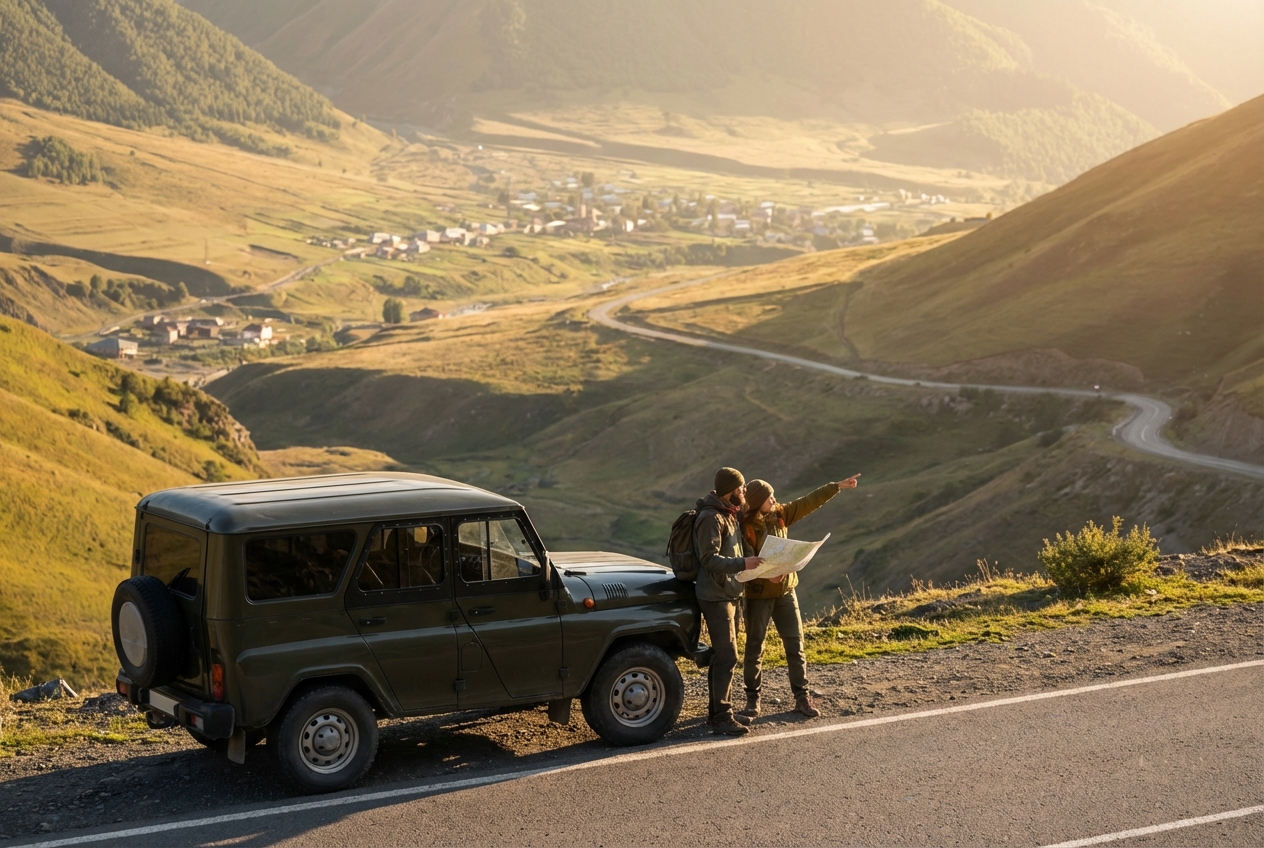
Georgia sits at the crossroads of Europe and Asia, tucked between the Greater Caucasus mountains and the Black Sea. It's a country where ancient monasteries cling to cliffsides, wine flows from 8,000-year-old traditions, and the landscapes shift from subtropical coastlines to snow-capped peaks within a few hours. The question of whether renting a car in Georgia makes sense depends entirely on what kind of trip you're planning. For some travelers, it's the obvious choice. For others, it's an unnecessary expense that adds stress to an otherwise relaxed journey.
Having watched countless travelers wrestle with this decision, I can tell you there's no universal answer. A couple spending a week in Tbilisi and Batumi has completely different needs than a group of friends determined to reach Ushguli or camp near the Gergeti Trinity Church. The country's compact size can be deceiving: distances that look short on a map often involve winding mountain roads that take three times longer than expected. Public transport exists and works reasonably well on major routes, but it leaves significant gaps. According to experts at holidaycar.rent, "Renting a car in Georgia is highly recommended for travelers who want the freedom to explore the country at their own pace and access remote locations." That freedom comes with trade-offs worth understanding before you book.
Evaluating the Pros and Cons of Driving in Georgia
Freedom to Explore Remote Regions
The strongest argument for renting a car in Georgia comes down to access. Some of the country's most spectacular destinations simply aren't reachable by public transport, or require such convoluted connections that you'd spend more time waiting than exploring.
Consider Tusheti National Park, one of Europe's last true wilderness areas. The only way in is a harrowing mountain road that's impassable for much of the year. Shared jeeps run from Telavi, but they operate on their own schedules and fill up quickly in summer. With your own vehicle, preferably a capable 4×4, you control when you go and how long you stay.
The same logic applies to countless smaller discoveries. That unmarked waterfall a local mentioned at dinner. The family winery tucked behind a village church. The hot springs that don't appear in guidebooks. These moments define memorable trips, and they're nearly impossible to plan around fixed transport schedules.
Driving also solves the luggage problem. Georgia's marshrutkas (shared minivans) have limited storage, and hauling bags between connections gets old fast. A rental car means you can pack properly, stock up on wine without worrying about weight limits, and change plans spontaneously when you hear about something interesting nearby.
Challenges of Local Driving Culture and Infrastructure
Georgian driving culture can be jarring for visitors accustomed to predictable traffic patterns. Overtaking on blind curves happens regularly. Speed limits function more as suggestions than rules. Horn use is constant and communicative rather than aggressive, but it takes adjustment.
The good news: Georgian drivers are generally skilled and aware. The chaos has an underlying logic, and locals are often patient with confused tourists trying to navigate roundabouts or merge into traffic. The bad news: you need to stay alert constantly. Defensive driving isn't optional here.
Road quality varies dramatically. Major highways connecting Tbilisi to Batumi or Kutaisi are generally well-maintained. Secondary roads range from acceptable to genuinely challenging. Some mountain routes involve unpaved sections, single-lane passages with sheer drops, and conditions that deteriorate rapidly after rain.
Understanding Road Conditions and Geographic Requirements
City Driving vs. Mountain Passes
Tbilisi driving presents its own character. The city sprawls across hills, and navigation can confuse even experienced drivers. One-way streets appear without warning, parking is scarce and competitive, and traffic jams during rush hours rival any European capital. Many visitors find it easier to use Bolt (the local ride-hailing app) within Tbilisi and pick up their rental when leaving the city.
Outside urban areas, the experience transforms completely. The Georgian Military Highway heading north toward Kazbegi offers stunning scenery but demands respect. You'll encounter hairpin turns, occasional rockfall zones, and weather that can shift from sunshine to fog within minutes. The road itself is paved and maintained, but conditions during winter or early spring can require chains.
Western Georgia's routes toward Svaneti present the biggest challenges. The road to Mestia has improved significantly in recent years, but sections remain narrow and exposed. Beyond Mestia, reaching Ushguli requires either a serious 4×4 or hiring a local driver familiar with the route.
| Route | Distance from Tbilisi | Typical Drive Time | Road Condition | Vehicle Needed |
|---|---|---|---|---|
| Tbilisi to Batumi | 380 km | 5-6 hours | Excellent highway | Any vehicle |
| Tbilisi to Kazbegi | 150 km | 3-4 hours | Good, mountain passes | Standard car works |
| Tbilisi to Mestia | 460 km | 8-9 hours | Mixed, some rough sections | SUV recommended |
| Mestia to Ushguli | 45 km | 2-3 hours | Unpaved, challenging | 4×4 essential |
| Tbilisi to Sighnaghi | 110 km | 1.5-2 hours | Good | Any vehicle |
When a 4×4 Vehicle is Essential
For most Georgia itineraries, a standard compact car handles the job fine. The main tourist routes, including Kakheti wine country, Mtskheta, the Black Sea coast, and even Kazbegi, don't require anything special.
A 4×4 or SUV becomes necessary when your plans include Tusheti, the road beyond Mestia to Ushguli, or exploring genuinely off-the-beaten-path areas in Racha or Samegrelo. These vehicles cost more to rent, typically ranging from $50-$90 per day according to unitedcarsrent.com, but attempting these routes in an underpowered sedan risks getting stuck, damaging the vehicle, or worse.
If your itinerary includes one challenging destination surrounded by easier driving, consider renting a standard car for most of the trip and hiring a local driver with an appropriate vehicle for the difficult section. This often works out cheaper than renting a 4×4 for your entire stay.
Practical Logistics of Renting a Car
Required Documentation and Insurance Coverage
Renting a car in Georgia requires a valid driver's license from your home country. An International Driving Permit isn't legally mandatory but can smooth interactions with rental agencies and police. Bring both to be safe.
Most agencies require drivers to be at least 21, with some setting the minimum at 23 for larger vehicles. A credit card is typically needed for the security deposit, though aleksblog.com notes that many local companies offer no-deposit rentals, especially for standard categories. This can be helpful if you're traveling without a credit card or prefer not to have funds held.
Insurance deserves careful attention. Basic coverage is usually included, but deductibles can run high. Full coverage with zero deductible typically adds $10-20 per day but provides peace of mind on challenging roads. Read the fine print regarding coverage on unpaved roads: some policies exclude damage sustained off-pavement, which matters if you're planning mountain excursions.
Choosing Between Local Agencies and International Brands
International chains like Hertz, Avis, and Europcar operate in Georgia, primarily at Tbilisi airport. They offer familiar booking processes, standardized vehicles, and customer service in multiple languages. Prices tend to run higher than local alternatives.
Georgian rental companies often provide better value, more flexible terms, and vehicles better suited to local conditions. Companies like Hertz Georgia, Local Rent, and Premium Auto Rent have solid reputations. The trade-off involves potentially less polished customer service and booking systems.
Airport pickup is convenient but usually costs more. Picking up from a city location can save money and avoid airport surcharges. Many agencies offer free delivery to your hotel in Tbilisi.
Economy car rentals can start from $25-$40 per day during low season, as reported by unitedcarsrent.com. High season (June through September) pushes prices up considerably, and booking in advance becomes essential.
Cost Analysis: Rental vs. Public Transport and Private Drivers
Fuel Prices and Parking Fees
Fuel in Georgia runs cheaper than Western Europe but represents a meaningful expense over a multi-week trip. Stations are plentiful along main routes, though you should fill up before heading into remote mountain areas where options thin out.
Parking in Tbilisi requires patience and sometimes creativity. Street parking exists but fills quickly in central areas. Paid lots and garages charge modest fees by European standards. Outside the capital, parking is rarely an issue: most towns have ample free parking near attractions.
Tolls are minimal. The main highway between Tbilisi and Batumi has toll sections, but costs are negligible. Budget around 10-15 GEL for the full journey.
The Marshrutka and Bolt Alternatives
Georgia's marshrutka network connects most towns and cities at remarkably low prices. A trip from Tbilisi to Batumi costs around 35-40 GEL, taking roughly six hours. Comfort levels vary: some vehicles are modern minibuses, others are aging vans packed beyond reasonable capacity.
For shorter distances or urban transport, Bolt works excellently in Tbilisi and Batumi. Rides cost a fraction of Western prices, and the app eliminates language barriers and negotiation. A 20-minute ride across Tbilisi rarely exceeds 10 GEL.
Private drivers offer a middle ground between rental cars and public transport. Hiring a driver for a day trip to Kazbegi or a wine tour through Kakheti typically costs $80-150 depending on distance and negotiation skills. For solo travelers or couples, this often makes more financial sense than renting, especially when factoring in fuel, insurance, and the stress of unfamiliar roads.
Safety Tips for Navigating Georgian Roads
Dealing with Livestock and Unpredictable Hazards
Cows, sheep, horses, and pigs wander Georgian roads with complete disregard for traffic. This isn't occasional: it's constant outside urban areas. Animals have right of way by default, and hitting one creates serious problems beyond vehicle damage.
Drive slower than you think necessary, especially around blind curves and through villages. Shepherds moving flocks along roads can block traffic for extended periods. Patience isn't optional.
Other hazards include potholes that appear suddenly, drivers stopping without warning to chat with friends, and pedestrians crossing highways far from designated crossings. The alcohol limit is 0.3‰ according to premiumautorent-ge.com, and it's best to avoid driving after drinking entirely.
Navigating Police Checkpoints and Traffic Laws
Speed limits in Georgia are 60 km/h in urban areas, 90 km/h outside urban areas, and 110 km/h on highways, as specified by premiumautorent-ge.com. Speed cameras exist, particularly on the Tbilisi-Batumi highway, and fines arrive automatically.
Police checkpoints are common, especially near borders and on major routes. These are typically routine: officers check documents and wave you through. Keep your license, passport, and rental agreement accessible. Being polite and patient resolves most interactions quickly.
If you receive a traffic fine, you can often pay at any bank within a specified period. Serious violations may require appearing in person. Rental agencies can help navigate the process if needed.
Final Verdict: Who Should Rent a Car in Georgia?
Renting a car makes the most sense for travelers planning to explore beyond major cities, visit multiple regions, or reach destinations inaccessible by public transport. Groups of three or more almost always save money compared to hiring private drivers repeatedly. Anyone prioritizing flexibility and spontaneity will appreciate having their own vehicle.
Skip the rental if you're staying primarily in Tbilisi, planning a beach-focused trip to Batumi, or uncomfortable with assertive driving cultures. Solo travelers and couples on tight budgets often find combinations of marshrutkas, Bolt, and occasional hired drivers more economical.
The country rewards exploration, and a car unlocks corners that most visitors never see. Just go in with realistic expectations about road conditions, local driving norms, and the time mountain routes actually require. The freedom to stop at that roadside monastery, follow a hand-painted sign to a family cellar, or chase a sunset to the perfect viewpoint: that's what makes the rental worthwhile.