
Table of Contents
- Rustaveli Avenue: The Heart of the Georgian Capital
- Quick Reference: Famous Streets in Tbilisi Compared
- Exploring Shardeni Street and the Old Town Charms
- Agmashenebeli Avenue: A Pedestrian Paradise
- Alternative Cultural Hubs: Fabrika and Beyond
- Tips for Navigating Tbilisi’s Most Iconic Routes
Ask anyone who’s spent time in the Georgian capital about its most famous street, and you’ll get the same answer almost every time: Rustaveli Avenue. Named after the medieval poet Shota Rustaveli, this boulevard has served as the political, cultural, and emotional backbone of Tbilisi for well over a century. It’s where Georgians celebrate, protest, shop, and stroll, often all in the same afternoon.
But Tbilisi isn’t a one-street city. While Rustaveli claims the title of most iconic thoroughfare, several other streets and districts compete fiercely for a visitor’s attention. Shardeni Street draws you in with cobblestones and wine bars. Agmashenebeli Avenue has been quietly reinventing itself as a pedestrian-friendly food destination. And converted industrial spaces like Fabrika have created entirely new cultural corridors. If you’re wondering which Tbilisi street deserves your time, the honest answer is: more than one. But Rustaveli is where we start.
Rustaveli Avenue: The Heart of the Georgian Capital
Historical Significance and Development
Rustaveli Avenue stretches roughly 1.5 kilometers from Freedom Square to Heroes’ Square, and nearly every major chapter of modern Georgian history has played out along its length. Russian Imperial administrators laid out the boulevard in the 19th century as Tbilisi’s main ceremonial axis. Soviet planners later widened it and lined it with institutional buildings. And since independence, the avenue has been the default stage for Georgia’s most significant political demonstrations, from the tragic events of April 9, 1989, to the massive protests of recent years.
Walking down Rustaveli today, you’re essentially reading a timeline of the country. The pavement itself carries plaques and memorials. The buildings shift from ornate 19th-century facades to Soviet-era monoliths to glass-and-steel additions from the 2000s. It’s not always pretty in a postcard sense, but it’s genuinely layered in a way few European boulevards can match.
Tbilisi City Hall has allocated 40 million GEL (approximately $15 million) for a comprehensive rehabilitation of Rustaveli Avenue set to begin in May 2026. The project aims to modernize infrastructure, improve pedestrian flow, and restore heritage facades. If you’re visiting during the construction period, expect some detours, but the long-term payoff should be significant.
Architectural Landmarks and Institutions
The concentration of cultural institutions along Rustaveli is staggering for a street this short. The Georgian National Museum anchors one end, housing everything from pre-Christian gold artifacts to Soviet-era exhibits. The Rustaveli Theatre, one of the oldest in the Caucasus, sits across from the Parliament building. The Opera and Ballet Theatre, originally built in Moorish Revival style in 1851 and rebuilt after a fire, is another anchor.
Between these major landmarks, you’ll find the National Gallery, the Kashveti Church of St. George (a 20th-century recreation of a medieval original), and the former Viceroy’s Palace. The avenue also hosts bookstores, cafes, and underground passages that connect to the metro. I’ve spent entire afternoons just moving from the museum to a cafe to the gallery without crossing a single side street. It’s that dense with things worth seeing.
Quick Reference: Famous Streets in Tbilisi Compared
| Street | Character | Best For | Typical Visit Length |
|---|---|---|---|
| Rustaveli Avenue | Grand, institutional, historic | Museums, architecture, people-watching | 2-4 hours |
| Shardeni Street | Cobblestone, intimate, lively | Wine bars, cafes, evening dining | 2-3 hours |
| Agmashenebeli Avenue | Restored, pedestrian-friendly | Georgian food, outdoor dining, local vibe | 1.5-3 hours |
| Leselidze Street | Touristy, colorful, compact | Souvenirs, churches, quick exploration | 1-2 hours |
| Chardin Street | Artistic, bohemian | Art galleries, brunch spots | 1-2 hours |
Each of these streets occupies a distinct niche. Rustaveli is the most well-known street in Tbilisi by a wide margin, but the others reward exploration in different ways. If you only have a day, prioritize Rustaveli and Shardeni. With two or three days, add Agmashenebeli and the Fabrika area.
Exploring Shardeni Street and the Old Town Charms
Shardeni Street sits in the heart of Tbilisi’s Old Town, a narrow pedestrian lane paved with smooth cobblestones and flanked by two- and three-story buildings with wrought-iron balconies. The name comes from the French traveler Jean Chardin, who visited Tbilisi in the 17th century and left detailed accounts of its bazaars and bathhouses. Today, the street bearing his name has become the city’s most concentrated strip of restaurants, wine bars, and small galleries.
What makes Shardeni work is its scale. You can walk the entire street in about three minutes, but you’ll probably linger for hours. The buildings press in close, tables spill onto the stone pavement, and live music drifts from open doorways most evenings. It connects naturally to Chardin Street and the broader Old Town network, making it easy to wander without a fixed plan.
The Modern Hub of Nightlife and Cafes
After dark, Shardeni transforms. The wine bars fill up by 8 PM, and by 10 PM the street has a buzzing energy that feels distinctly Mediterranean despite being in the Caucasus. A glass of good Georgian natural wine runs about 12-18 GEL ($4.50-$7), and most bars offer tasting flights that let you sample Kakheti reds alongside Imeretian ambers.
The cafe culture here is strong during daylight hours too. Several spots serve excellent Georgian coffee alongside khachapuri for around 8-10 GEL. I’ve found that weekday mornings are the best time to grab a table outside and watch the Old Town wake up, before the tourist crowds arrive around noon.
Art Galleries and Souvenir Shopping
Shardeni and its surrounding streets host a rotating collection of small galleries showcasing Georgian contemporary art. These aren’t stuffy museum spaces: most are single-room affairs where the artist or gallery owner is happy to talk about the work. Prices for original paintings and prints range from 50 GEL to several thousand, depending on the artist’s profile.
For souvenirs, the Old Town streets branching off Shardeni offer cloisonné enamel jewelry (a Georgian specialty), hand-carved drinking horns, and carpets from various Caucasian traditions. A word of advice: the shops closest to Shardeni charge tourist premiums. Walk two blocks in any direction and prices drop noticeably. The Dry Bridge Market, a short walk away, remains the best spot for Soviet-era curiosities, antique daggers, and handmade silver.
Agmashenebeli Avenue: A Pedestrian Paradise
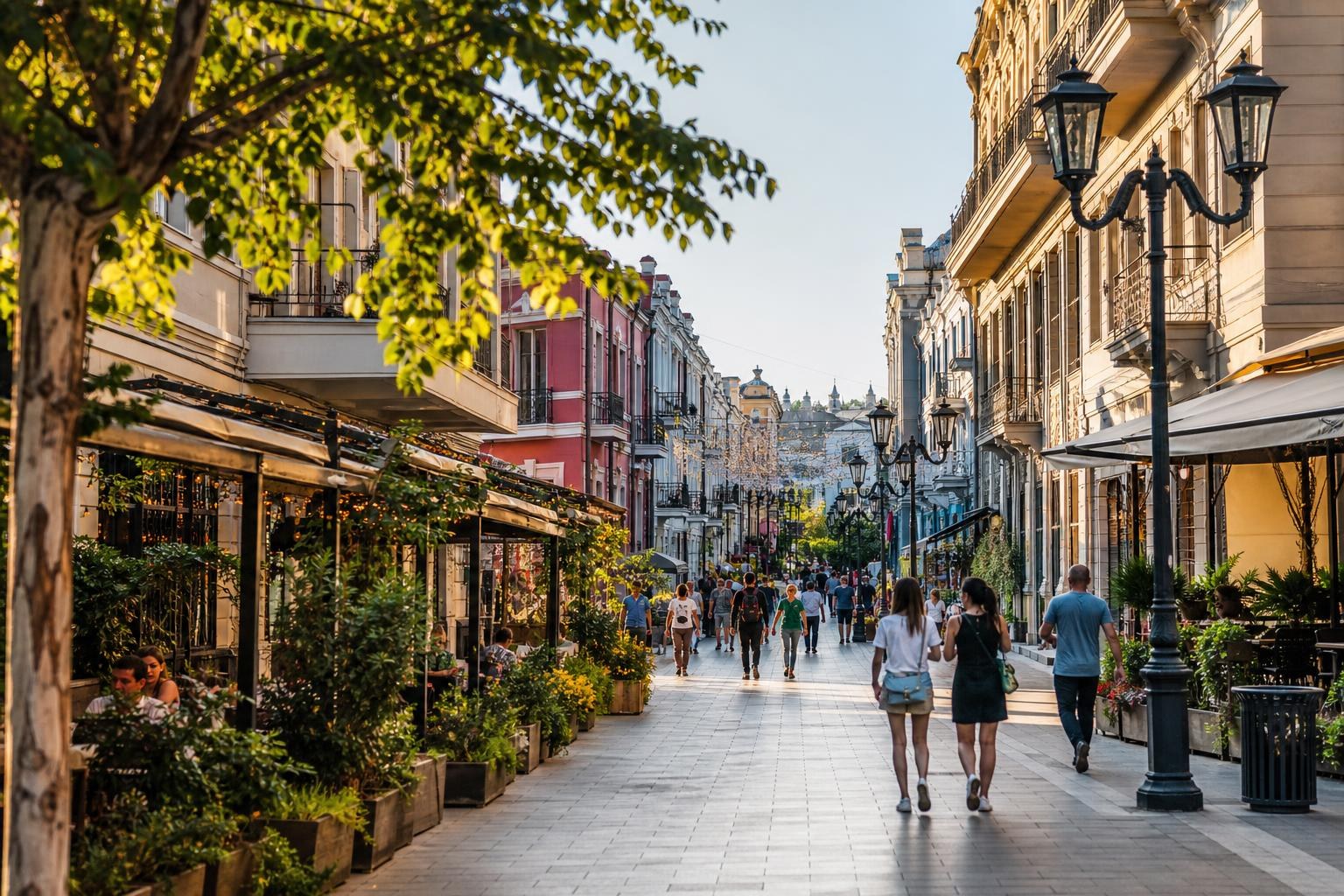
If Rustaveli is Tbilisi’s formal living room, Agmashenebeli Avenue is its relaxed kitchen table. Located south of the river in what was historically called “New Tiflis,” this avenue has undergone a remarkable transformation over the past decade. The pedestrianized section now stretches for several blocks, lined with restored 19th-century buildings painted in pastels and earth tones.
The avenue was named after King David IV, known as David Agmashenebeli (David the Builder), the 12th-century monarch who unified Georgia and made it a regional power. The street’s character reflects a different era of Tbilisi’s development: the late 1800s, when the city was expanding beyond its medieval walls and new neighborhoods were built with wide European-style boulevards.
Restoration of the New Tiflis District
The restoration of Agmashenebeli has been one of Tbilisi’s genuine urban success stories. Buildings that were crumbling a decade ago now sport fresh facades, repaired balconies, and ground-floor businesses. The pedestrian zone includes proper street furniture, planted trees, and lighting that makes evening walks genuinely pleasant.
What’s notable is that the restoration hasn’t (yet) displaced the local character entirely. You’ll still find elderly neighbors sitting on balconies, corner shops selling churchkhela and spices by weight, and small repair workshops operating alongside new wine bars. Georgia’s tourism numbers have been climbing steadily, and Agmashenebeli has benefited from that growth without losing its residential soul, at least for now.
Dining and Outdoor Culture
This is where Tbilisi’s food scene gets interesting. Agmashenebeli hosts some of the city’s best mid-range Georgian restaurants, where a full meal for two with wine rarely exceeds 80-100 GEL ($30-$38). The outdoor seating culture here is strong from April through October, with tables stretching across the wide pedestrian boulevard.
Look for restaurants serving regional specialties rather than generic “Georgian cuisine.” Megrelian-style dishes tend to be spicier and heavier on walnut sauces. Kakhetian places emphasize grilled meats and robust wines. A few Adjarian-style spots serve the boat-shaped khachapuri that’s become Georgia’s most photographed dish. The avenue also hosts a growing number of craft beer bars and specialty coffee roasters, reflecting Tbilisi’s younger generation putting its own stamp on the food scene.
Alternative Cultural Hubs: Fabrika and Beyond
Fabrika, a converted Soviet-era sewing factory in the Marjanishvili district, has become Tbilisi’s most visible example of adaptive reuse. The complex houses a hostel, co-working spaces, design studios, bars, and a sprawling courtyard where street art covers every available surface. It’s the kind of place that could feel forced in another city, but Fabrika works because it grew organically from Tbilisi’s creative community rather than being imposed by developers.
The surrounding Marjanishvili neighborhood has benefited from the spillover. New galleries, vintage shops, and small restaurants have opened on adjacent streets, creating a cultural district that feels distinctly different from the Old Town or Rustaveli. For visitors interested in contemporary Georgian culture rather than historical sights, this area is essential.
Other emerging hubs include the area around Dedaena Park, where a weekend book market draws locals, and the Vera district north of Rustaveli, which has a quieter, residential charm with hidden courtyard cafes. Tbilisi’s cultural geography is shifting, and the most interesting developments in 2026 are happening in these peripheral neighborhoods rather than on the established tourist routes.
Tips for Navigating Tbilisi’s Most Iconic Routes
Getting around Tbilisi’s famous streets is straightforward if you know a few basics. The metro connects Rustaveli (Rustaveli station) to Agmashenebeli (Marjanishvili station) in one stop, costing just 1 GEL ($0.38). Shardeni and the Old Town are best reached on foot from either station, or by a short Bolt ride that typically runs 4-6 GEL.
Here are some practical tips for making the most of your time:
- Walk Rustaveli in the morning when the museums open and foot traffic is manageable. The rehabilitation project starting in 2026 may redirect pedestrian routes, so check locally for updates.
- Save Shardeni and the Old Town for late afternoon into evening, when the light is golden on the stone facades and the bars start filling up.
- Visit Agmashenebeli for a weekday lunch to experience it at its most authentic, before weekend crowds arrive.
- Download the Bolt app before arrival: it’s the dominant ride-hailing service and eliminates the need to negotiate with taxi drivers.
- Carry cash in smaller denominations. Many Old Town vendors and smaller Agmashenebeli restaurants prefer GEL notes under 50.
- Wear comfortable shoes. Every famous street in Tbilisi involves uneven cobblestones, steep side streets, or both.
Tbilisi rewards the walker. The distances between its most celebrated streets are short enough that you can cover Rustaveli, Shardeni, and Agmashenebeli in a single ambitious day, though spreading them across two or three days lets you absorb the atmosphere rather than just check locations off a list. The city’s best-known boulevard may be Rustaveli Avenue, but the real discovery happens when you turn off the main drag and follow a side street wherever it leads.