
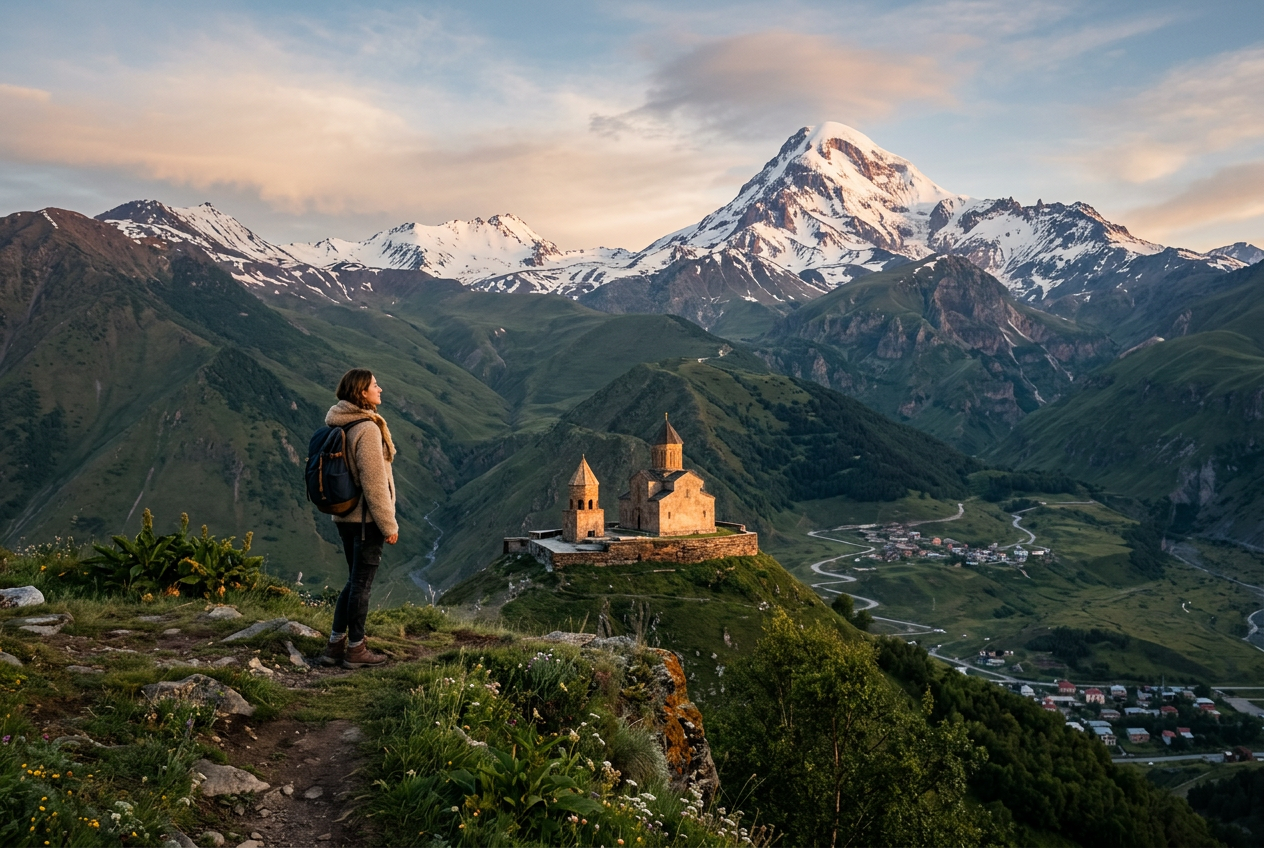
Few countries have captured the imagination of travelers quite like Georgia. Tucked between the soaring peaks of the Caucasus Mountains and the shimmering Black Sea, this small nation at the crossroads of Europe and Asia offers something increasingly rare: genuine authenticity. Why do tourists go to Georgia? The answers are as layered as the country's 8,000-year history, but they share a common thread: this is a place where ancient traditions breathe alongside modern energy, where strangers become family over endless toasts, and where your travel budget stretches further than you'd ever expect.
The numbers tell part of the story. In 2025, Georgia welcomed 5.52 million international tourists, an 8.4% increase from the previous year. International travel revenue reached $3.64 billion in just the first nine months of 2025, reflecting a 12% jump compared to 2024. These aren't abstract statistics. They represent millions of people who discovered what makes Sakartvelo, as Georgians call their homeland, so magnetically appealing. Having spent considerable time wandering its cobblestone streets and mountain trails, I can tell you the reasons run far deeper than any tourism brochure suggests.
The Birthplace of Wine and Culinary Traditions
Georgia's claim as the birthplace of wine isn't marketing hyperbole. Archaeological evidence confirms that winemaking began here around 6000 BCE, making Georgian wine culture older than the Egyptian pyramids. This isn't merely historical trivia: it fundamentally shapes how Georgians live, celebrate, and welcome guests today.
The 8,000-Year-Old Qvevri Winemaking Method
The qvevri, a large clay vessel buried underground for fermentation, represents UNESCO-recognized intangible cultural heritage. Unlike modern stainless steel tanks, qvevri allow wine to ferment with grape skins, seeds, and sometimes stems, producing amber wines with complex tannins and earthy depth. Visiting a family winery in Kakheti, Georgia's premier wine region, offers an experience no Napa Valley tour can replicate. You'll likely find yourself in someone's backyard, watching a winemaker whose family has used the same techniques for generations. The wine tastes different here: richer, wilder, more alive.
Over 500 indigenous grape varieties grow in Georgia, with Saperavi and Rkatsiteli being the most celebrated. Many small producers still crush grapes by foot and age wine in qvevri for six months before bottling. Tasting these wines isn't just drinking: it's participating in humanity's oldest continuous winemaking tradition.
The Supra: A Traditional Georgian Feast
The supra transforms eating into ritual. This traditional feast follows strict customs orchestrated by the tamada, or toastmaster, who guides the evening through elaborate toasts to God, family, ancestors, and guests. The Georgian phrase "stumari ghvtisaa" translates to "a guest is a gift from God," and the supra embodies this belief completely.
Expect dishes to arrive continuously: platters of cheese-stuffed bread, walnut-paste vegetables, grilled meats, fresh herbs. Each toast requires you to drain your glass, typically filled with homemade wine. A proper supra lasts hours, sometimes until dawn. Visitors often describe it as overwhelming, emotional, and utterly unforgettable.
Regional Specialties from Khinkali to Khachapuri
Georgian cuisine varies dramatically by region. Khinkali, soup-filled dumplings from the mountains, require specific eating technique: grab the twisted top, bite a small hole, slurp the broth, then eat the dumpling while discarding the doughy knob. Adjarian khachapuri, the boat-shaped bread filled with cheese, butter, and a raw egg, originates from the Black Sea coast. Megrelian cuisine runs spicier, while Kakhetian food pairs perfectly with the region's wines.
| Regional Dish | Origin | Key Ingredients |
|---|---|---|
| Khinkali | Mountainous regions | Spiced meat, herbs, dough |
| Adjarian Khachapuri | Batumi/Adjara | Cheese, butter, egg |
| Pkhali | Throughout Georgia | Vegetables, walnuts, spices |
| Mtsvadi | Kakheti | Grilled pork or beef |
| Lobio | Western Georgia | Beans, herbs, spices |
Breathtaking Landscapes of the Caucasus Mountains
The Caucasus Mountains form Europe's highest range, and Georgia claims some of their most dramatic scenery. From glaciated peaks exceeding 5,000 meters to lush subtropical valleys, the landscape diversity within this Connecticut-sized country defies logic.
Hiking and Adventure in Svaneti and Kazbegi
Svaneti feels like stepping into a medieval time capsule. This remote northwestern region, accessible only by winding mountain roads, contains Europe's highest continuously inhabited settlement. Ancient stone towers, built centuries ago for defense against invaders, dot villages where Svan, a distinct language predating Georgian, still echoes through the streets.
The trek from Mestia to Ushguli takes four days and passes through landscapes ranging from alpine meadows to glacier-carved valleys. Kazbegi, closer to Tbilisi, offers easier access to high-altitude adventure. The hike to Gergeti Trinity Church, perched at 2,170 meters with Mount Kazbek looming behind, remains Georgia's most photographed scene for good reason.
Winter Sports and Ski Resorts
Georgia's ski resorts offer European-quality slopes at a fraction of Alpine prices. Gudauri, the country's premier resort, features 57 kilometers of runs, modern lifts, and reliable powder from December through April. Lift passes cost roughly $25-30 per day, and equipment rental runs similarly affordable. Bakuriani, a Soviet-era resort now modernized, attracts families and beginners with gentler terrain.
Freeriders increasingly discover Georgia's backcountry potential. Heli-skiing operations launch from Gudauri, accessing untouched powder in the surrounding peaks. The combination of quality snow, minimal crowds, and low costs has positioned Georgia as an emerging winter sports destination.
A Rich Tapestry of History and Ancient Architecture
Georgia's location at the crossroads of empires, where Persian, Ottoman, Russian, and Mongol forces repeatedly clashed, created a culture defined by resilience. Ancient churches and fortresses survived these invasions, standing today as monuments to Georgian tenacity.
UNESCO Heritage Sites and Medieval Monasteries
Three UNESCO World Heritage Sites anchor Georgia's historical tourism. The ancient capital of Mtskheta, just 20 kilometers from Tbilisi, contains Jvari Monastery and Svetitskhoveli Cathedral, both dating to the 6th century. Georgian Orthodox Christianity, adopted in 337 CE, makes Georgia one of the world's oldest Christian nations.
Gelati Monastery, near Kutaisi, once housed a medieval academy rivaling European universities. The frescoes inside remain remarkably preserved, depicting biblical scenes in Byzantine-Georgian style. Upper Svaneti, the third UNESCO site, encompasses the tower-studded villages mentioned earlier, representing a living medieval landscape.
Vardzia and the Ancient Cave Cities
Vardzia defies easy description. This 12th-century cave monastery complex, carved into a cliff face along the Mtkvari River, once contained 6,000 rooms, churches, and secret tunnels. Queen Tamar, Georgia's most celebrated ruler, used it as a military stronghold and spiritual center. An earthquake in 1283 exposed much of the complex, revealing its extraordinary scale to the outside world.
Uplistsikhe, an even older cave city near Gori, dates to the early Iron Age. Walking through its rock-hewn streets, theaters, and temples provides tangible connection to civilizations spanning three millennia.
The Vibrant Modernity of Tbilisi and Batumi
Georgia's cities balance historical preservation with contemporary ambition. Tbilisi and Batumi offer distinctly different urban experiences, both compelling in their own ways.
Old Tbilisi's Sulfur Baths and Narrow Alleys
Tbilisi's name derives from "tbili," meaning warm, referencing the sulfur hot springs that attracted settlers over 1,500 years ago. The Abanotubani bathhouse district still operates, offering traditional scrubs and soaks in domed brick buildings. The experience feels simultaneously ancient and thoroughly relaxing.
Old Tbilisi's winding streets reveal layers of history at every turn. Persian-influenced wooden balconies overhang cobblestone lanes. Orthodox churches share blocks with mosques and synagogues, reflecting centuries of religious coexistence. Street art covers abandoned buildings, while trendy cafes occupy Soviet-era courtyards. The city resists easy categorization, which is precisely its appeal.
The Black Sea Coastline and Batumi's Skyline
Batumi, Georgia's second city, presents a striking contrast. This Black Sea resort town has transformed dramatically since 2010, sprouting futuristic towers, casinos, and a palm-lined promenade. The architecture ranges from Art Nouveau mansions to buildings designed by international starchitects.
The Adjarian coast offers beaches, botanical gardens, and easy access to mountain villages where traditional life continues unchanged. Summer brings crowds and nightlife; shoulder seasons provide pleasant weather and peaceful exploration.
Unparalleled Hospitality and Cultural Authenticity
Georgian hospitality transcends simple friendliness. The cultural imperative to honor guests runs so deep that refusing offered food or drink genuinely offends hosts. This creates experiences impossible to manufacture or replicate elsewhere.
Taxi drivers regularly refuse payment from foreigners, insisting guests shouldn't pay. Village grandmothers invite passing hikers inside for impromptu feasts. Winemakers open their best bottles for complete strangers. These aren't isolated incidents but consistent patterns that travelers report repeatedly. As Governor Kemp noted, Georgia's scenic landscapes and vibrant communities make the state a top destination that leaves visitors wanting to return.
The hospitality contrasts sharply with transactional tourism elsewhere. There's no upselling, no pressure, no sense that your presence represents merely an economic transaction. Georgians genuinely want you to love their country, and they'll go to remarkable lengths to ensure you do.
Solo female travelers consistently report feeling safe and welcomed. Police maintain visible presence in tourist areas and respond reliably to concerns. The main caution involves avoiding political discussions about Russia and the occupied territories of Abkhazia and South Ossetia: sensitive topics best navigated carefully.
Practical Appeal: Affordability and Accessibility
Beyond cultural riches, practical considerations make Georgia increasingly attractive. The country offers exceptional value without sacrificing quality.
A comfortable daily budget of $50-70 covers accommodation, meals, transportation, and activities. Excellent wine costs $5-10 per bottle. Restaurant meals rarely exceed $15 even at upscale establishments. The tourism sector supports over 470,570 jobs in the broader Georgian economy, reflecting how tourism dollars circulate locally rather than flowing to international chains.
Visa policies favor travelers. Citizens from over 90 countries, including the EU, US, Canada, and Australia, enter visa-free for one year. Direct flights connect Tbilisi with major European and Middle Eastern hubs. Within Georgia, marshrutkas (shared minivans) reach virtually every corner affordably, while apps like Bolt and Yandex Go simplify urban transportation. Download Google Translate's offline Georgian pack before arrival: English proficiency outside Tbilisi remains limited.
Travel on Airbnb alone generated approximately $2.6 billion in economic activity in Georgia during 2024, demonstrating how alternative accommodation options have expanded visitor choices beyond traditional hotels.
Georgia rewards travelers seeking substance over superficiality. The wine tastes better because families have made it the same way for millennia. The hospitality feels genuine because it springs from deep cultural values rather than tourism training programs. The landscapes inspire because they remain largely undeveloped and uncrowded. For those wondering why tourists increasingly choose this small Caucasian nation, the answer ultimately comes down to authenticity: something increasingly precious and increasingly rare. Georgia delivers it in abundance.