
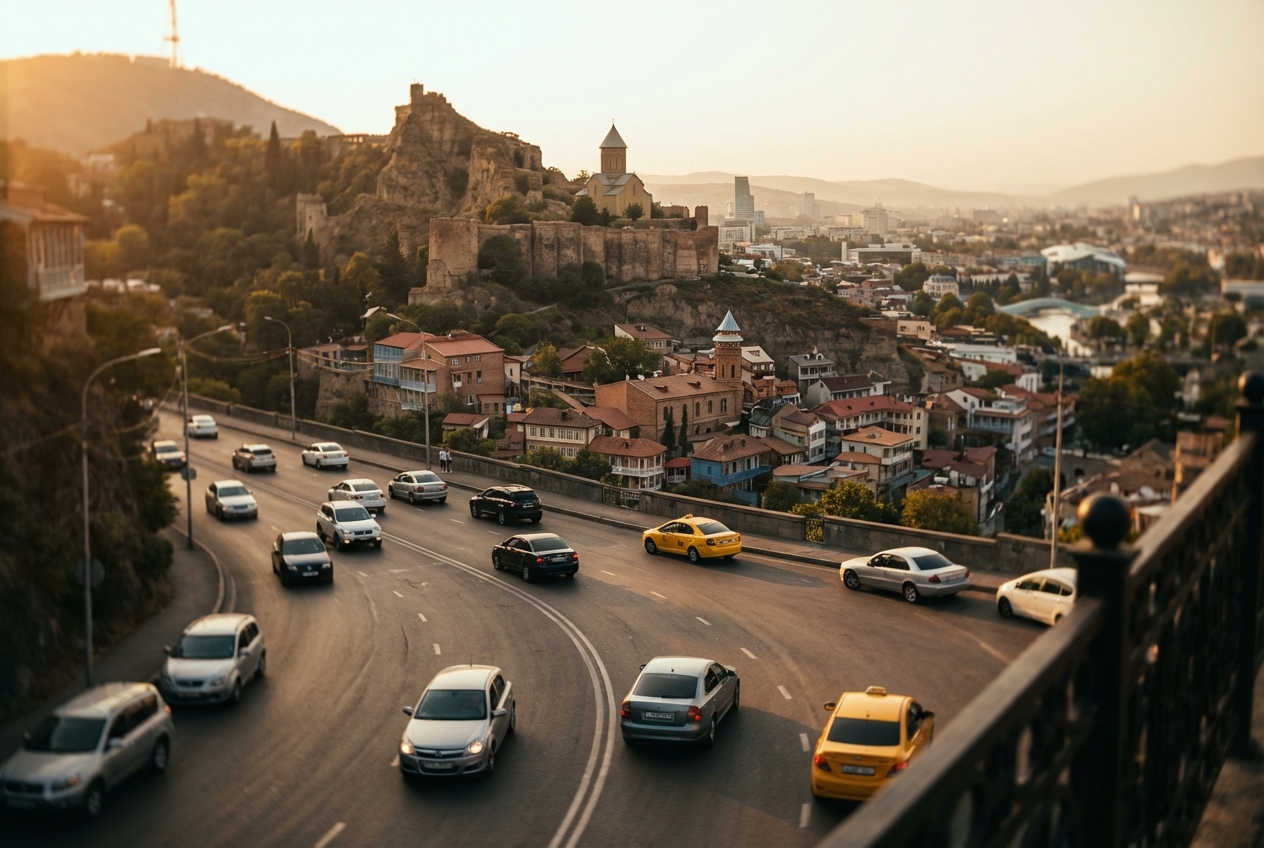
Tbilisi sits in a valley surrounded by hills, its streets a tangled mix of Soviet-era urban planning, medieval old town alleys, and modern highway projects that seem perpetually under construction. If you're wondering whether driving here is straightforward, the honest answer is: it depends entirely on your tolerance for chaos and your previous experience with aggressive driving cultures.
I've spent considerable time observing Tbilisi's roads, talking with locals and expats, and watching tourists white-knuckle their way through roundabouts. The city presents genuine challenges that go beyond typical "foreign driving" adjustments. With over 600,000 registered vehicles crammed into infrastructure designed for far fewer cars, congestion costs the city an estimated 2.4-2.8 billion GEL annually. Those aren't just abstract numbers: they represent real frustration for anyone behind the wheel.
But Tbilisi isn't impossible to drive in. Thousands of people do it daily, including plenty of foreigners who've adapted to local conditions. The key lies in understanding what you're getting into before you pick up those rental car keys.
The Realities of Tbilisi Traffic and Driver Behavior
The first thing that strikes newcomers about Tbilisi traffic isn't the volume: it's the attitude. Georgian drivers operate under a different set of assumptions than what most Western visitors expect. Lane markings serve as loose suggestions. Turn signals are optional. The horn functions as a multi-purpose communication tool expressing everything from "I'm passing you" to "hello, friend" to "move faster."
This isn't recklessness for its own sake. It's a driving culture that developed organically in a post-Soviet environment where traffic enforcement was minimal and road infrastructure lagged behind vehicle ownership growth. Understanding this context helps you anticipate rather than react.
Local Driving Style and Unwritten Road Rules
Georgian drivers follow an unspoken hierarchy on the road. Larger vehicles generally have right of way in practice, regardless of what traffic laws state. Marshrutkas, the ubiquitous minibuses, stop wherever passengers need them to, often without warning. Expect sudden lane changes, aggressive merging, and tailgating that would earn tickets in most European countries.
The unwritten rules include: flashing headlights means "I'm coming through" rather than "after you." Double-parking is standard practice in commercial areas. Pedestrians crossing outside designated areas is normal, and drivers expect it. Right turns on red happen frequently even where not permitted. If someone flashes their hazards briefly after you let them merge, that's a thank-you.
Experienced drivers here develop a sixth sense for predicting other motorists' movements. You'll need to watch not just the car ahead but two or three vehicles forward, anticipating the cascade of reactions when someone makes an unexpected move.
Rush Hour Hotspots and Peak Congestion Times
Tbilisi drivers spend an average of 1 to 1.5 hours daily stuck in traffic, totaling 350-500 hours annually. That's roughly two to three weeks of your life each year sitting in gridlock if you commute regularly.
Peak congestion hits between 8:00-10:00 AM and 5:00-8:00 PM. The worst bottlenecks occur at predictable locations:
- Rustaveli Avenue: The main artery through central Tbilisi crawls during rush hour
- Heroes Square: Multiple roads converge here, creating chronic backups
- Saburtalo District: Residential density meets commercial traffic
- Bridge crossings: The Mtkvari River bridges become chokepoints
- Varketili and Samgori: Eastern districts with limited alternative routes
The Head of the Tbilisi Transport and Urban Development Agency has stated that congestion stems primarily from the high number of private vehicles rather than construction projects. With vehicle registrations jumping 25% over five years, infrastructure simply hasn't kept pace.
Navigating the City Infrastructure
Tbilisi's road network reflects its complicated history. Ancient streets in the old town were never designed for cars. Soviet-era boulevards accommodate traffic but lack modern traffic management. Newer developments often feel disconnected from the existing grid.
Road Conditions and Modern Highway Developments
Main roads and recently renovated streets are generally well-maintained. The airport highway, central arteries, and routes connecting major districts feature decent asphalt and clear markings. However, venture into residential neighborhoods or older areas, and conditions deteriorate quickly. Potholes appear without warning. Unmarked speed bumps protect side streets. Drainage issues create flooding during heavy rain.
Recent years have brought significant infrastructure investment. New overpasses and tunnels have eased some bottlenecks. The road to Mtskheta and connections toward the mountains have improved substantially. But construction zones remain common, often poorly marked, with lane configurations changing overnight.
| Road Type | Condition | Challenges |
|---|---|---|
| Main highways | Good to excellent | Heavy traffic during peak hours |
| Central boulevards | Good | Parking congestion, pedestrians |
| Residential streets | Variable | Potholes, narrow passages, parked cars |
| Old Town | Poor for driving | Cobblestones, extremely narrow, tourist foot traffic |
| Mountain roads | Moderate | Steep grades, hairpin turns, occasional livestock |
One-Way Systems and Complex Intersections
Tbilisi's one-way street network confuses even locals sometimes. The old town is particularly labyrinthine, with streets that dead-end unexpectedly or loop back on themselves. GPS navigation helps but isn't foolproof: apps sometimes suggest routes through pedestrian-only zones or direct you against traffic flow on one-way streets that recently changed direction.
Several intersections deserve special caution. The area around Freedom Square involves multiple merging lanes with aggressive drivers jockeying for position. Marjanishvili Square features a confusing traffic pattern that seems designed to test your reflexes. The junction near Station Square combines bus terminals, metro access, and through-traffic in ways that feel genuinely chaotic.
Your best strategy: drive these areas first during low-traffic periods to learn the layout before attempting rush hour navigation.
Parking Challenges in the Capital
Finding parking in central Tbilisi ranks among the most frustrating aspects of driving here. The combination of limited spaces, unclear regulations, and aggressive competition for spots creates daily headaches for motorists.
Understanding the Zonal Parking System
Tbilisi operates a zonal parking system with different rates depending on location. Zone A parking costs 1 GEL per hour, covering the most central areas. Zones B and C offer lower rates for areas further from the core.
Payment happens through the Tbilisi Parking app, which requires a Georgian phone number and local payment method: a significant barrier for tourists. Some parking attendants accept cash, but this isn't universal. The app displays available zones and current rates, though coverage can be spotty.
Violations result in wheel clamps or towing. Retrieving a towed vehicle involves navigating bureaucracy that's challenging even for Georgian speakers. The fine plus towing fees add up quickly, making proper payment worth the hassle.
Private Lots vs. Street Parking Safety
Private parking lots near major attractions charge premium rates but offer several advantages. Attendants watch vehicles, reducing break-in risk. You avoid the confusion of zonal systems. Most accept cash from foreigners. Rates typically run 5-15 GEL for several hours depending on location.
Street parking carries inherent risks. Side mirrors get clipped by passing vehicles on narrow streets. Opportunistic theft, while not epidemic, does occur. Parking on sidewalks is common but technically illegal and occasionally enforced. If you park blocking someone's garage, expect an angry confrontation or worse.
The safest approach: use hotel parking when available, private lots for daytime excursions, and avoid leaving valuables visible regardless of where you park.
Legal Requirements and Traffic Enforcement
Georgia has modernized its traffic enforcement significantly in recent years, moving from widespread corruption to automated systems that fine without discrimination.
Speed Cameras and the Smart Monitoring System
Speed cameras dot Tbilisi's main roads, and they work. The automated system captures violations, matches plates to registrations, and issues fines that rental companies pass along to customers. Common speed limits include 60 km/h on main urban roads, 40 km/h in residential areas, and 110 km/h on highways outside the city.
The traffic safety situation remains serious despite enforcement efforts. In 2025, 469 people died in road accidents in Georgia, including 28 children and 164 pedestrians. These statistics reflect both infrastructure issues and driving behavior that enforcement alone cannot fix.
Red light cameras operate at major intersections. Seatbelt violations, mobile phone use while driving, and drunk driving all carry penalties. Police do conduct random stops, particularly on roads leaving the city toward popular destinations.
Necessary Documentation for Foreign Drivers
Foreign visitors can drive in Georgia using their home country license for up to one year. An International Driving Permit provides useful backup but isn't strictly required for most nationalities. You must carry your passport, license, vehicle registration, and insurance documents.
Rental car companies provide mandatory third-party liability insurance. Consider purchasing additional coverage: Georgian repair costs for accidents can surprise visitors expecting lower prices. Document any existing damage before accepting a rental vehicle, as disputes over scratches and dents are common.
If involved in an accident, call 112 for police. Don't move vehicles until officers arrive and document the scene. The insurance claim process requires a police report, so skipping this step creates problems later.
Public Transport and Walking as Alternatives
Before committing to driving, honestly assess whether you need a car at all. Tbilisi's public transport, while imperfect, covers most tourist destinations efficiently.
The metro system operates two lines connecting major districts, running from 6:00 AM to midnight. Fares cost 1 GEL per ride using a rechargeable Metromoney card. Buses and marshrutkas fill gaps in metro coverage, though route information can be difficult for non-Georgian speakers to decipher. The Tbilisi Transport Company app helps with planning.
Taxis and ride-sharing apps offer convenience without driving stress. Bolt and Yandex Go operate throughout the city with reasonable fares. A cross-city trip rarely exceeds 15-20 GEL. For airport transfers and day trips, hiring a driver through your hotel or a tour company provides comfort and local knowledge.
Walking works well in central areas. The old town, Rustaveli Avenue, and Mtatsminda district are best explored on foot anyway. Driving there means fighting for parking and missing details you'd notice while walking.
Final Verdict: Should You Drive or Hire a Driver?
So is it easy to drive in Tbilisi? For experienced drivers comfortable with aggressive traffic cultures, it's manageable. For those accustomed to orderly European or North American roads, the adjustment period involves genuine stress.
My recommendation: skip driving within Tbilisi itself. Use taxis, ride-shares, and public transport for city exploration. Rent a car only for excursions outside the capital, where traffic thins and Georgia's spectacular countryside rewards the freedom of your own vehicle. Mountain roads toward Kazbegi, wine country in Kakheti, and coastal routes to Batumi all justify having a car.
If you do drive in Tbilisi, start during quiet periods to learn key routes. Keep your phone charged for navigation. Budget extra time for every journey. Accept that local driving norms differ from home, and adapt rather than fight the flow.
The city's traffic challenges are real but not insurmountable. Thousands navigate these streets daily without incident. With proper preparation and realistic expectations, you can too.