
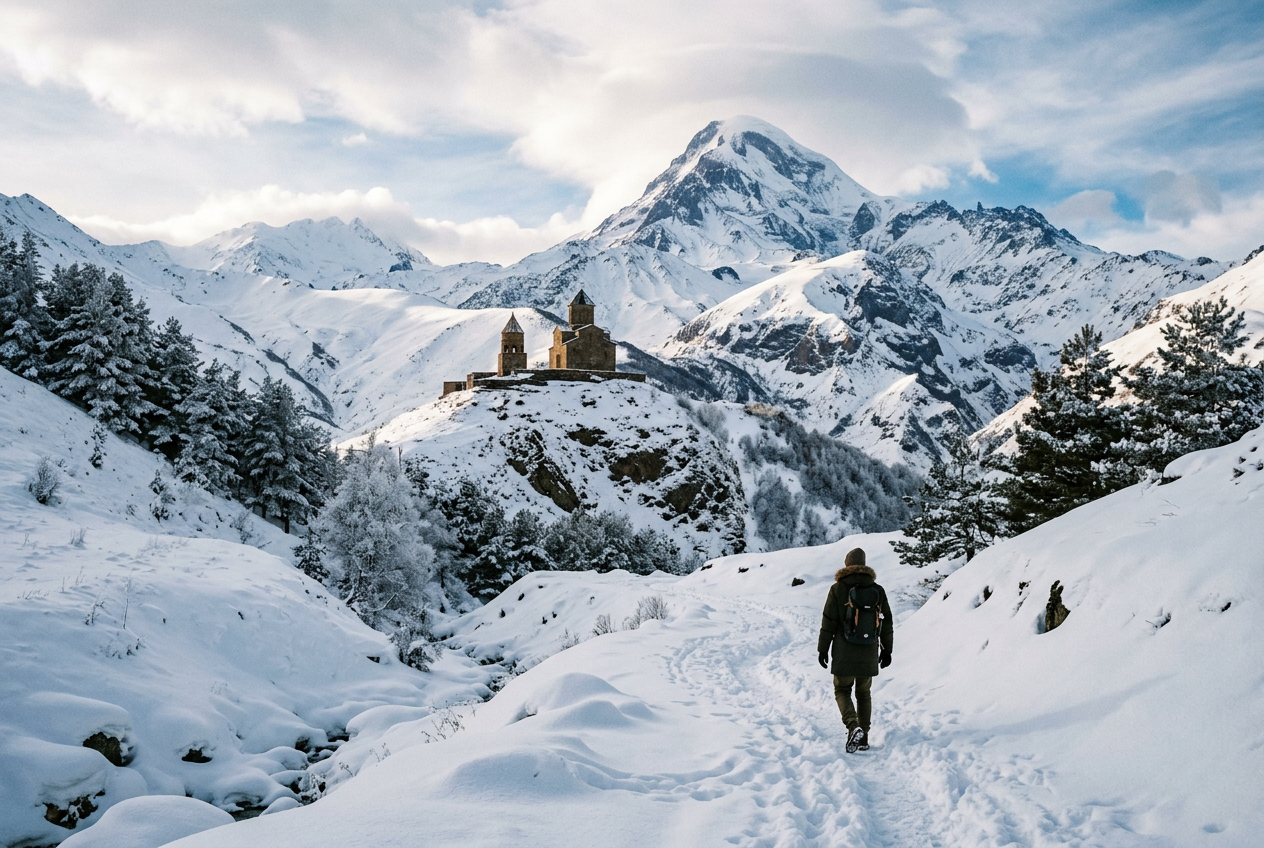
When temperatures drop across Europe and crowds thin at popular Mediterranean destinations, a small country nestled between the Black Sea and the Caucasus Mountains transforms into something extraordinary. Georgia in winter offers a compelling mix of snow-dusted medieval churches, world-class skiing at bargain prices, and the kind of soul-warming hospitality that makes you forget the cold entirely. The question of whether Georgia is worth visiting in the winter comes down to what you're seeking: if it's authentic experiences without tourist hordes, exceptional food and wine, and alpine adventures that won't empty your wallet, then the answer is a resounding yes.
This former Soviet republic has quietly become a winter destination that rivals its more famous European counterparts. Tourism revenues in Georgia increased by 13.4% year-on-year to $325 million in January 2026, a clear sign that travelers are discovering what locals have always known: winter here is special. The country welcomed 7.8 million international arrivals in 2025, marking a 6% increase over the previous year, with winter months contributing significantly to this growth.
The Allure of Georgia's Winter Landscapes
Snow-Capped Peaks of the Greater Caucasus
The Greater Caucasus mountain range forms Georgia's northern border with Russia, and in winter, these peaks become a photographer's paradise. Imagine villages like Ushguli, Europe's highest continuously inhabited settlement, blanketed in pristine white snow with its distinctive medieval defensive towers piercing the grey winter sky. The Svaneti region transforms into something from a fairytale, where ancient traditions persist and time moves differently.
Driving through mountain passes during winter requires preparation, but the rewards are immense. The Jvari Pass leading to Kazbegi offers views of Mount Kazbek, a dormant stratovolcano rising over 5,000 meters. The Gergeti Trinity Church, perched at 2,170 meters, becomes even more dramatic against a backdrop of snow and swirling clouds. These aren't the manicured landscapes of Swiss postcards but something wilder and more authentic.
The Festive Charm of Tbilisi's Old Town
Tbilisi experiences average daytime temperatures of 2-8 degrees Celsius from December to February, making it cold but manageable for exploring on foot. The capital's old town, with its winding cobblestone streets and ornate wooden balconies, takes on a magical quality when dusted with occasional snow. String lights illuminate the narrow passages, and the smell of freshly baked bread wafts from corner bakeries.
The contrast between seasons is striking. Summer tourists crowd the same streets that become intimate and peaceful in winter. You can actually photograph the famous leaning clock tower of Rezo Gabriadze's puppet theater without dozens of people in the frame. Cafes that have outdoor seating packed in warmer months become cozy refuges where you can linger over coffee and chacha, Georgia's potent grape brandy.
World-Class Winter Sports and Adventure
Skiing and Snowboarding in Gudauri
Gudauri sits at 2,200 meters elevation and offers something rare in the skiing world: excellent terrain without the pretension or prices of Western European resorts. The resort features 57 kilometers of marked runs served by modern lifts, with vertical drops exceeding 1,200 meters. Snow conditions from December through April are consistently good, with the resort receiving an average of 3-4 meters of snowfall annually.
What sets Gudauri apart is accessibility and value. A full season pass for all four Georgian resorts costs just 650 GEL, approximately 240 USD, a fraction of what you'd pay in the Alps. Daily lift passes run around 70-80 GEL (roughly 25-30 USD), and equipment rental is similarly affordable. The resort has invested heavily in infrastructure, with high-speed gondolas and chairlifts replacing older equipment.
Family-Friendly Slopes in Bakuriani
Bakuriani offers a gentler introduction to Georgian skiing, with terrain better suited to beginners and intermediate skiers. Originally developed as a winter sports center during the Soviet era, the resort hosted the 1988 World Junior Alpine Skiing Championships and retains a nostalgic charm alongside modern improvements.
The town itself feels more established than Gudauri, with tree-lined streets and a proper village atmosphere. Families appreciate the slower pace and the variety of activities beyond skiing: horse-drawn sleigh rides, cross-country skiing trails through forests, and a small but entertaining bobsled track. Accommodation ranges from Soviet-era sanatoriums with updated interiors to modern guesthouses run by local families who treat guests like extended relatives.
Off-Piste Freedom in Mestia and Goderdzi
For experienced skiers and snowboarders seeking adventure beyond groomed runs, Mestia and Goderdzi represent Georgia's wilder side. Mestia, the main town in Svaneti, operates a small but growing ski area with exceptional backcountry access. Heli-skiing operations have emerged here, offering access to untracked powder at prices significantly lower than comparable experiences in Canada or Alaska.
Goderdzi, in the Adjara region near the Turkish border, is Georgia's newest resort and receives enormous snowfall due to its proximity to the Black Sea. The resort is still developing, which means fewer crowds and a frontier atmosphere that appeals to adventurous spirits. Local guides offer ski touring excursions into the surrounding mountains, where you might not see another person all day.
| Resort | Elevation | Best For | Season Pass Cost | Unique Feature |
|---|---|---|---|---|
| Gudauri | 2,200m | Intermediate to advanced | ~240 USD | Modern lifts, night skiing |
| Bakuriani | 1,700m | Families, beginners | ~240 USD | Village atmosphere, cross-country |
| Mestia | 2,350m | Backcountry, heli-skiing | ~240 USD | Svaneti culture, untouched terrain |
| Goderdzi | 2,000m | Powder seekers | ~240 USD | Massive snowfall, few crowds |
Indulging in Georgian Gastronomy and Wine
Hearty Winter Dishes and Comfort Food
Georgian cuisine seems designed for cold weather. Khinkali, the famous soup dumplings filled with spiced meat and broth, become even more satisfying when you're warming up after a day in the mountains. The technique for eating them is specific: hold by the twisted top knob, bite a small hole, slurp the hot broth, then devour the rest. That top knob gets left on your plate as a count of how many you've consumed.
Winter brings specific dishes to the table. Kharcho, a rich beef and walnut soup seasoned with dried marigold petals and tart plum sauce, warms you from the inside. Lobio, a stew of red beans cooked in a clay pot with herbs and spices, pairs perfectly with fresh cornbread called mchadi. Cheese-filled breads like khachapuri take on different regional forms, but the Adjarian version, shaped like a boat with a runny egg and butter melting in the center, remains the most dramatic.
Wine Tastings and the Qvevri Tradition
Georgia claims to be the birthplace of wine, with archaeological evidence of winemaking dating back 8,000 years. The traditional qvevri method, using large clay vessels buried underground for fermentation and aging, earned UNESCO Intangible Cultural Heritage status. Winter is an ideal time to explore wine regions like Kakheti without the harvest-season crowds.
Small family wineries welcome visitors for tastings that often turn into extended meals. The supra, Georgia's traditional feast, follows specific rituals led by a tamada, or toastmaster, who guides the evening through a series of increasingly heartfelt toasts. These gatherings can last hours, and refusing hospitality is considered poor form. The phrase "stumari ghvtisaa," meaning "a guest is a gift from God," reflects the genuine warmth you'll encounter.
Relaxation and Cultural Traditions
The Historic Sulfur Baths of Abanotubani
The sulfur baths of Tbilisi's Abanotubani district have operated for centuries, their distinctive domed rooftops a landmark of the old town. The natural hot springs, rich in sulfur and other minerals, feel particularly luxurious when it's cold outside. Private rooms with their own pools offer a more intimate experience, while public sections provide a glimpse into local bathing culture.
The experience typically includes a vigorous scrub from a professional bath attendant, leaving your skin impossibly soft. Afterward, many visitors wrap themselves in towels and drink tea on heated platforms, letting the mineral-rich water continue its work. Prices remain remarkably affordable, with private rooms costing between 50-150 GEL (roughly 18-55 USD) per hour depending on the bathhouse and room size.
Celebrating Orthodox Christmas and Bedoba
December marks the start of winter celebrations in Georgia, making it a festive time to visit. Orthodox Christmas falls on January 7th following the Julian calendar, and the celebrations differ from Western traditions. Alilo processions wind through streets, with participants dressed in traditional costumes singing carols and collecting donations for charity.
Bedoba, celebrated on January 2nd, represents the first day of the new year by the old calendar. Georgians believe the first person to enter your home that day determines your fortune for the coming year. Families carefully choose their "mekvle," the first footer, selecting someone believed to bring good luck. Witnessing these traditions offers insight into Georgian culture that summer visitors rarely experience.
Practical Considerations for Your Winter Trip
Navigating Weather and Mountain Road Safety
Winter driving in Georgia requires respect for mountain conditions. The main highway connecting Tbilisi to Gudauri and Kazbegi crosses the Jvari Pass at 2,379 meters, and closures due to avalanche danger or heavy snow occur regularly. Check road conditions before departing, and consider hiring a local driver with a suitable vehicle if you're not experienced in winter mountain driving.
Within Tbilisi and lowland areas, conditions are milder but still require preparation. Pack layers, waterproof boots, and don't underestimate how cold evenings can get. The Bolt and Yandex Go apps work well for arranging taxis, eliminating language barriers and ensuring fair pricing. Download offline Georgian language packs for Google Translate before arriving, as English proficiency varies significantly between Tbilisi's cosmopolitan center and rural areas.
Budgeting for Off-Season Travel Perks
Winter travel to Georgia offers exceptional value. Accommodation prices drop 20-40% compared to peak summer months, and you'll have more negotiating power at guesthouses and small hotels. A comfortable mid-range hotel in Tbilisi runs 150-250 GEL (55-90 USD) per night, while guesthouses in ski towns charge 80-150 GEL including breakfast.
Food remains inexpensive year-round. A full meal at a local restaurant costs 25-40 GEL (9-15 USD), and even upscale Tbilisi restaurants rarely exceed 100 GEL per person with wine. The marshrutka minibus network connects major destinations cheaply, though winter schedules may be reduced for mountain routes.
Final Verdict: Is Georgia a Top Winter Destination?
Georgia has risen above the "underrated travel destination" category in 2025, catching worldwide travelers' attention for good reason. The combination of affordable skiing, rich cultural traditions, exceptional food and wine, and genuine hospitality creates an experience that larger, more commercialized destinations simply cannot match.
Is a winter visit to Georgia worth it? If you want alpine adventures without Alpine prices, if you appreciate authentic cultural experiences over manufactured tourist attractions, and if you believe that the best travel memories come from unexpected connections with locals, then absolutely yes. Pack warm layers, bring an appetite, and prepare to discover why this small Caucasus nation has captured the hearts of travelers who've ventured here during the colder months.