
Georgia sits at the crossroads where Europe blurs into Asia, a sliver of land wedged between the Greater Caucasus mountains and the Black Sea that most travelers have never considered visiting. That's changing rapidly. The country welcomed over 5.52 million foreign tourists in 2025, an 8.4% jump from the previous year, and those numbers keep climbing as word spreads about what this tiny nation offers. Is Georgia worth seeing? Having spent considerable time exploring its mountain villages, coastal towns, and the chaotic charm of Tbilisi, I can say the answer depends entirely on what kind of traveler you are. If you want predictable resort experiences with English menus and tour buses, look elsewhere. But if you're drawn to places where hospitality feels almost uncomfortably generous, where winemaking traditions stretch back 8,000 years, and where you can hike through landscapes that rival the Swiss Alps at a fraction of the cost, Georgia delivers something increasingly rare: genuine discovery.
The Unique Appeal of the Caucasus Gem
Georgia, or Sakartvelo as locals call it, occupies a peculiar position in the traveler's imagination. It's technically in the South Caucasus, straddling the line between Eastern Europe and Western Asia, which means it doesn't fit neatly into any regional category. This geographic ambiguity translates into a cultural richness that catches visitors off guard. You'll find Persian-influenced architecture next to Soviet brutalism, Orthodox monasteries perched on cliffsides that predate most European cathedrals, and a food culture that borrows from Mediterranean, Middle Eastern, and Slavic traditions while remaining distinctly its own.
The country punches well above its weight in terms of sheer variety packed into a small territory. Within a few hours' drive, you can move from subtropical beach towns to alpine meadows to semi-desert landscapes. The tourism infrastructure has improved dramatically in recent years, with revenue from foreign travel reaching USD 4.4 billion in 2024, a 7.3% annual increase that's funding better roads, more accommodation options, and improved services. Yet Georgia retains an authenticity that mass tourism tends to erode. The grandmother who invites you in for homemade chacha isn't performing for tips; she's following a cultural code where "stumari ghvtisaa" – the guest is a gift from God – isn't just a saying but a lived practice.
Breathtaking Landscapes and Outdoor Adventures
Georgia's terrain reads like a geography textbook trying to show off. The country spans climate zones that shouldn't logically exist in such proximity, creating opportunities for adventure that few destinations can match.
The Majestic Peaks of the Greater Caucasus
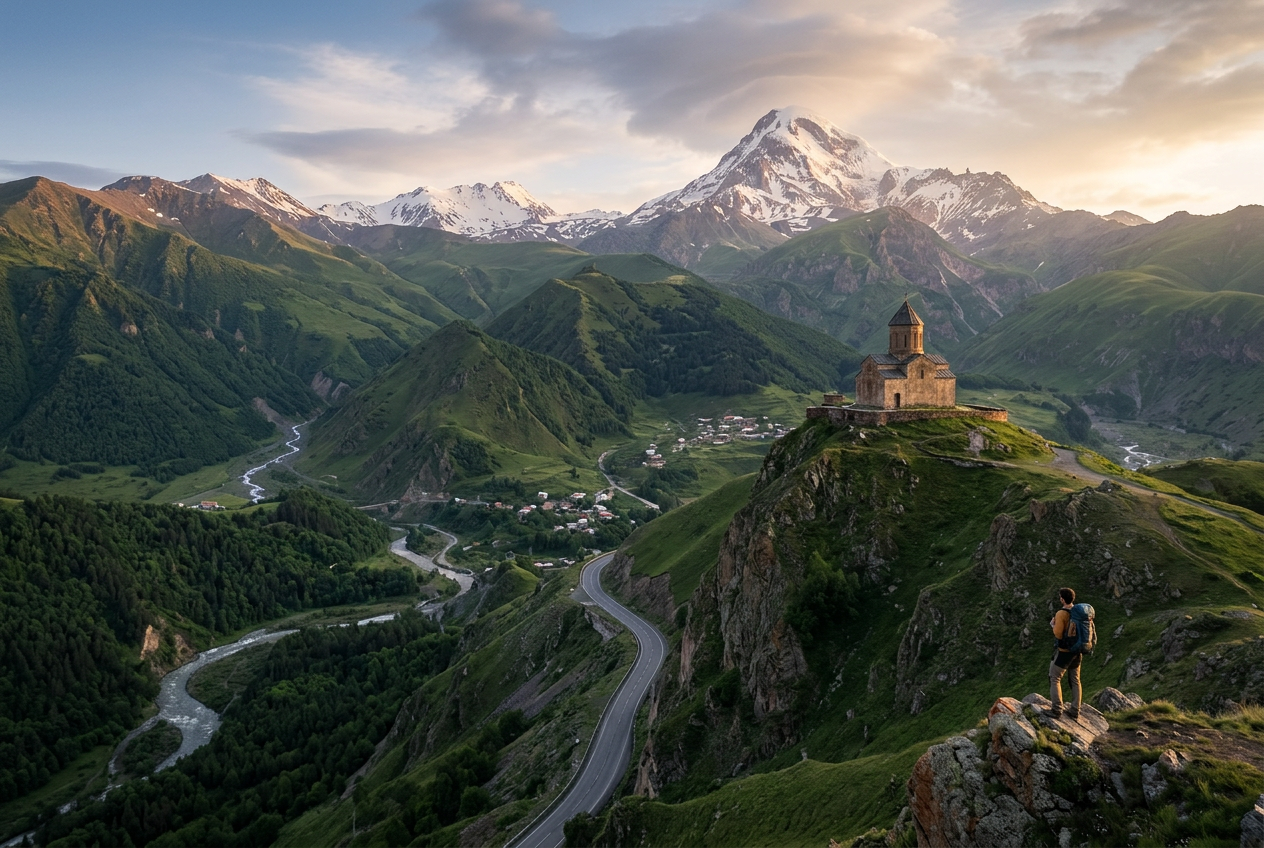
The Greater Caucasus range forms Georgia's northern border with Russia, and these mountains deserve their growing reputation among serious trekkers and casual hikers alike. Kazbegi, now officially called Stepantsminda, serves as the gateway to some of the most accessible high-altitude scenery in the region. The hike to Gergeti Trinity Church, a 14th-century monastery sitting at 2,170 meters with Mount Kazbek's 5,047-meter peak as its backdrop, has become something of a pilgrimage for visitors. On a clear day, the view alone justifies the trip to Georgia.
But the real magic lies deeper in the mountains. Svaneti, a remote northwestern region accessible by a winding road that takes about eight hours from Tbilisi, feels like stepping into a medieval time capsule. The Svan people maintained such isolation that they developed their own language, distinct from Georgian, and built defensive towers that still dominate village skylines. Trekking routes here connect ancient settlements like Mestia and Ushguli, the latter one of Europe's highest continuously inhabited villages. The trails offer moderate difficulty with extraordinary payoff: glacier views, wildflower meadows, and encounters with a culture that's survived largely unchanged for centuries.
Subtropical Shores and the Black Sea Coast
The contrast between mountain and coast takes only a few hours to experience. Batumi, Georgia's second-largest city, sits on the Black Sea with a personality split between Soviet-era beach resort and ambitious modern development. The waterfront features a strange mix of glass towers, a moving metal sculpture of Ali and Nino, and palm-lined promenades that wouldn't look out of place on the French Riviera.
Beyond Batumi, the Adjara region offers quieter coastal experiences. Small towns like Gonio have Roman fortress ruins steps from the beach. The water here is warmer than you'd expect, and the beaches, while pebbly rather than sandy, attract far fewer crowds than Mediterranean alternatives. Inland Adjara climbs quickly into forested mountains where waterfalls and traditional villages provide day-trip options for those who tire of the seaside.
A Deep Dive into Georgian Gastronomy and Wine
Food and drink aren't just sustenance in Georgia; they're the primary vehicles for social connection and cultural expression. Prepare to eat and drink more than you planned.
The 8,000-Year-Old Qvevri Winemaking Tradition
Georgia's claim to being the birthplace of wine isn't marketing hyperbole. Archaeological evidence confirms grape cultivation and winemaking here dating back approximately 8,000 years, making Georgian wine culture older than the Egyptian pyramids. The traditional method involves fermenting grapes in qvevri, large clay vessels buried underground, which creates wines with distinctive amber colors and tannic profiles unlike anything produced elsewhere.
The Kakheti region, about 90 minutes east of Tbilisi, serves as Georgia's wine heartland. Family-run wineries outnumber commercial operations, and tastings often happen in someone's backyard cellar with the winemaker pouring generous samples while explaining techniques passed down through generations. The indigenous grape varieties – Saperavi for reds, Rkatsiteli and Mtsvane for whites – produce flavors that wine enthusiasts find genuinely novel. Even if you're not a wine person, watching a qvevri being opened after months of underground fermentation connects you to a living tradition that predates most human institutions.
The Art of the Supra and Iconic Local Dishes
The supra, Georgia's traditional feast, operates according to rules that confuse and delight foreigners in equal measure. A tamada, or toastmaster, guides the evening through elaborate toasts to ancestors, friendship, Georgia itself, and increasingly specific subjects as the evening progresses. Refusing to drink is complicated; the workaround involves sipping rather than draining your glass, though even this can draw gentle pressure.
The food at a supra showcases Georgian cuisine's greatest hits. Khinkali, soup dumplings that require specific eating technique to avoid scalding broth, come stuffed with spiced meat, cheese, or mushrooms. Khachapuri, the cheese-filled bread that varies by region, reaches its most theatrical form in the Adjaran style: a boat-shaped vessel filled with molten cheese, topped with butter and a raw egg you stir in at the table. Pkhali, vegetable pâtés made from beets, spinach, or beans mixed with walnut paste, offer lighter options. The walnut appears everywhere in Georgian cooking, ground into sauces for chicken (satsivi) or stuffed into eggplant rolls (badrijani).
| Dish | Description | Region |
|---|---|---|
| Khinkali | Soup dumplings with meat, cheese, or mushroom filling | Originally Pshavi/Khevsureti |
| Khachapuri | Cheese bread in various regional styles | Nationwide, Adjaran most famous |
| Mtsvadi | Grilled meat skewers, often pork | Nationwide |
| Lobio | Spiced bean stew served in clay pot | Nationwide |
| Churchkhela | Grape must and walnut "candles" | Kakheti |
Architectural Heritage and Ancient History
Georgia's position as a crossroads of empires left architectural layers that span millennia. The country adopted Christianity in 337 AD, making it one of the world's oldest Christian nations, and the religious structures from subsequent centuries remain remarkably intact.
Medieval Monasteries and Cave Cities
Vardzia, a 12th-century cave monastery complex carved into a cliff face in southern Georgia, exemplifies the ambition of medieval Georgian architecture. Queen Tamar commissioned this city-in-stone, which once held 6,000 monks across 13 levels of tunnels, churches, and living quarters. An earthquake in 1283 exposed much of the interior, but the remaining frescoes and chambers convey the scale of what existed.
Uplistsikhe, closer to Tbilisi, predates Christianity entirely. This rock-hewn town functioned as a major center along the Silk Road, with structures dating back to the Iron Age. Walking through its carved streets, past pagan temple sites later converted to Christian churches, compresses thousands of years of history into a single afternoon.
The monastery at Jvari, overlooking the confluence of the Mtkvari and Aragvi rivers, offers perhaps the most photogenic religious site. Built in the 6th century, it sits on a hilltop that provides panoramic views of Mtskheta, Georgia's ancient capital and a UNESCO World Heritage site.
Tbilisi's Blend of Old World and Futurism
Tbilisi itself functions as an architectural palimpsest. The Old Town's wooden balconies and sulfur bath domes reflect Persian and Ottoman influences. The Narikala Fortress, dating to the 4th century, watches over narrow streets where Art Nouveau mansions decay photogenically next to renovated boutique hotels. Cross the river and you encounter the Bridge of Peace, a glass-and-steel pedestrian walkway that sparked controversy when built but now serves as a symbol of Georgia's European aspirations.
The Fabrika complex, a former Soviet sewing factory converted into a hostel, co-working space, and courtyard filled with food vendors and bars, represents Tbilisi's creative reinvention. Street art covers entire building facades in neighborhoods like Vera and Sololaki. The city rewards wandering; getting lost in its hilly streets reveals hidden courtyards, underground wine bars, and views that explain why Georgia is considered a must-visit destination for travelers seeking authentic experiences.
Practical Considerations: Safety, Costs, and Logistics
Enthusiasm for Georgia's attractions should be balanced with realistic expectations about the travel experience.
Budget-Friendly Travel and Value for Money
Georgia offers extraordinary value compared to Western European destinations. A comfortable mid-range hotel in Tbilisi runs $40-70 per night. Restaurant meals, even at well-regarded establishments, rarely exceed $15-20 per person with wine. Marshrutkas, the shared minivans that connect most towns, cost a few dollars for multi-hour journeys.
This affordability extends to experiences. Wine tastings that would cost $50-100 in Napa Valley happen for $10-15 in Kakheti. Guided day trips to mountain regions run $30-50 per person. The combination of low costs and high quality creates a travel experience where you can splurge without financial anxiety.
Navigating Transportation and Infrastructure
Getting around Georgia requires flexibility. Tbilisi's metro works well for the city center, and ride-hailing apps like Bolt and Yandex Go have transformed urban transportation. Between cities, marshrutkas depart when full rather than on fixed schedules, which can mean waiting or arriving at unpredictable times.
Renting a car opens up the country but demands confident driving skills. Mountain roads involve hairpin turns, occasional livestock, and local driving customs that prioritize boldness over caution. The Georgian Military Highway to Kazbegi, while paved, narrows to single lanes in sections with sheer drops and no guardrails.
English proficiency varies dramatically. Tbilisi's tourism-oriented businesses communicate easily, but rural areas often require creative gesturing or translation apps. Download Google Translate's offline Georgian pack before arriving. Solo female travelers report feeling safe throughout the country, with police generally helpful and reliable. Avoid discussing the Russia-Georgia conflict or the occupied territories of Abkhazia and South Ossetia unless you understand the sensitivities involved.
Final Verdict: Who is Georgia Best For?
Georgia rewards a specific type of traveler: someone curious enough to navigate minor inconveniences, adventurous enough to try unfamiliar foods and drinks, and open enough to accept hospitality that can feel overwhelming by Western standards. If you want polished, predictable experiences, the infrastructure isn't quite there yet. If you want genuine connection with a culture that hasn't been smoothed over for tourist consumption, few places deliver as powerfully.
The country works exceptionally well for food and wine enthusiasts, budget-conscious travelers seeking quality experiences, hikers and outdoor adventurers, and anyone interested in religious history or Silk Road heritage. Couples find romance in Tbilisi's atmospheric streets; solo travelers discover that Georgian hospitality makes loneliness nearly impossible.
Is Georgia worth seeing? The 5.5 million visitors who came last year answered that question with their feet. The real question is whether you're ready for a destination that gives more than it takes, that challenges comfortable assumptions about hospitality and history, and that lingers in memory long after you've returned home. Georgia doesn't just meet expectations; it redefines them entirely.