
Georgia sits at the crossroads of Europe and Asia, a country smaller than South Carolina yet packed with enough diversity to make your head spin. Snow-capped peaks over 5,000 meters tall, ancient wine regions with 8,000 years of viticulture history, Soviet-era cities reinventing themselves, and a Black Sea coastline that feels Mediterranean in summer. The question of how many days in Georgia is enough depends entirely on what you want from your trip, and I’ve watched travelers get this calculation wrong in both directions.
Some visitors squeeze the country into a long weekend and leave frustrated, having barely scratched Tbilisi’s surface before rushing to the airport. Others book three weeks and find themselves lingering in one region, realizing they’d rather go deep than wide. The sweet spot exists, but it’s different for everyone. Georgia recorded over 6 million international trips in 2023, and those travelers ranged from 48-hour city breakers to month-long overlanders tracing the ancient Silk Road.
What I can tell you after extensive time on the ground: this country rewards patience. The best experiences here unfold slowly, over glasses of amber wine in a village cellar, during unexpected invitations to family supras, or on mountain trails where you won’t see another tourist for hours. Rush through Georgia and you’ll collect photos. Linger and you’ll collect stories.
Factors Influencing Your Georgia Itinerary Duration
Geographic Diversity: From the Caucasus to the Black Sea
Georgia’s compact size on a map is deceptive. The country spans roughly 500 kilometers from east to west, but those kilometers contain more geographic variety than countries ten times its size. The Greater Caucasus mountains form the northern border, with peaks exceeding 5,000 meters and glaciers that feed rivers running south to the Black Sea. Between these extremes lie semi-desert badlands, subtropical lowlands, alpine meadows, and everything in between.
This diversity means you can’t simply “see Georgia” in a few days. Tbilisi in the east feels distinctly different from Batumi on the western coast, not just in architecture but in climate, cuisine, and cultural influences. The wine regions of Kakheti have more in common with Mediterranean landscapes than with the high-altitude villages of Svaneti, where medieval towers dot valleys that remain snowbound for half the year.
What this means for planning: each major region deserves dedicated time. Trying to sample everything in a week means spending more hours in transit than actually experiencing places. The Caucasus alone could occupy serious hikers for months. The wine region has over 500 indigenous grape varieties across dozens of microclimates. Coastal Adjara blends Georgian, Turkish, and Russian influences in ways that take time to appreciate.
Transportation Logistics and Travel Times
Here’s where many itineraries fall apart. Georgia’s road infrastructure has improved dramatically, but this isn’t Western Europe. The drive from Tbilisi to Mestia in Svaneti takes roughly 8-9 hours on winding mountain roads, not the 4 hours Google Maps optimistically suggests. Marshrutkas, the ubiquitous minibuses connecting towns, run on flexible schedules that depend on passenger loads rather than timetables.
| Route | Distance | Realistic Driving Time | Public Transport Time |
|---|---|---|---|
| Tbilisi to Kazbegi | 150 km | 3-4 hours | 4-5 hours |
| Tbilisi to Batumi | 380 km | 5-6 hours | 6-7 hours |
| Tbilisi to Mestia | 460 km | 8-10 hours | 9-12 hours |
| Kutaisi to Mestia | 230 km | 4-5 hours | 5-6 hours |
| Tbilisi to Sighnaghi | 110 km | 2 hours | 2.5 hours |
The Bolt and Yandex Go apps work well in cities and for arranging intercity transfers, but once you’re in mountain regions, you’ll rely on local drivers, shared taxis, or your own rental car. Domestic flights exist between Tbilisi and Mestia or Batumi, saving significant time but adding cost and limiting flexibility.
My advice: build buffer days into any itinerary. Georgia doesn’t reward rigid scheduling. That random invitation to a village feast, the weather window that opens for a mountain hike, the winemaker who insists you stay for just one more glass, these moments define travel here. They require slack in your calendar.
The 3 to 5 Day Quick Escape: Tbilisi and Surrounds
Exploring the Capital and Mtskheta
If you have less than a week, concentrate your energy on Tbilisi and its immediate surroundings. The capital alone could occupy curious travelers for days. The Old Town’s maze of cobblestone streets, sulfur baths, and crumbling balconies reveals new details with each wander. Narikala Fortress offers sunset views over the Mtkvari River that explain why travelers have stopped here for millennia.
Tbilisi’s neighborhoods each carry distinct personalities. Sololaki’s Art Nouveau facades and hidden courtyards contrast with Fabrika’s converted Soviet sewing factory, now a hostel and creative hub. The Dry Bridge flea market sprawls with Soviet memorabilia, antique daggers, and family heirlooms sold by elderly vendors who remember different eras. Dedicate at least two full days to the city itself.
Mtskheta sits just 20 kilometers north and functions as Georgia’s spiritual heart. This ancient capital, now a UNESCO World Heritage site, contains Svetitskhoveli Cathedral, where Georgians believe Christ’s robe is buried. Jvari Monastery perches on a hilltop above the confluence of two rivers, offering the iconic view you’ve seen in every Georgia travel photo. A half-day suffices for the major sites, though the atmosphere rewards slower exploration.
For solo female travelers, Tbilisi feels remarkably safe. I’ve spoken with dozens of women who wandered the city at all hours without incident. Police presence is visible and generally reliable. The main caution applies to political conversations: avoid discussing Russia, occupied territories, or the 2008 war unless you know your audience well.
Day Trips to Kazbegi or Kakheti Wine Region
With three to five days, you can add one significant day trip beyond the capital. The choice typically comes down to mountains or wine, and both options deliver.
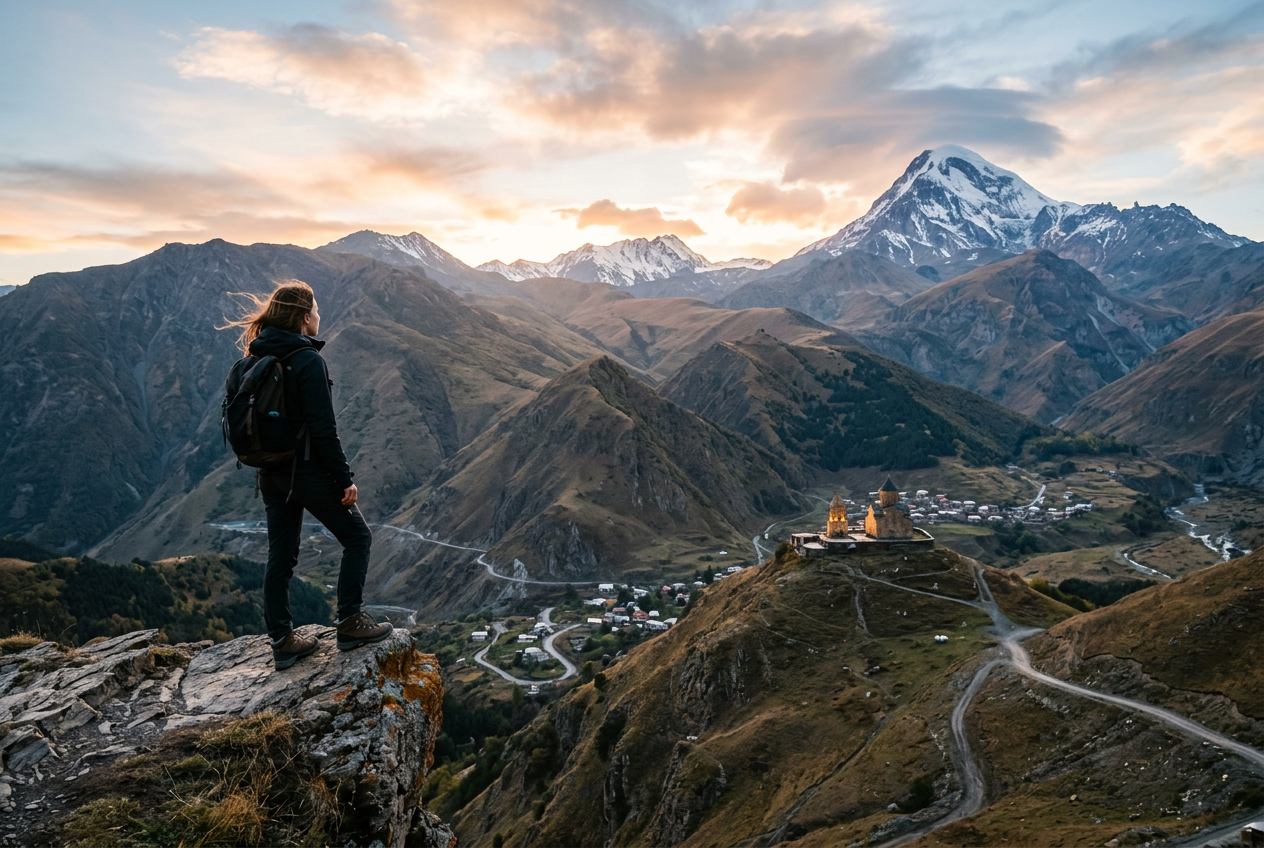
The Georgian Military Highway to Kazbegi, officially Stepantsminda, ranks among the world’s great road journeys. The route climbs through the Jvari Pass at 2,379 meters, passing the Ananuri fortress complex and the Russia-Georgia Friendship Monument before descending into the Kazbegi valley. Gergeti Trinity Church, perched at 2,170 meters with Mount Kazbek towering behind it, provides the payoff. As a day trip, you’ll have time for the church hike and a quick lunch before the return drive.
Kakheti wine country offers a different rhythm. The region produces most of Georgia’s wine using qvevri, large clay vessels buried underground for fermentation, a technique UNESCO recognizes as intangible cultural heritage. Day trips typically visit Sighnaghi, a picturesque hilltop town with fortress walls and valley views, plus one or two wineries. You’ll taste wines that exist nowhere else on earth, made from grapes like Saperavi and Rkatsiteli using methods unchanged for millennia.
Travel experts note that a week is sufficient to explore the highlights of Eastern Georgia, including Tbilisi, Mtskheta, Kazbegi, and the Kakheti wine region. But sufficient and satisfying aren’t synonyms. A rushed day trip to either destination leaves you wanting more.
The 7 to 10 Day Classic Route: Mountains and History
Deep Dive into Kakheti’s Wine Culture
A week or more allows Kakheti to reveal its depth rather than just its highlights. The region deserves two to three dedicated days, ideally with your own transportation or a hired driver who knows the back roads.
Beyond the tourist circuit of Sighnaghi and the larger commercial wineries, Kakheti hides family operations where the marani, the traditional wine cellar, has served the same family for generations. These aren’t polished tasting rooms. You’ll sit on plastic chairs while a grandfather retrieves bottles from his qvevri collection, pouring wines that will never see export markets. The phrase “stumari ghvtisaa,” meaning “a guest is a gift from God,” gets tested here. Expect to stay longer than planned, eat more than expected, and possibly sleep in a spare room if the host insists.
The Tsinandali Estate offers a more structured experience, with manicured gardens and a museum dedicated to the aristocratic Chavchavadze family. Gremi’s fortress church complex and Alaverdi Monastery provide historical anchors between tastings. The David Gareja monastery complex, carved into cliffs on the Azerbaijan border, requires a half-day excursion but delivers some of Georgia’s most dramatic sacred architecture.
Practical note: download Google Translate’s Georgian language pack before visiting rural areas. English proficiency drops significantly outside Tbilisi. Georgia ranks quite low on the EF English Proficiency Index, and in wine villages, you’ll encounter grandmothers who speak only Georgian and perhaps Russian. A few memorized phrases, especially “madloba” for thank you and “gaumarjos” for the toast that will inevitably come, smooth every interaction.
Exploring Central Georgia: Gori and Vardzia
Central Georgia often gets skipped by travelers racing between Tbilisi and the coast, but the region contains some of the country’s most significant historical sites. Gori, Stalin’s birthplace, houses a museum that offers fascinating insight into how Georgia grapples with its most infamous son. The presentation has evolved over decades, now providing more context than pure hagiography, though it remains a complicated experience.
Vardzia demands the journey south. This 12th-century cave monastery complex stretches across a cliff face, with hundreds of rooms carved into the rock including churches, living quarters, and a sophisticated irrigation system. At its peak, Vardzia housed 2,000 monks. Earthquakes and invasions reduced it, but enough remains to convey the ambition of Queen Tamar’s Georgia. Budget a full day for Vardzia, including the drive from Tbilisi or Borjomi.
Borjomi itself merits a stop for its mineral water springs, forested parks, and faded Soviet-era grandeur. The town’s namesake water fills bottles across the former Soviet Union, and drinking it fresh from the source tastes notably different from the bottled version. Uplistsikhe, an ancient cave town predating Christianity, sits between Gori and Tbilisi and pairs well with a Gori visit.
Hiking and Adventure in Stepantsminda
With a week or more, Kazbegi transforms from a day trip into a proper mountain destination. The town of Stepantsminda serves as a base for hikes ranging from the two-hour Gergeti Trinity Church climb to multi-day treks toward the Kazbek glacier.
The Gergeti Glacier hike takes experienced trekkers to the edge of the ice at roughly 3,600 meters. It’s demanding but doesn’t require technical climbing skills in summer months. The Juta Valley, accessed from a turnoff before Stepantsminda, offers gentler hiking through alpine meadows with fewer crowds than the main Kazbegi trails. The trek from Juta to Roshka crosses a 3,300-meter pass and can be done in a long day or split over two days with wild camping.
Accommodation in Stepantsminda ranges from basic guesthouses to the Rooms Hotel, which combines mountain lodge aesthetics with genuine luxury. Whichever you choose, you’ll eat well. The khinkali here, Georgia’s signature dumplings, reportedly taste better at altitude. I’m not sure about the science, but the experience supports the claim.
A 10-day backpacking trip can cover Kutaisi, Tbilisi, Kazbegi, and Batumi, giving you a solid overview of Georgia’s diversity without feeling impossibly rushed.
The 14-Day Grand Tour: Svaneti and the Coast
The Remote Towers of Mestia and Ushguli
Two weeks opens Georgia’s most dramatic region: Svaneti. This highland area in the northwest remained semi-independent throughout history, developing unique traditions, architecture, and even its own language distinct from Georgian. The medieval defensive towers that define Svaneti’s villages served both as family homes and fortresses during blood feuds that lasted generations.
Mestia, the regional capital, has transformed from isolated mountain town to adventure tourism hub while retaining its tower-studded skyline. The Svaneti Museum of History and Ethnography houses icons, manuscripts, and artifacts that couldn’t be transported to Tbilisi’s museums because the mountain communities refused to part with them. Hiking trails radiate in every direction, from day walks to the Chalaadi Glacier to multi-day treks through high passes.
Ushguli, a cluster of villages at 2,200 meters, claims status as Europe’s highest continuously inhabited settlement. The four-hour drive from Mestia on rough roads passes through landscapes that feel genuinely wild. Ushguli’s towers are UNESCO-protected, and the setting beneath Mount Shkhara, Georgia’s highest peak, delivers on every photograph’s promise. Plan to overnight here rather than rushing back to Mestia.
The classic Mestia to Ushguli trek takes three to four days, crossing high passes and staying in village guesthouses along the way. It’s one of the Caucasus’s great walks, though it requires good fitness and proper gear. Summer and early autumn provide the only reliable weather windows.
Coastal Relaxation in Batumi and Adjara
After mountain intensity, Batumi offers a complete shift. Georgia’s second city sits on the Black Sea coast, a subtropical resort town that blends Ottoman heritage, Soviet planning, and modern glass towers in ways that shouldn’t work but somehow do. The beach isn’t Georgia’s highlight, but the city’s energy, architecture, and food scene justify two or three days.
The Adjara region surrounding Batumi carries distinct cultural influences from centuries of Ottoman rule. Villages in the mountains above the coast maintain traditions different from the rest of Georgia, including unique music, dance, and cuisine. Gonio Fortress, a Roman-era fortification south of Batumi, and the botanical garden north of the city provide half-day excursions.
Batumi’s restaurant scene has exploded in recent years. Adjarian khachapuri, the boat-shaped cheese bread with an egg and butter pool in the center, originated here and tastes different from versions elsewhere. The city’s bars and nightlife cater to the Russian and Turkish tourists who fill the beachfront hotels in summer.
Exploring the Canyons of Imereti
The Imereti region, with Kutaisi as its hub, sits between Svaneti and the coast. Most travelers pass through en route elsewhere, but the area deserves dedicated time. Kutaisi itself is Georgia’s second-oldest city, less polished than Tbilisi but with genuine charm in its riverside setting and hilltop Bagrati Cathedral.
The canyons and caves surrounding Kutaisi provide the real draw. Prometheus Cave stretches over a kilometer underground, with boat rides through subterranean rivers. Martvili and Okatse canyons offer dramatic gorge walks, the latter featuring a transparent walkway bolted to cliff faces. Sataplia Nature Reserve combines dinosaur footprints with another cave system and glass-floored viewing platforms.
An 18-day road trip allows for extensive exploration of Georgia, including Tbilisi, Kakheti, Kazbegi, Vardzia, Batumi, and Svaneti. With two weeks, you can cover most of this ground, though you’ll make choices about depth versus breadth.
Best Time to Visit Based on Your Stay Length
Your trip duration should influence when you visit, not just where you go. Georgia’s seasons create dramatically different experiences.
Hiking is best in summer or early autumn, mid-June to mid-October, when high passes clear of snow and mountain guesthouses open for the season. If Svaneti or serious trekking features in your plans, this window is non-negotiable. Shoulder seasons in the mountains mean closed trails, unpredictable weather, and limited accommodation options.
Spring, from April through early June, brings wildflowers to lower elevations and comfortable temperatures in Tbilisi and the wine regions. It’s ideal for a shorter trip focused on eastern Georgia. The Kakheti harvest happens in September and October, making autumn the prime season for wine-focused visits.
Skiing is ideal in winter, December to March, with Gudauri and Bakuriani offering surprisingly good slopes at reasonable prices. Winter limits your geographic options but provides a different Georgia entirely: snow-covered cities, hearty mountain food, and far fewer tourists.
| Trip Length | Best Season | Recommended Focus |
|---|---|---|
| 3-5 days | Spring or Fall | Tbilisi, Mtskheta, one day trip |
| 7-10 days | Late Spring or Early Fall | Eastern Georgia circuit |
| 14+ days | Summer | Full country including Svaneti |
| Ski-focused | Winter | Gudauri, Tbilisi, wine country |
Summer in Tbilisi gets genuinely hot, with temperatures regularly exceeding 35°C. If your trip is short and city-focused, avoid July and August. The coast stays humid but cooler, while the mountains remain pleasant throughout summer.
Final Verdict: Choosing Your Perfect Number of Days
So how many days in Georgia is enough? The honest answer: it depends on your travel style, but I’d argue strongly for at least a week. Three to five days gives you a taste of Tbilisi and one region beyond. You’ll leave impressed but aware of how much you missed.
Seven to ten days allows the classic eastern Georgia circuit: Tbilisi, Mtskheta, Kazbegi, and Kakheti with enough time to linger when something captures your attention. This duration suits most first-time visitors who want meaningful experiences without exhausting themselves.
Two weeks opens the entire country, including Svaneti’s remote valleys and the Black Sea coast. You’ll still make choices, but they’ll be about emphasis rather than wholesale omission. For travelers who hate feeling rushed, this is the sweet spot.
The country rewards return visits. Many travelers come for a week, fall for Georgia’s combination of hospitality, landscape, and affordability, then return for longer. The Georgian concept of “supra,” the feast that can last hours and involves endless toasts from the tamada, the toastmaster, embodies the national approach to time. Nothing here happens quickly. Fighting that rhythm makes for a frustrating trip. Embracing it makes for an unforgettable one.
My recommendation: book more days than you think you need. Georgia has a way of expanding to fill whatever time you give it, and you’re unlikely to regret the extra days. What you will regret is rushing through a country that asks you to slow down.