
Can I Buy a SIM Card in Tbilisi Airport?
You've just landed at Tbilisi International Airport after a long flight, and your phone stubbornly displays "No Service." Your hotel confirmation is somewhere in your email, the taxi app won't load, and Google Maps is useless without data. Sound familiar? This scenario plays out daily for travelers arriving in Georgia, and the good news is straightforward: yes, you can absolutely buy a SIM card at Tbilisi airport, and the process takes about ten minutes.
Georgia has quietly become one of the most traveler-friendly countries in the Caucasus region, and connectivity options reflect this hospitality. The airport arrivals hall hosts multiple mobile operator booths ready to get you online before you even step outside. Prices are reasonable by European standards, data packages are generous, and the staff generally speaks enough English to handle the transaction smoothly. I've watched countless travelers fumble through this process, and having done it myself several times, I can tell you exactly what to expect and how to avoid the common pitfalls that waste time and money.
What makes Georgia particularly appealing is that buying a SIM at the airport is quick and easy, allowing you to get connected as soon as you deplane. The country's mobile infrastructure punches above its weight, offering 4G coverage across most populated areas and increasingly reliable service even in remote mountain villages. Whether you're here for a week of wine tasting in Kakheti or a month exploring ancient monasteries, getting connected at the airport sets you up for a smoother trip.
Availability of SIM Cards at Tbilisi International Airport (TBS)
Tbilisi International Airport, known locally as Shota Rustaveli Tbilisi International Airport, handles the vast majority of international arrivals into Georgia. The terminal underwent significant modernization in recent years, and the infrastructure for tourists includes well-positioned mobile operator kiosks that cater specifically to arriving travelers. You won't need to hunt for these booths or ask around: they're positioned exactly where you'd expect them, right after you clear customs and enter the arrivals hall.
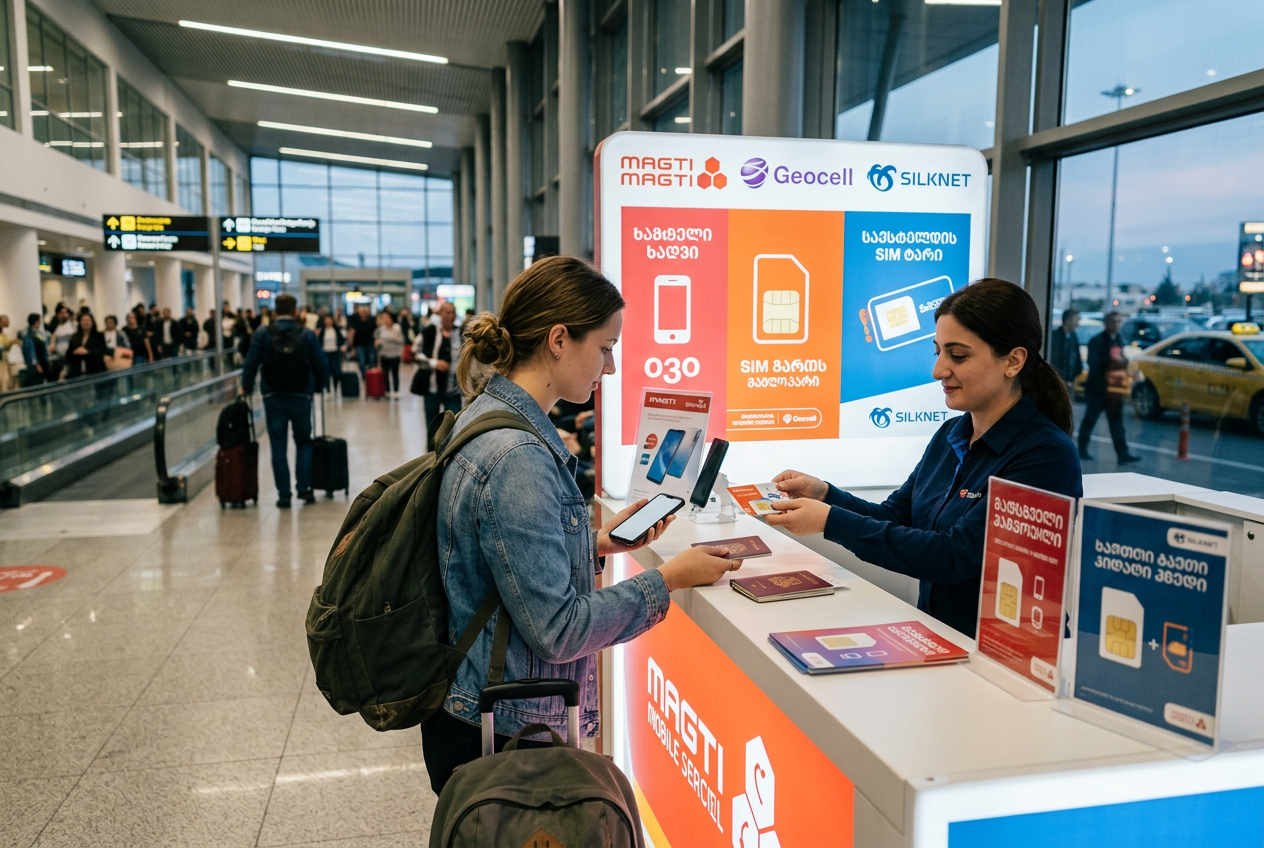
Three major Georgian mobile operators maintain a presence at the airport: MagtiCom, Silknet/Geocell, and Cellfie, the latter formerly known as Beeline Georgia. Each offers tourist-specific packages designed for short to medium-term stays, and competition between them keeps prices competitive. The booths are staffed by employees who handle foreign visitors all day, so language barriers rarely become a significant issue.
Locating Mobile Operator Booths in the Arrivals Hall
After collecting your luggage and passing through the "Nothing to Declare" customs lane, you'll enter the main arrivals hall. The mobile operator booths are typically located along the right side of the hall as you exit, near the currency exchange counters and car rental desks. MagtiCom usually occupies the most prominent position, with Silknet and Cellfie nearby. The booths are small but clearly branded with each company's logo and colors.
During peak arrival times, particularly when multiple international flights land within the same hour, you might encounter short queues. Budget five to fifteen minutes for the entire process, including any waiting time. The booths are compact, so only one or two customers can be served simultaneously at each operator's counter.
Operating Hours and 24/7 Accessibility
Here's where things get slightly complicated. While Tbilisi airport operates around the clock, the mobile operator booths don't always match flight schedules perfectly. MagtiCom typically maintains the most consistent hours, often staying open until late evening and reopening early morning to catch the first arrivals. Silknet and Cellfie booths may have more limited hours, particularly during low-traffic periods.
If you're arriving on a red-eye flight or very early morning, there's a chance some booths might be closed. In this situation, you have options: wait until booths open, use airport Wi-Fi temporarily, or purchase a SIM card in the city center the next day. The airport does offer free Wi-Fi, though speeds can be inconsistent and it requires registration.
Major Georgian Mobile Operators and Their Offers
Georgia's mobile market is dominated by three players, each with distinct strengths. Understanding their differences helps you make a quick decision at the airport rather than standing confused while comparing packages you don't fully understand.
| Operator | SIM Card Cost | Popular Tourist Package | Network Strength |
|---|---|---|---|
| MagtiCom | 10 GEL | 20GB for 28 GEL | Excellent nationwide |
| Silknet | 5 GEL | Various data bundles | Strong in urban areas |
| Cellfie | 5-10 GEL | Budget data options | Good value coverage |
MagtiCom: Coverage and Reliability
MagtiCom is Georgia's largest mobile operator and generally considered the most reliable choice for travelers. Their network coverage extends to remote areas where competitors sometimes struggle, making them ideal if you're planning to venture beyond Tbilisi into the mountains of Svaneti or the valleys of Tusheti. MagtiCom offers a 20GB data pack for around $10.68 (28 GEL) with their SIM card costing an additional 10 GEL, bringing your total investment to roughly 38 GEL for substantial connectivity.
The company also offers tourist-specific packages at some Georgian airports. Interestingly, Kutaisi Airport offers free Magti tourist SIM cards with 3GB of data, international minutes, and local calls, valid for 15 days. Tbilisi doesn't typically offer this freebie, but it demonstrates MagtiCom's focus on capturing the tourist market.
Silknet (Geocell): Competitive Data Bundles
Silknet, which absorbed the Geocell brand, positions itself as the value-conscious choice. Their SIM card costs just 5 GEL, making the initial purchase cheaper than MagtiCom. Data packages are competitively priced, and their 4G network performs well in Tbilisi, Batumi, and other major cities.
Where Silknet occasionally falls short is in truly remote areas. If your itinerary sticks to main tourist routes and urban centers, you likely won't notice any difference. The company's app is reasonably user-friendly for topping up credit or purchasing additional data packages, though navigating it requires some patience if you don't read Georgian.
Cellfie (formerly Beeline): Budget-Friendly Options
Cellfie rebranded from Beeline Georgia and targets budget-conscious users. Their packages often undercut competitors on price, though coverage in remote areas can be spottier. For travelers staying primarily in Tbilisi with occasional day trips to nearby regions, Cellfie provides adequate service at lower cost.
The company's airport booth isn't always staffed as consistently as MagtiCom or Silknet, so availability can be hit or miss depending on your arrival time. If budget is your primary concern and you're not heading into the backcountry, Cellfie deserves consideration.
Required Documents and Registration Process
Georgian SIM card registration is refreshingly simple compared to some countries that require extensive documentation, biometric data, or lengthy waiting periods. You'll need just one thing: your passport. The registration process takes place right at the booth, with the staff member entering your passport details into their system and activating the SIM card on the spot.
The staff will ask which package you want, process payment in Georgian Lari (though some booths accept cards), insert the SIM into your phone if you'd like assistance, and confirm that data is working before you leave. The entire transaction typically takes five to ten minutes, assuming no queue.
One practical note: bring your phone's SIM ejector tool or a paperclip. While booth staff usually have tools available, having your own speeds things up. Also ensure your phone is unlocked for international SIM cards. Most modern phones purchased outright are unlocked, but carrier-subsidized phones from some countries may be locked to specific networks.
Keep your passport accessible rather than buried in your carry-on. You'll need it for the SIM purchase, and you may also need it for currency exchange or other airport transactions.
Comparing Airport Prices vs. City Center Stores
A common question travelers ask is whether they're paying an "airport premium" for convenience. The honest answer: yes, slightly, but probably not enough to matter for most visitors.
Airport booth prices typically run 10-20% higher than identical packages at city center stores. A SIM card that costs 5 GEL downtown might cost 7-8 GEL at the airport. Data packages show similar modest markups. For a traveler spending thousands on flights and accommodation, the few extra Lari for immediate connectivity usually represents worthwhile convenience.
The time-cost calculation matters too. Taking a taxi into central Tbilisi, finding a mobile shop, completing the purchase, and potentially dealing with language barriers in a less tourist-oriented store can consume an hour or more. That hour might be better spent settling into your hotel, grabbing a meal, or starting to explore.
Tourist SIM Packages and Hidden Fees
Georgian mobile operators are generally transparent with pricing, but a few things catch travelers off guard. Data speeds may throttle after you exceed your package allocation, dropping to nearly unusable speeds rather than cutting off entirely. Some packages include domestic calls but charge premium rates for international calls or texts.
Ask specifically about data validity periods. A "monthly" package might mean 30 days from activation or might expire at the end of the calendar month regardless of when you purchased it. For short trips, confirm that your data won't expire before you leave. Most tourist packages are designed with visitors in mind, but clarifying the terms takes thirty seconds and prevents surprises.
Topping up credit is straightforward through the operator's app, at convenience stores throughout Georgia, or at dedicated service centers. The apps support English and allow you to purchase additional data packages without visiting a physical location.
Alternative Solutions: eSIMs and Local Wi-Fi
Physical SIM cards aren't your only option. The rise of eSIM technology has created alternatives worth considering, particularly for travelers with compatible devices who prefer not to swap physical cards.
Digital SIM Options for Immediate Connectivity
eSIMs offer several advantages: you can purchase and activate before leaving home, there's no physical card to lose, and you can maintain your home number on a physical SIM while using the eSIM for data. Gigago offers Georgia eSIM plans starting at $6.5 for 1GB of high-speed data for 7 days, with larger packages available for longer stays or heavier data users.
The catch is device compatibility. iPhones from the XS/XR generation onward support eSIM, as do many recent Android flagships. Older phones or budget models may lack eSIM capability. Check your device specifications before counting on this option.
eSIM pricing tends to be comparable to or slightly higher than local physical SIMs, but the convenience of pre-arrival activation appeals to many travelers. You can land in Tbilisi with data already working, skip the booth queue entirely, and start navigating immediately.
For those who prefer physical SIMs but want backup options, Tbilisi offers decent public Wi-Fi coverage. Most cafes, restaurants, and hotels provide free Wi-Fi, and the quality in central Tbilisi is generally acceptable for basic browsing and messaging. Relying solely on public Wi-Fi isn't practical for navigation or time-sensitive communication, but it works as a backup.
Practical Tips for First-Time Travelers to Georgia
Getting your SIM card sorted is just one piece of arriving smoothly in Georgia. A few additional considerations make the transition easier.
Download offline maps of Georgia through Google Maps or Maps.me before departure. Even with mobile data, offline maps work faster and don't consume your data allowance. This proves particularly valuable in mountainous areas where coverage can be inconsistent.
Install the Bolt app for ride-hailing before you arrive. Bolt dominates Georgia's taxi market and works seamlessly once you have data. Prices are reasonable, drivers are generally reliable, and you avoid the negotiation sometimes required with traditional taxis.
Consider downloading a Google Translate offline language pack for Georgian. While English is increasingly common in tourist areas, older Georgians and those in rural regions often speak only Georgian or Russian. The camera translation feature helps decipher menus, signs, and other text.
Georgian Lari is the local currency, and you'll need some cash for the SIM purchase if the booth doesn't accept cards. Airport exchange rates are typically worse than city center rates, so exchange only what you need immediately and find better rates downtown later.
The Georgian concept of hospitality, encapsulated in the phrase "stumari ghvtisaa" meaning "a guest is a gift from God," extends to practical matters. If you're confused at the mobile booth or anywhere else, Georgians generally go out of their way to help. Don't hesitate to ask questions or request clarification on packages.
Your phone becomes an essential tool for navigating Georgia's sometimes chaotic transportation, finding restaurants, translating menus, and staying connected with home. The small investment in a local SIM card pays dividends throughout your trip. Whether you choose MagtiCom for reliability, Silknet for value, or an eSIM for convenience, getting connected at the airport sets the right tone for exploring this remarkable country. The process is simple, the prices are fair, and within minutes of landing, you'll have the connectivity needed to start your Georgian adventure properly.